
Unbiased headlines. Facts, not spin.
Every story is an unbiased news briefing written from 110+ sources across the spectrum — sources linked so you can verify it yourself.
 health
Major Story (7/10)
July 9, 2026 at 05:06 PM
health
Major Story (7/10)
July 9, 2026 at 05:06 PM
U.S. Deportees Held in Equatorial Guinea Hotel Alongside Suspected Ebola Patients, Lawyers Say
What Happened
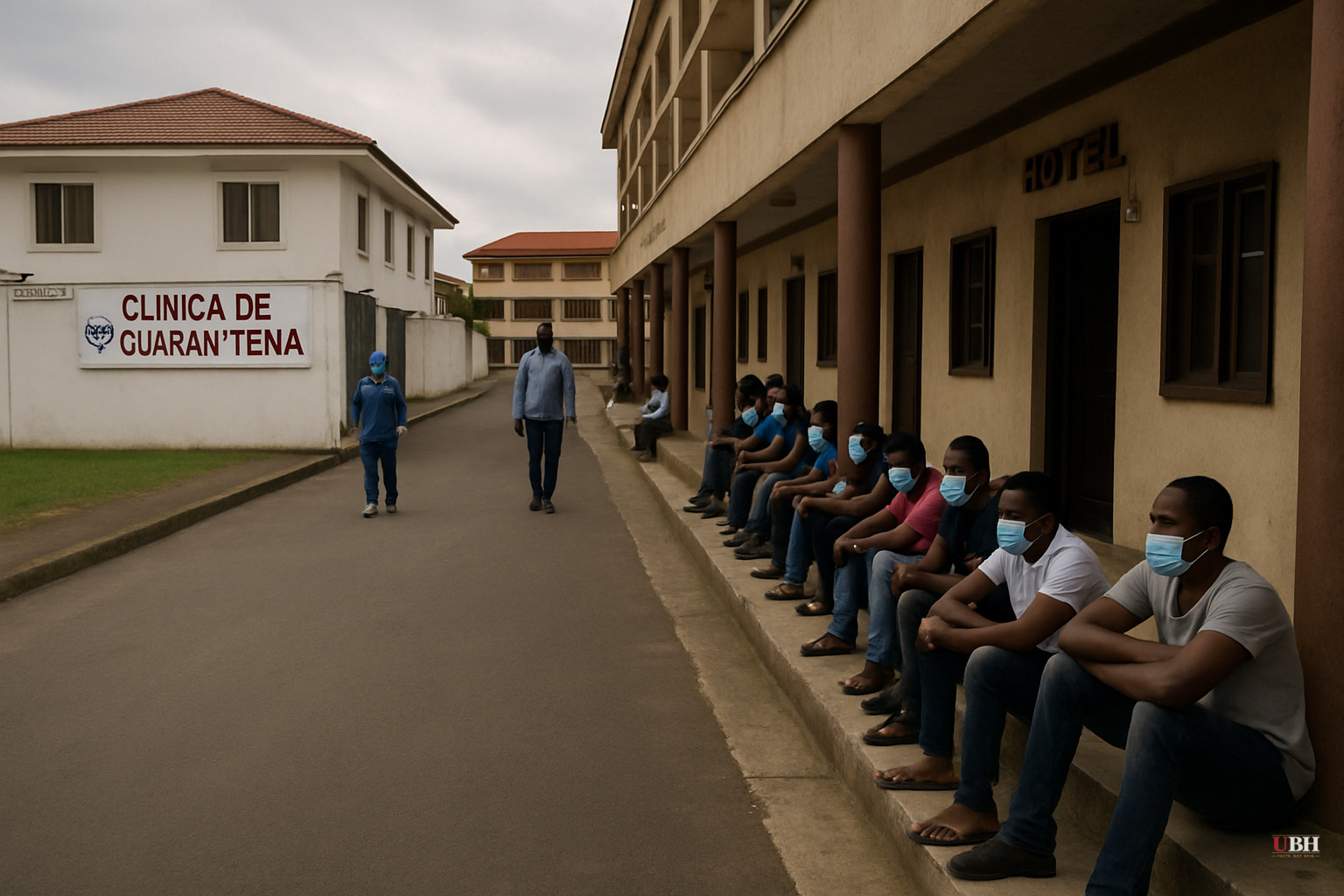
Migrants deported from the United States and currently detained in a hotel in Equatorial Guinea say the same facility has been used to quarantine at least two people suspected of carrying Ebola, according to interviews the Associated Press conducted with two detainees on Thursday, July 9.
The hotel sits on a tropical island off the coast of Equatorial Guinea. It is owned by President Teodoro Obiang Nguema Mbasogo, one of the world's longest-serving heads of state. The 17 detainees come from Angola, Mauritania, Ethiopia, and other countries — none of them Equatorial Guinea — and were sent there under a third-country deportation agreement with the Trump administration.
According to the Associated Press, a man suspected of having Ebola was brought to the hotel last week by medical personnel wearing hazmat suits and placed on a floor below the detainees. One of the detainees told the AP that a second person, a woman, was brought to the same quarantine floor on Sunday and was also identified by staff as a suspected Ebola case.
What the Detainees Say
Two detainees, speaking anonymously to the AP out of fear of reprisals, said a doctor told them in English that the man was a suspected Ebola patient and that they should be careful. No further information was provided to them.
"Things are getting worse every day," one detainee said. "It's very confusing, no one is coming to talk to us. No one is informing us of anything. The hygiene is unimaginable."
For several days after the suspected patient's arrival, the detainees were given no masks, no disinfectants, and no other protective supplies, according to both the detainees and a coalition of human rights organizations that has been monitoring the situation.
The AP reviewed videos showing medical personnel in full protective gear transporting patients into the hotel, which was also used as a Covid-19 isolation center during the pandemic.
The Ebola Context
Equatorial Guinea shares no border with the Democratic Republic of Congo, which is roughly 1,885 miles away and has been battling a rare Ebola strain since May. That outbreak has killed more than 600 people, according to the AP. Cases have since been confirmed in neighboring Uganda. As of July 9, no confirmed or officially reported suspected Ebola cases have been announced in Equatorial Guinea itself, which makes the presence of hazmat-suited personnel transporting patients into this facility a significant and unresolved data point.
The Legal Action Already Underway
On June 5, a coalition that includes the Institute for Human Rights and Development in Africa (IHRDA), the Pan African Lawyers Union (PALU), EG Justice, Asian Americans Advancing Justice-Atlanta, and the Global Strategic Litigation Council (GSLC) filed a case against the Government of Equatorial Guinea before the African Commission on Human and Peoples' Rights. The filing sought to stop deportations to the country and secure humane treatment for those already held there.
"When the Government agreed to accept people deported as part of the Trump Administration mass deportation policy, they triggered a duty to safeguard their rights," said Beatrice Njeri, Regional Litigator for Africa at the Global Strategic Litigation Council, in a statement released Thursday.
The coalition describes the detention as arbitrary and says detainees have been denied independent legal assistance and adequate medical care for months.
The Strongest Case for the Other Side
The Trump administration's basic position is clear: the U.S. has deported thousands of people it determined to be unlawfully present to roughly two dozen countries under third-country agreements, and the administration argues those countries bear legal responsibility for detainee welfare once people are transferred. Supporters of aggressive deportation policy argue that accepting any non-citizen deportee regardless of origin country is a sovereign act that shifts responsibility to the receiving government. Under that framework, conditions inside Equatorial Guinea's detention facility are Malabo's problem, not Washington's. That argument has genuine legal grounding in the structure of these agreements.
The problem is that if the agreements are, as advocates describe them, opaque or secret, the precise obligations the U.S. retained cannot be easily verified. None of the source material includes the actual text of the U.S.-Equatorial Guinea deportation agreement, so the precise contractual responsibilities remain unverified.
What Has NOT Been Established
Equatorial Guinea's government has not publicly confirmed that any suspected Ebola cases are present in the facility. The U.S. State Department has not commented publicly on the reported conditions as of July 9. No independent medical inspection of the hotel has been permitted. The suspected Ebola cases have not been laboratory-confirmed, and no charges or formal findings have been issued against any party.
The GSLC's case before the African Commission is active but has not produced a ruling.
The unresolved question driving this story: under the terms of the U.S.-Equatorial Guinea deportation agreement, does Washington retain any legal or contractual duty to ensure that detainees are not exposed to infectious disease in facilities it arranged to have them sent to? Until that agreement is made public, the answer cannot be confirmed either way.
Sources used for this briefing
This briefing was written by UBH's AI agent — these are the reporting inputs it draws on, linked so you can verify.


