
Unbiased headlines. Facts, not spin.
Unbiased Headlines is an independently owned news organization. We bring you the facts, not opinions, written fresh from 110+ named sources. Sources linked so you can verify it yourself.
 finance
Major Story (7/10)
Event date: October 14, 2026 ·
US Deficit Hits $1.99 Trillion in Fiscal 2026 as 10-Year Treasury Yield Stays Above 5%
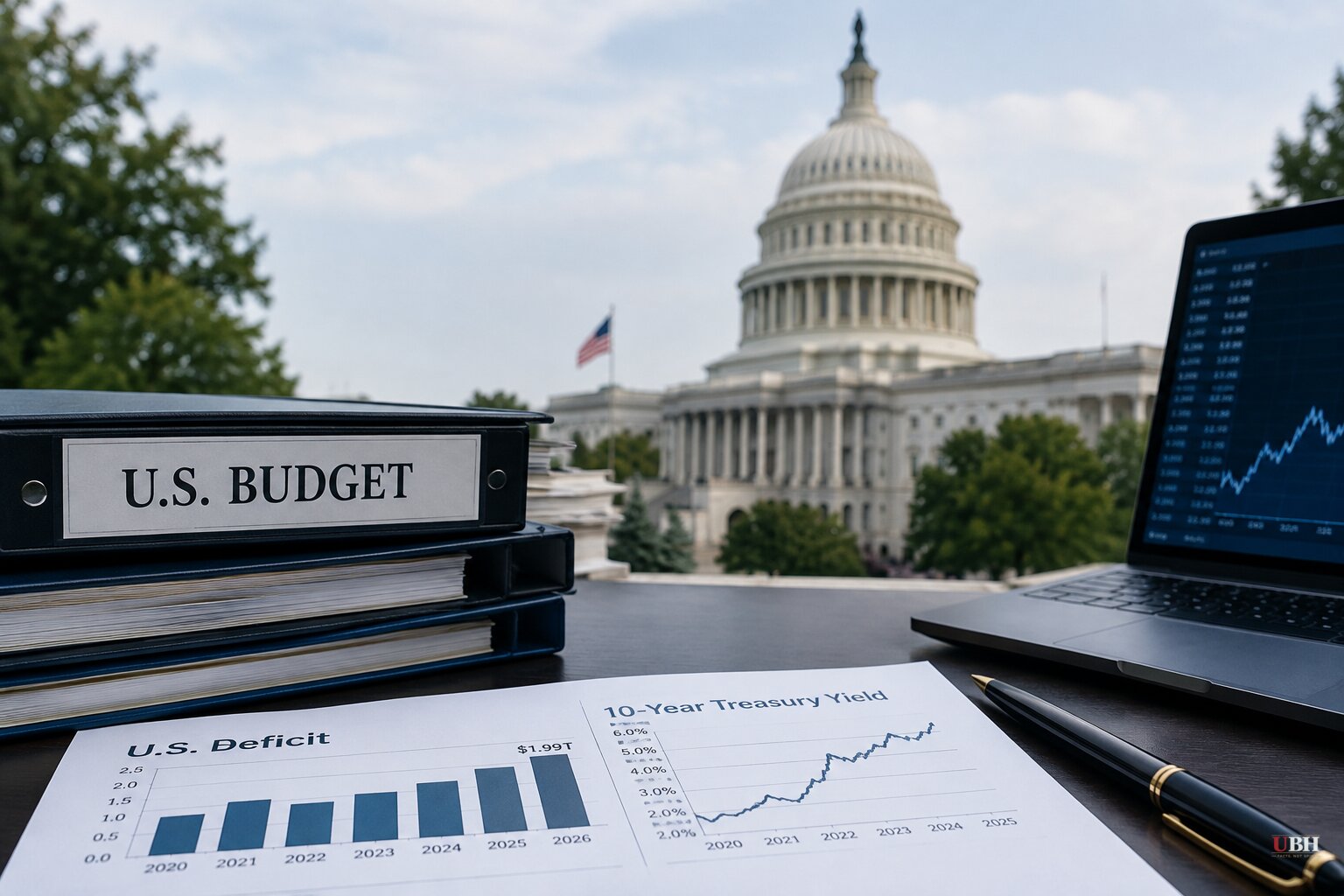
The U.S. government ran a $1.99 trillion deficit in fiscal year 2026, the Treasury Department said Friday. That is up 12% from $1.78 trillion a year earlier and the largest since 2021.
It happened under a president who promised to cut spending.
Revenue rose 3% to $5.40 trillion. Spending rose 6% to $7.40 trillion. A Treasury official put the deficit at about 6.2% of GDP, up from 5.8% the year before.
Where the money went
Interest is the biggest single pressure. Treasury said interest paid on the public debt jumped $144 billion to a record $1.36 trillion. Total debt now stands at $40.3 trillion, with about $32 trillion held by the public.
Net interest is a narrower figure. It was about $1.05 trillion in the first 11 months of the fiscal year, according to CNBC's tally, and TD Securities estimates about $1.1 trillion for the full year.
Defense spending rose $48 billion, or 6%, to $917 billion.
Tariffs, meanwhile, did not deliver the cash the White House expected. The Supreme Court struck down President Trump's global duties in February, and Treasury data show $145 billion in customs refunds over the year, mostly tariff-related. That erased much of the revenue the duties had raised.
The administration did cut the federal workforce and foreign aid. The Republican-controlled Congress pushed through Medicaid cuts and moved to shrink food assistance. It also extended expiring tax cuts and added funding for the deportation drive. The spending cuts were not enough to offset higher interest costs, tariff refunds and lower corporate tax collection.
Nancy Vanden Houten of Oxford Economics expects a similar deficit next year. She warned that "the risk may be for a larger budget gap if the war with Iran persists well into the fiscal year."
Yields and the warnings
The 10-year Treasury yield is now above 5%. Aberdeen Investments data show it climbed from below 4.0% in early March to above 5.2% at the end of September.
Maya MacGuineas, president of the Committee for a Responsible Federal Budget, warned last month after the 10-year crossed 5%: "The real threat is the debt spiral. If interest begets debt, and debt begets interest, eventually debt will spin out of control. A fiscal crisis, once unthinkable, is now a distinct possibility."
IMF Managing Director Kristalina Georgieva made a similar point at the IMF and World Bank autumn meetings in Bangkok. She said Treasury Secretary Scott Bessent and other U.S. leaders recognize the deficit and debt are too high. But growth alone, she said, "cannot deliver fast enough the necessary adjustments."
"There is no magic," Georgieva said. "You have to go in a direction of tightening that, bringing it down, bringing the deficit down."
Rodrigo Valdes, director of the IMF's Fiscal Affairs Department, said "in major advanced economies, the effect of fiscal indiscipline does not stop at the border. It travels to the rest of the world."
The case that this is manageable
Not everyone sees a crisis. TD Securities strategists Gennadiy Goldberg and Molly Brooks wrote that "a fiscal apocalypse is not upon us just yet." They said the surge in yields may owe as much to a resilient economy as to debt fears.
Their argument rests on numbers. The weighted-average maturity of U.S. government debt is about 5.9 years, so higher rates feed through gradually. The average coupon on Treasury securities excluding bills is 3.1%. The average interest rate on all U.S. debt is about 3.4%.
Nominal GDP grew at an 8.5% annualized rate in the second quarter, according to the Bureau of Economic Analysis. TD says that keeps the burden manageable even with large deficits. Matthew Rees, head of global bond strategies at L&G Asset Management, called fears of an imminent U.S. fiscal crisis "exaggerated."
TD also projects that financing costs reach $1.4 trillion in fiscal 2027, $1.5 trillion in 2028 and $1.6 trillion in 2029 if yields stay near current levels.
Money is moving, not fleeing
Higher Treasury yields would once have hammered emerging-market debt. This time they have not.
Bank of America data based on EPFR Global show emerging bond funds with 12 straight weeks of inflows. Investors from JPMorgan Asset Management to Generali and Ninety One are adding exposure.
Aberdeen, itself an emerging-market debt manager, says sovereign spreads are only about 9 basis points wider this year against a rise of more than 110 basis points in the 10-year Treasury yield. Ecuador, Gabon, the Democratic Republic of Congo and Pakistan have all sold Eurobonds in recent months.
Poorer countries still carry the heaviest load. Alexander De Croo, administrator of the UN Development Programme and a former Belgian prime minister, said the median developing country pays three times more in interest than developed countries. UK Foreign Secretary Ed Miliband said at the IMF meetings that "the Global South is paying the price for rising interest rates in wealthier countries."
The central bank question
The Official Monetary and Financial Institutions Forum, a London think tank, argues that central banks should speak up more on fiscal matters. Its concern is "fiscal dominance," where heavy debt makes it harder for central banks to raise rates. It cited Trump's pressure on the Federal Reserve last year, when he claimed a 3-point rate cut would save $1 trillion a year.
KPMG says expanded Treasury supply and rising interest costs will keep long-term yields elevated even if the Fed cuts. France's 10-year yield has hit its highest level in more than two decades. Bank of Korea Governor Shin Hyun-song has said he will speak out on fiscal sustainability.
The next test comes before the new fiscal year is far along. Midterm elections are in November, borrowing costs are weighing on voters, and the Iran war has no announced end date. Vanden Houten's warning is that the deficit could grow again if it drags on.
Sources used for this briefing
7 links from 7 independent newsrooms (syndicated copies of the same report count once)
These are the sources it draws on, linked so you can verify.


