
Unbiased headlines. Facts, not spin.
Unbiased Headlines is an independently owned news organization. We bring you the facts, not opinions, written fresh from 110+ named sources. Sources linked so you can verify it yourself.
 finance
Major Story (7/10)
Event date: October 23, 2026 ·
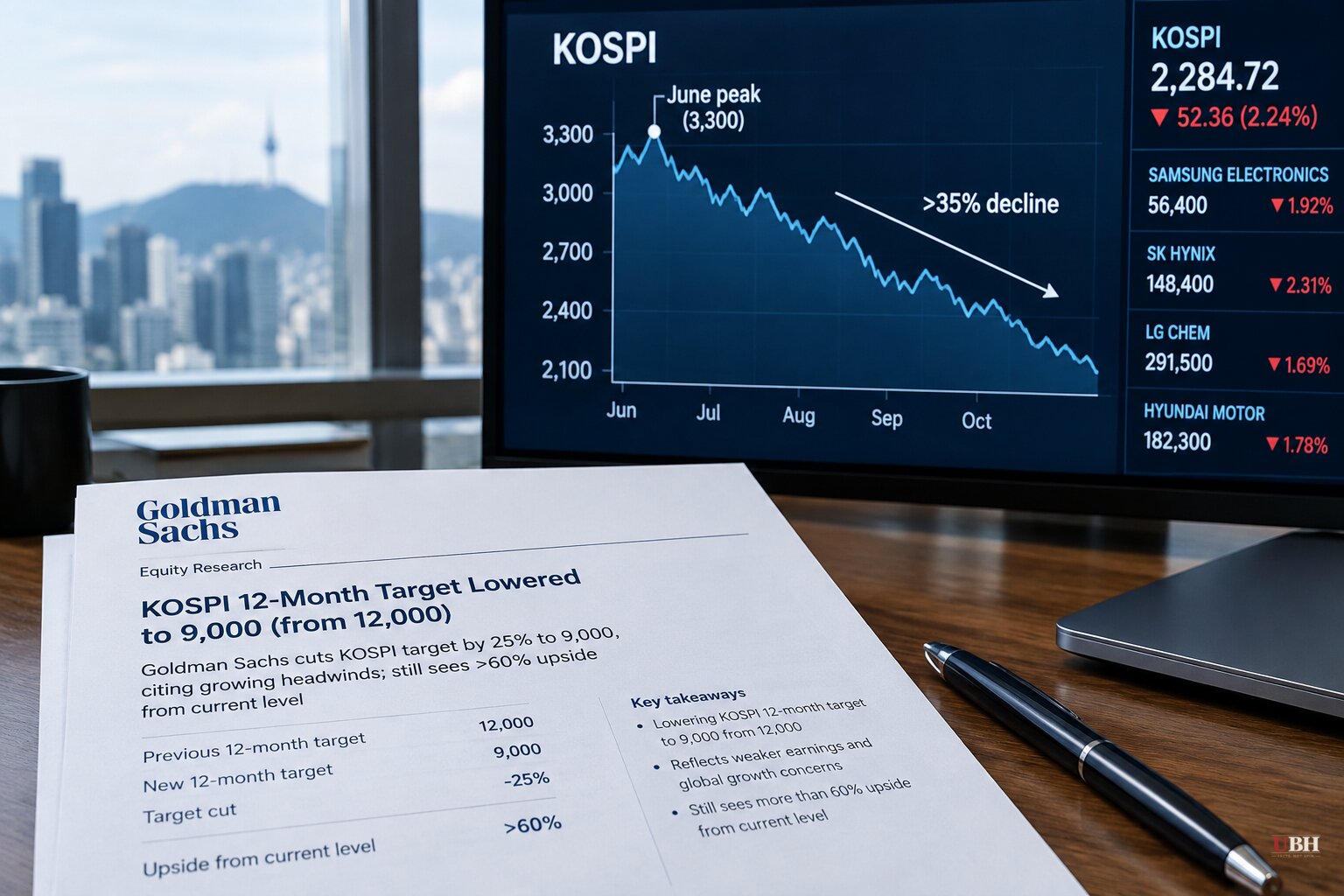
Goldman Cuts Kospi 12-Month Target 25% to 9,000 After Index Drops More Than 35% From June Peak
Since the Kospi began its slide from its June high, South Korea's market has gone from one of the year's biggest AI winners to one of its most exposed. Goldman Sachs has now moved its forecast to match.
Strategists led by Timothy Moe cut their 12-month target for the benchmark to 9,000 from 12,000, a 25% reduction. They had raised the target several times earlier this year.
Goldman cited "more conservative valuation assumptions" after the index fell more than 35% from its June peak. The strategists called Korean equities highly undervalued and said the new target still implies upside of more than 60% from current levels.
How far the selloff has gone
The damage has been fast. Business Insider described a swing from boom to a bust of nearly 40% in four months.
On Oct. 15, the Kospi plunged almost 8% in a single session and was down 18% over five sessions, according to figures compiled by The Epoch Times. Even then, the index was still up almost 30% for the year.
On a later Tuesday, it slid more than 3% to around 5,595 and closed 4% lower, even though U.S. tech stocks had rebounded the day before. Samsung Electronics fell about 3%. SK hynix fell 4% at the close, and more than 6% at one point in the session.
The declines ran well beyond chips. SK Square dropped 7.1%, Hyundai Motor 4.8%, LG Energy Solution 3.9%, Hanwha Aerospace 11.3%, Doosan Enerbility 6.6% and HD Hyundai Heavy Industries 7.4%.
The IPO that cratered
Elice, a South Korean company that rents out computing power for AI workloads, made its Kosdaq debut that same Tuesday. It closed at 61,500 won, a 32% drop from its IPO price of 90,500 won.
The offering raised about 201 billion won, or $151 million, the largest Kosdaq IPO this year. Institutional and retail subscriptions topped available shares by roughly 400 times.
Elice's IPO valued it more richly than comparable AI cloud companies, whose shares had already fallen 20% to 60% over the preceding month.
The pattern extends beyond Korea. U.S.-listed CoreWeave saw its shares and bonds tumble last week over concern about its debt-fueled expansion. Nvidia-backed Firmus withdrew a planned $5 billion Australian IPO, citing volatile market conditions.
What is driving it
The market is pointing to debt and borrowing costs. Trading commentary tied the Tuesday selling to worries over debt-funded AI infrastructure and elevated borrowing costs.
On Oct. 15, producer prices showed their sharpest monthly gain since 2022, and core producer inflation rose 0.7%, above estimates. The 10-year Treasury yield slipped below 5.1% as investors moved into bonds and blue chips. The PHLX Semiconductor Index fell about 2% that day and was down almost 10% over the week, though still up 61% for the year.
Adam Turnquist, chief cross-asset strategist at LPL Financial, said the Kospi has diverged from the Nasdaq 100 because of its memory exposure. "While enthusiasm around the broader AI investment cycle remains intact, Korea's concentrated exposure to memory leaves it more vulnerable to competitive threats, positioning unwinds, and shifts in the memory cycle," he said.
The case against panic
Goldman is not the only voice arguing the selling has run ahead of the business. Hendi Susanto, a portfolio manager at Gabelli Funds, said the AI infrastructure buildout will continue into the new year, with demand still high for accelerators, chipmaking equipment, memory chips and networking.
"The biggest challenge in AI investing right now isn't the fundamentals," Susanto said. "It is the expectations that are fragile."
He also pointed to supplier behavior: "Companies don't commit billions to new fabs unless they see the orders coming."
South Korea is committing on that scale. Its planned 800 trillion won investment in four semiconductor fabs and SK hynix's 2 trillion won supplier financing program are meant to expand domestic chipmaking capacity. Infrastructure and U.S. trade-related hurdles remain.
What to watch
A 9,000 target is a 12-month forecast, not a floor. For it to be reached, the index has to climb more than 60% from here.
Susanto says investors want proof that AI spending will persist through 2027 and beyond. Until that proof arrives, the Kospi, a market built around memory chips, will keep trading as the most direct test of whether it does.
Sources used for this briefing
7 links from 7 independent newsrooms (syndicated copies of the same report count once)
These are the sources it draws on, linked so you can verify.


