
Unbiased headlines. Facts, not spin.
Unbiased Headlines is an independently owned news organization. We bring you the facts, not opinions, written fresh from 110+ named sources. Sources linked so you can verify it yourself.
 finance
Major Story (7/10)
Event date: October 21, 2026 ·
Kazakhstan Starts Selling Gold, Citing 24-Year-High Treasury Yields, as Russia Cuts and Poland, China Keep Buying
Central banks are no longer moving in one direction on gold.
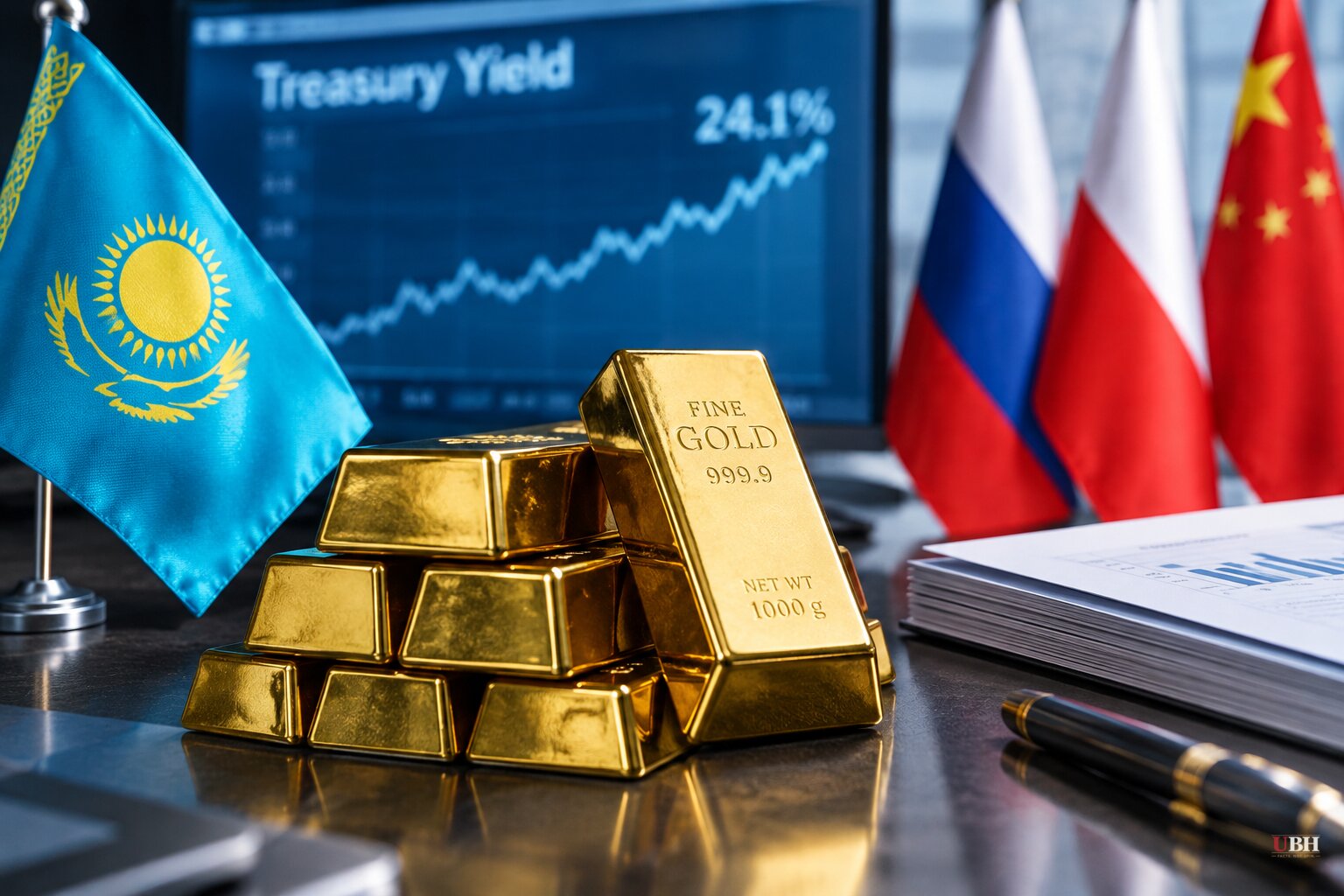
Kazakhstan, ranked fourth among buyers in World Gold Council data for the first eight months of 2026, is switching to selling. Russia has been trimming its stockpile all year. Poland and China are still buying at a steady clip.
Kazakhstan: too much gold, too much yield elsewhere
Aliya Moldabekova, deputy governor of the National Bank of Kazakhstan, laid out the reasoning in an interview. The bank holds 386 tons of gold, about 78% of its $66.4 billion in reserves as of the end of September. That is too high, she said.
"With such a share of gold, our holdings are starting to resemble a single-asset portfolio," Moldabekova said.
The bank wants gold at about 75% of reserves by the end of the year, a cut of roughly 3 percentage points. Half will come from selling options and half from selling physical metal, she said.
The other driver is the bond market. The 10-year Treasury yield touched 5.34% intraday last week, its highest in 24 years. "This makes the dollar an attractive option, thereby reducing the appeal of gold as an investment asset," Moldabekova said.
There is a floor to the selling. If gold falls below $4,000 an ounce, she said, the share may drift down toward the target on its own.
Russia's drawdown
Russia's gold reserves fell by about 6.2 tonnes in September, according to Bank of Russia data cited by Euronews. That puts the reduction since January at around 62 tonnes. A separate BestBrokers tally through August put Russia's cut at 34.2 tonnes, and the World Gold Council counted a 6-ton sale in August alone.
The last time Russia sold gold this fast was 1998, when it unloaded 118 tonnes in three months.
Adam Stroniawski, managing director of the Polish dealer Mennica Skarbowa, attributes the sales to money. "Russia has a serious budget shortfall because of its war in Ukraine and wants to inject more funds into the defence sector," he told Euronews. Moscow has not said that publicly in the material here.
Stroniawski also says the gold is going through Hong Kong rather than London, with China's central bank as the main buyer. Hong Kong trade data shows about 100 tonnes of Russian gold arrived there from January to July, nearly triple the same period last year. The data does not identify the buyer. That part is Stroniawski's assessment.
His conclusion is that the sales will barely move global prices. He also does not rule out Russia buying again later, as it did after 1998.
Turkey is the year's largest seller, according to BestBrokers, with an 81.6-tonne reduction through August, including 60.4 tonnes in March. Mining.com reported that the Iran war set off a scramble for dollars to pay for costlier energy imports, and Turkey and Russia sold some gold earlier in the year.
Poland and China keep stacking
The World Gold Council says central banks bought a net 62 tons in July and August. The buyers were the usual ones.
Poland has added 97.8 tonnes through August, lifting its total to 647.98 tonnes, according to BestBrokers' analysis. The National Bank of Poland is working toward a 700-tonne target. Stroniawski says Poland is unlikely to follow Kazakhstan and Russia into selling, citing domestic circumstances.
China bought 20 tons in August, its 22nd straight month of purchases, bringing 2026 additions to about 80 tons, per the World Gold Council. Gold is roughly 9% of China's reserves. Uzbekistan has added around 50 tons and the Czech Republic has bought every month.
What it means for the price
Gold peaked at $5,600 an ounce in January. It has since fallen about 20% from its level when the US-Iran war began in late February, as energy disruption fuels inflation and pushes up bond yields. BestBrokers put spot gold near a two-month low of around $4,100, pressured by a stronger dollar and elevated Treasury yields.
Goldman Sachs still projects central banks will buy an average of 50 tons per month this year, against 17 tons per month before 2022. It forecasts gold at $4,900 an ounce by year-end.
Rick Kanda, managing director of The Gold Bullion Company, told The Epoch Times that central bank purchases are not the main catalyst for prices but could help set a long-term floor. "If these elevated levels of central bank demand persist, gold prices will likely increase over the long term or at least be heavily supported," he said.
Marissa Salim, senior research lead at the World Gold Council, said monthly swings reflect "differences in implementation, market conditions, and country-specific liquidity requirements," while longer-term reserve goals remain intact.
The Kazakh position cuts the other way. Moldabekova's argument is that when Treasuries pay this much, a metal that pays nothing is harder to justify holding at a 78% weight. The Epoch Times also notes that higher rates could cap gold if central banks keep tightening during the war-driven energy shock.
What remains open is the price. Gold sits roughly $100 above the $4,000 line Moldabekova named, and Goldman's $4,900 forecast needs a rise of nearly $800 from current levels. Kazakhstan's year-end target arrives well before that is settled.
Sources used for this briefing
7 links from 7 independent newsrooms (syndicated copies of the same report count once)
These are the sources it draws on, linked so you can verify.


