
Unbiased headlines. Facts, not spin.
Unbiased Headlines is an independently owned news organization. We bring you the facts, not opinions, written fresh from 110+ named sources. Sources linked so you can verify it yourself.
 finance
Major Story (7/10)
Event date: October 24, 2026 ·
Morgan Stanley Puts AI Data Center Bill at $2.9 Trillion, With a $1.5 Trillion Gap Beyond Big Tech's Cash
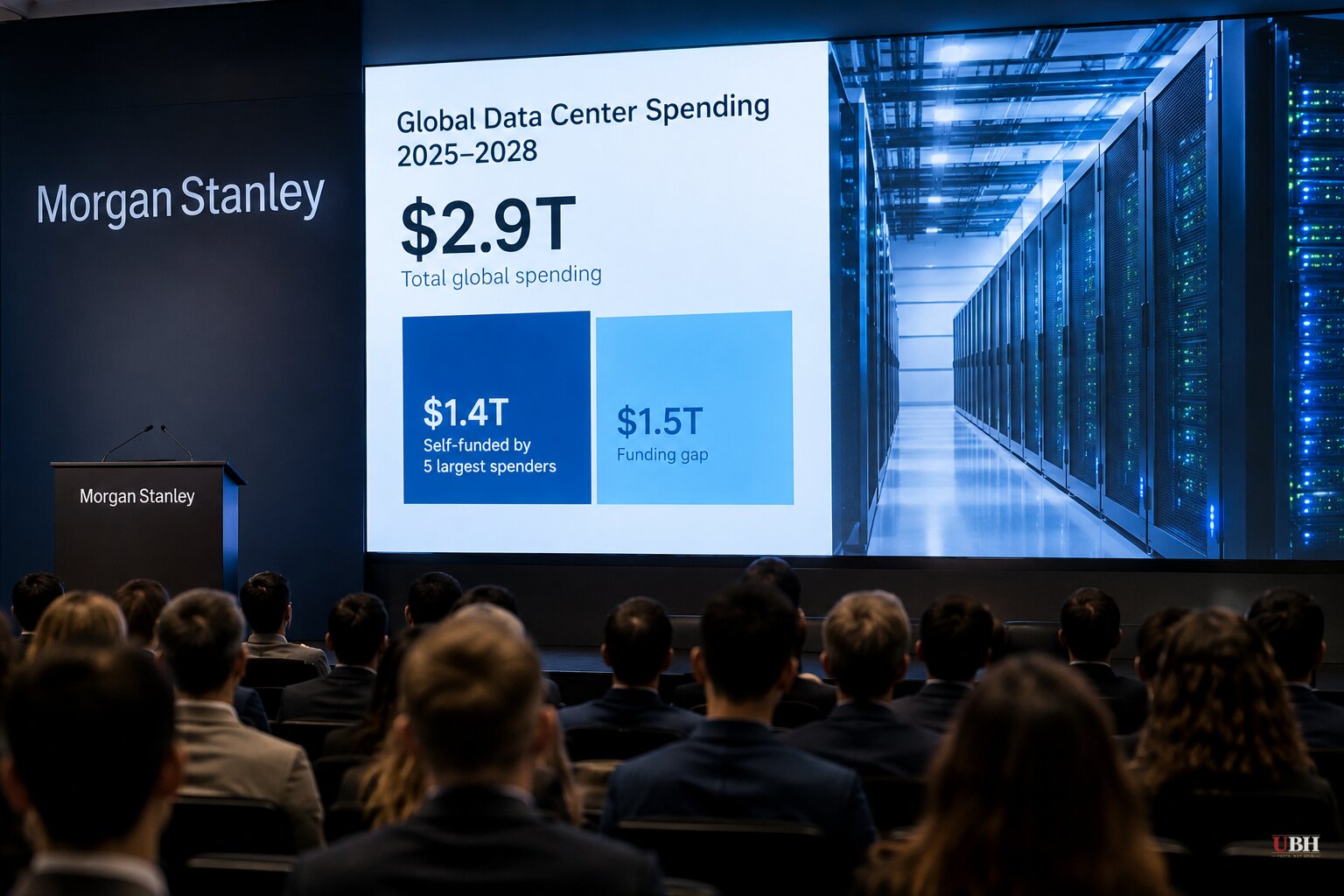
Morgan Stanley has put a number on the physical bill for the AI race. Its research projects global data center capital spending of about $2.9 trillion from 2025 to 2028.
The bank splits that into roughly $1.6 trillion for IT hardware, meaning chips and servers, and $1.3 trillion for physical infrastructure and construction.
Amazon, Microsoft, Alphabet, Meta and Oracle are projected to fund about $1.4 trillion from their own cash flows. Subtract that from the total and Morgan Stanley's estimate of the external financing gap is $1.5 trillion.
Who is expected to fill the gap
Morgan Stanley expects private credit to supply roughly $800 billion of the shortfall. The preferred structure is asset-specific lending, where a loan is tied to a particular facility or batch of equipment rather than a company's whole balance sheet.
The bank's research also points to potentially higher yields on that paper than on conventional corporate debt. On top of the borrowing, hyperscaler lease commitments exceed $1.2 trillion in undiscounted future payments.
Nvidia is part of the picture too. The chipmaker has been in discussions about backstop guarantees of up to $250 billion to support data center debt. Nothing in the research indicates those talks have been finalized.
Money is not the only limit. Morgan Stanley's revised forecast has the U.S. data center power shortfall growing to 32 to 33 gigawatts by 2028.
The lenders are already spread thin
The borrowing is not new. Goldman Sachs expects the five largest spenders to sell about $250 billion of bonds in 2026. UBP, a Swiss private bank, estimates the five will spend about $820 billion on capital projects this year against about $750 billion of operating cash flow.
PIMCO has estimated that hyperscaler capex now absorbs 93% to 94% of operating cash flow, according to the Financial Times. The FT also reported that hyperscaler debt issuance hit $121 billion in 2025, four times the historical average, and that Bank of America expects another $100 billion this year.
Banks are in too. JPMorgan and MUFG led a package of about $38 billion for two Vantage Data Centers sites leased to Oracle. The Bank for International Settlements counts more than $200 billion of private loans to AI-related companies.
The tally of total bank exposure is murky because no bank discloses a standalone figure. Federal Reserve Bank of Chicago staff put large-bank commitments to "AI-adjacent" borrowers at about $450 billion. A Columbia academic estimate runs to roughly $800 billion.
A newer market lends against the chips themselves. CCIR, which tracks company filings, counted about $63 billion of GPU-secured commitments. Figures from these channels overlap, since one Oracle lease can support a bank loan, an equity return and Oracle's own credit at once.
Where the strain is showing
CoreWeave, the Nvidia-backed cloud provider, had a rough mid-October. Its bonds fell below 80% of face value and the yield approached 15% on Thursday, according to SiliconANGLE and Naked Capitalism. The company carries roughly $52 billion in debt and lease obligations. Its credit default swap spreads widened to 643 basis points, according to StartupFortune.
Oracle's Project Jupiter, a 1,400-acre campus in Doña Ana County, New Mexico, is the other pressure point. About $18 billion in loans tied to it trade at 89 to 91 cents on the dollar, according to Bloomberg Law and Tradersunion. Permit denials, environmental litigation and construction delays have pushed the schedule back by at least seven months, the reporting says. Construction was about 26% complete in early September, and Oracle has reportedly invoked force majeure. Oracle's credit rating slipped to BBB-, one notch above junk, before mid-September.
The Philadelphia Semiconductor Index fell 4.3% on Oct. 14, with Micron down 13.2% and Qualcomm down 8%.
A caution on the numbers. Nvidia's widely reported $500 billion financing initiative is a target for capital it hopes to attract, and only about $3.5 billion of its guarantees were actually in force, according to the analysis from useluminix. That sits alongside the $250 billion backstop discussions Morgan Stanley describes. The same analysis says the strain so far sits with Oracle, smaller cloud providers and single-tenant projects, and that whether it spreads is an open question.
The case that the math works
The industry's own position is that the returns justify the debt. Nvidia CEO Jensen Huang, touring Europe, said this week that "each gigawatt datacenter is $50 billion. The revenue generation you expect is tens of billion dollars per year," and put potential annual revenue at about $40 billion per gigawatt.
Lenders price these loans mainly on the credit of the tenant renting the capacity, because the tenant's payments repay the debt. For the riskiest slice, the chain ends at OpenAI through its landlord Oracle, according to the same analysis.
Power, politics and a possible backstop
The physical buildout is drawing local resistance. CNBC's 2026 state business rankings flagged a strained Virginia grid and a growing public backlash, with some localities weighing outright bans. Texas Agriculture Commissioner Sid Miller has called for a statewide pause on large data center projects. ERCOT, the Texas grid operator, expects data centers alone to need more than 22,000 megawatts by 2030.
A ZeroHedge piece cited by Crypto Briefing argues private credit is funding the buildout against collateral with a short clock. Its author expects Washington to eventually backstop that credit. That is the author's own forecast, not an announced policy.
It is unclear who absorbs losses if tenants cannot pay. Project Jupiter's loans are already priced below par with an opening date of 2028, and Nvidia's $250 billion guarantee talks have not been finalized.
Sources used for this briefing
7 links from 7 independent newsrooms (syndicated copies of the same report count once)
These are the sources it draws on, linked so you can verify.


