
Unbiased headlines. Facts, not spin.
Unbiased Headlines is an independently owned news organization. We bring you the facts, not opinions, written fresh from 110+ named sources. Sources linked so you can verify it yourself.
 finance
Notable (6/10)
JetBlue Creditors Hire Restructuring Advisers as 2031 Bonds Fall to 42 Cents, WSJ Reports
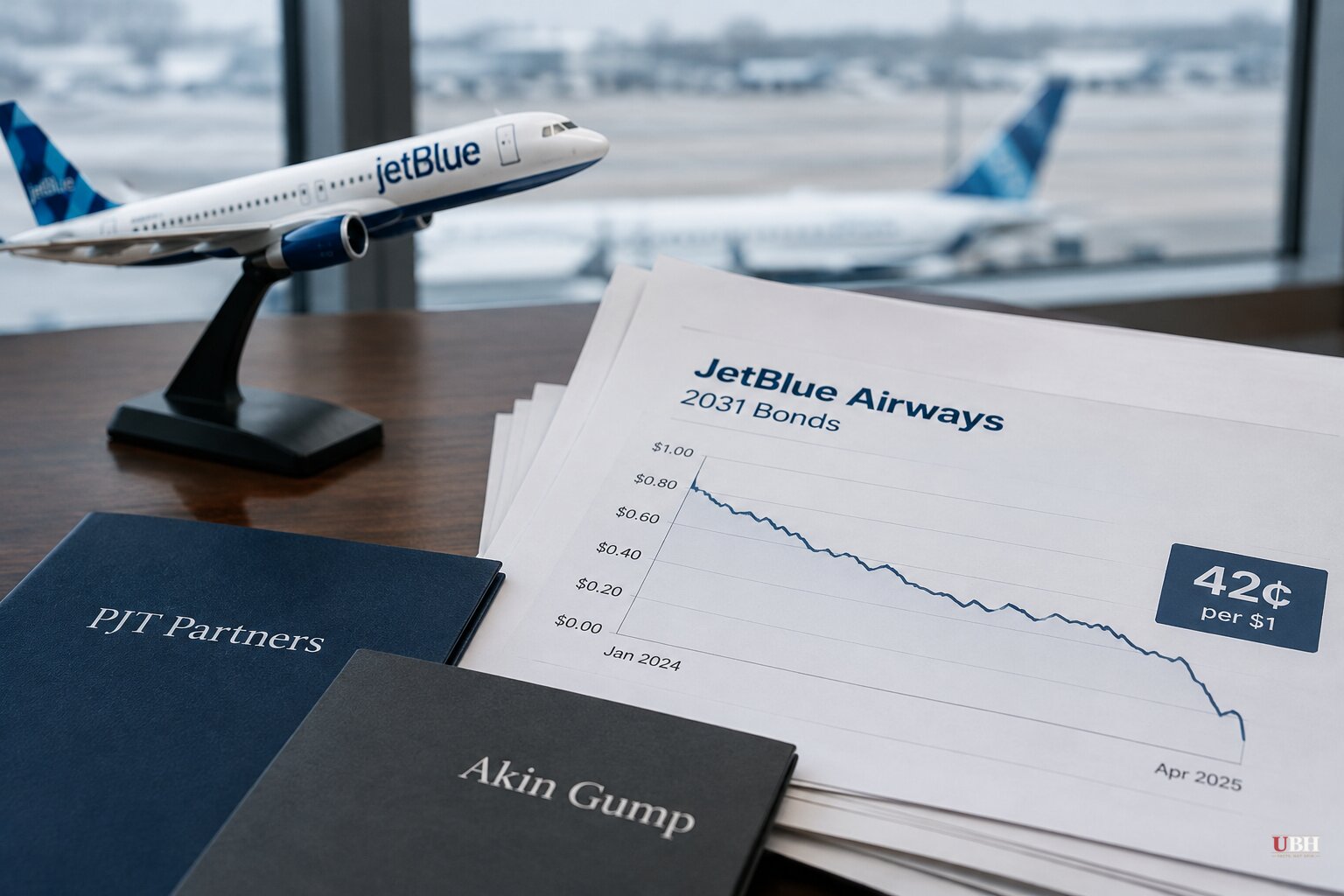
A group of senior JetBlue creditors has hired a financial adviser and a law firm, The Wall Street Journal reported Friday, citing people familiar with the matter. The advisers are PJT Partners and Akin Gump Strauss Hauer & Feld.
The move comes as the airline's bonds and stock have dropped sharply this month. JetBlue has not announced any restructuring plan, and no bankruptcy filing exists.
The numbers
JetBlue's $2 billion in 9.875% notes due 2031 traded near 80 cents on the dollar at the start of October. They hit 42 cents on Thursday, Oct. 22, and recovered to the mid-40s Friday.
Those notes are secured by the TrueBlue loyalty program and the revenue from its Barclays credit card deal, according to aviation analysis site View from the Wing. That site puts the annual interest at $197.5 million. The creditor group also includes holders of a $742 million first-lien loan, per ZeroHedge's account of the WSJ report.
The stock hit a record low Thursday, with short interest above 30% of the float, according to Seeking Alpha. Shares closed Friday at about $2.62, down from roughly $4.50 at the start of the month. U.S. markets are closed for the weekend.
The balance sheet
As of June 30, JetBlue reported about $2.2 billion in unrestricted cash and investments, an undrawn $600 million credit line, and $8.5 billion in total debt and finance leases. The company says it holds $6 billion in unencumbered assets.
View from the Wing argues it is far from clear how much cash could actually be raised against those assets. It says roughly 67% of the airline's assets at book value are already pledged.
The same analysis points to covenants on the TrueBlue-backed financing: at least $750 million in quarter-end liquidity and a senior debt-to-collateral ratio capped at 62.5%. Breaching either would redirect credit card revenue toward faster debt repayment. That reading of the covenants comes from one analyst, not from a JetBlue filing quoted here.
The second quarter produced a $141 million operating loss. JetBlue also reported new premium Barclays card acquisitions up almost 40%, and Fort Lauderdale revenue per available seat mile up 11% on nearly 40% more capacity there.
S&P has said JetBlue has sufficient liquidity and borrowing capacity, while warning about mounting debt-service costs.
Fuel, and the rest of the industry
Jet fuel is hitting the whole sector. Southwest cut its full-year adjusted earnings guidance to $2.60-$2.85 a share from $3.25-$4.25. American Airlines cut its outlook to an adjusted loss of $1.00-$1.60 a share, from a prior range of a $0.65 loss to $0.65 in earnings.
The writer at Live and Let's Fly argues JetBlue's problems cannot be pinned on fuel prices, any more than Spirit's could. In his telling, the airline's debt and long record of weak profitability matter more. One Mile at a Time says JetBlue has not turned a profit since before the pandemic.
The debt load is large for the size of the carrier. One Mile at a Time notes that Delta carries only about twice JetBlue's debt on roughly seven times the revenue. Southwest has materially less debt on more than three times the revenue.
The blocked deals
JetBlue's $3.8 billion bid for Spirit Airlines was blocked by a federal judge during the Biden administration, in a ruling meant to protect consumers. Its partnership with American Airlines was also blocked by regulators. Spirit has since shut down all operations, according to ZeroHedge.
ZeroHedge calls the Spirit ruling a decision that now looks "disastrous" for both airlines and travelers. View from the Wing takes a different view. Its author wrote in July 2022 that JetBlue should not buy Spirit at all, arguing the premium, integration costs and lost seats would make the airline worse off. He says the failed deal still paid Spirit shareholders more than $500 million without delivering an airline.
The facts leave open how much of JetBlue's position comes from regulators and how much from management's choices. JetBlue's statements do not address that question.
JetBlue's response and the United question
JetBlue told the WSJ it is focused on strengthening revenue and building a more profitable business. In a separate statement, the company said it "remains confident in its JetForward strategy and the progress being made toward returning to sustained profitability."
Hiring advisers does not mean a filing is coming. Creditors often organize early to protect their position in negotiations, and the group's retention reflects concern about repayment.
Speculation has also revived over United Airlines. Under the existing Blue Sky agreement, JetBlue is to give United access to slots for up to seven daily round-trip flights at JFK starting in 2027. Live and Let's Fly argues CEO Scott Kirby may want JetBlue's JFK and Fort Lauderdale positions at the right price.
No offer or agreement exists. Kirby has previously dismissed the economics of buying JetBlue, according to the same outlet, and has not signaled a change in position. Any deal would depend on price, a debt restructuring and antitrust approval, with United's Newark hub in play.
JetBlue reports third-quarter results Tuesday, Oct. 27. Whether management offers new detail on liquidity, covenant headroom or its debt, and where the 2031 notes trade when markets reopen Monday, will be the next test of how seriously lenders are taking the risk.
Sources used for this briefing
7 links from 7 independent newsrooms (syndicated copies of the same report count once)
These are the sources it draws on, linked so you can verify.


