
Unbiased headlines. Facts, not spin.
Unbiased Headlines is an independently owned news organization. We bring you the facts, not opinions, written fresh from 110+ named sources. Sources linked so you can verify it yourself.
 finance
Major Story (7/10)
More Than $351 Million Raised in California Billionaire Tax Fight, About 90% to Defeat Prop. 40
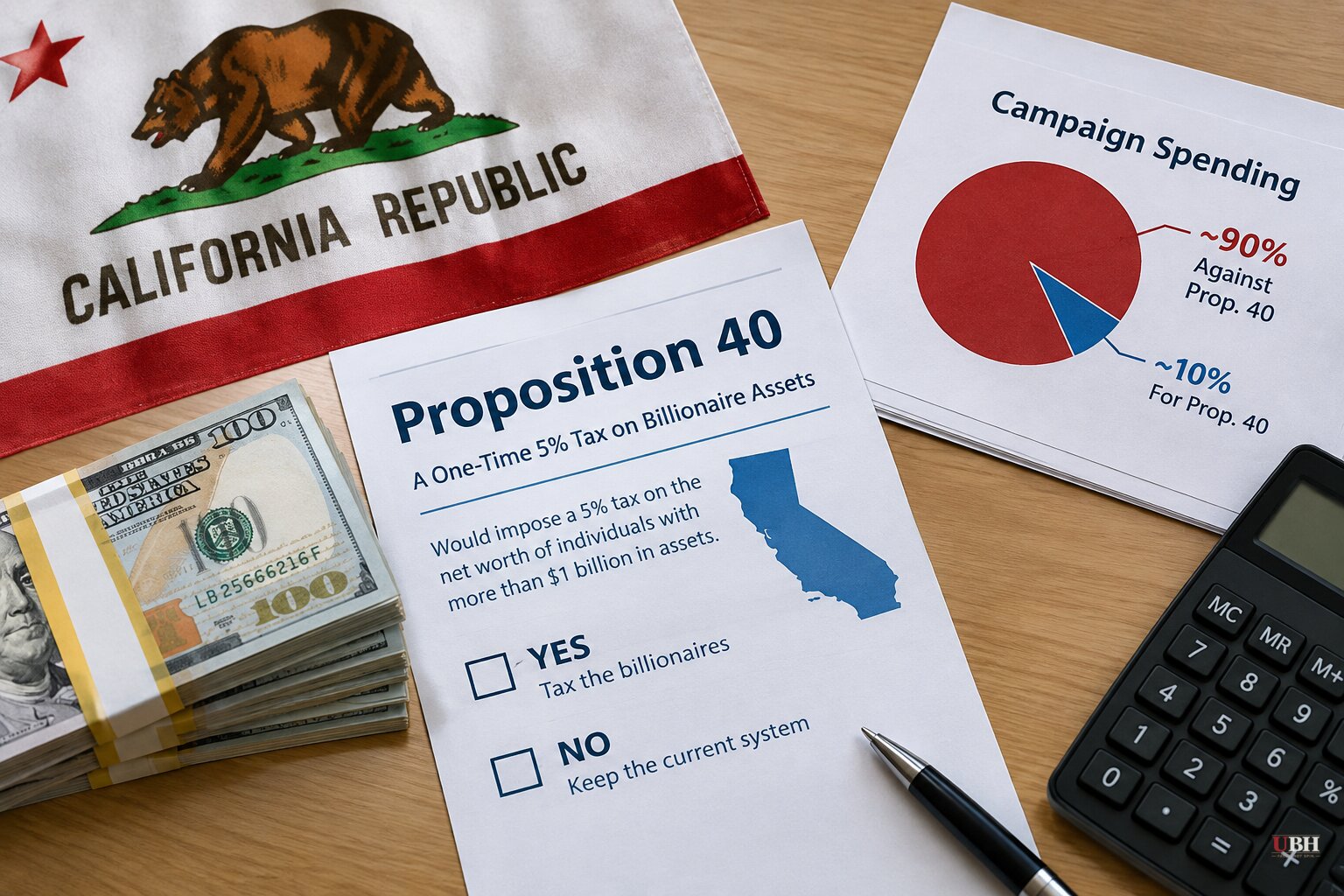
With the November election closing in, spending on California's billionaire tax fight has passed $351 million, making it one of the costliest campaigns in state history.
About 90% of that money is being spent to defeat Proposition 40. Opponents of the measure have raised $316.7 million, versus the $34.3 million raised by supporters. Nearly all of the supporters' money came from one union.
What Prop. 40 would do
Proposition 40 would impose a one-time, 5% tax on many assets of California billionaires who lived in the state as of Jan. 1.
Service Employees International Union-United Healthcare Workers West crafted the measure. The union says it is a response to federal healthcare cuts President Trump signed last year, which are expected to reduce California's healthcare budget by $100 billion.
"Trump's 'Big Beautiful Bill' slashes healthcare funding, with major coverage cuts scheduled to hit after the midterms," said Suzanne Jimenez, the union's chief of staff. "More than 3 million Californians could lose their health insurance. Hospitals and emergency rooms face closure. Patients will die unnecessarily when the care they need is no longer there. Proposition 40 is an emergency response to that looming disaster."
That is the union's projection, not an established outcome. The cuts have not yet hit.
Two measures built to cancel it
The opposition is not just a media blitz. It includes two competing initiatives, Propositions 41 and 42, that would nullify the billionaire tax if either one gets more votes than Prop. 40.
Proposition 41's supporters say it would cut wasteful government spending by requiring audits of new state special taxes. It would also bar new state taxes that exempt their revenue from the state spending limit.
Backers of Proposition 42 say it would prohibit new taxes on retirement holdings, individually owned assets and other forms of personal savings.
Advocates for the billionaire tax call both measures well-financed smokescreens meant to undercut Prop. 40.
So voters face a layered contest. Prop. 40 can win its own vote and still be wiped out by a stronger showing for either of the other two.
The money gap
The opposition effort is bankrolled mainly by the ultra-rich Californians the tax would hit. Among the largest donors are Google co-founder Sergey Brin, who has donated more than $100 million to anti-wealth-tax efforts, and former Google leader Eric Schmidt and venture capitalist L. John Doerr, who each kicked in $40 million. Brin, Schmidt and Doerr did not respond to requests for comment.
Building a Better California, the main funder of efforts to defeat the wealth tax, said its allies include Democratic and Republican politicians, prominent labor groups and business leaders. "It's rare for such a broad coalition to unite around any single cause in California, but it reflects the potentially devastating impact of this measure on healthcare, education, and our state's economy," the group said in a statement.
The opposition's reach extends well beyond ads.
"The pro-40 campaign picked a fight and then came to that fight with a butter knife against a nuclear arsenal," said Rob Stutzman, a Republican strategist who is not involved in any of the wealth-tax measures. "Because they're so well funded, in today's multifaceted media world, they are able to show up everywhere from network TV to inside video games. That is a very, very large advantage few campaigns ever get to have."
Stutzman also cautioned that money does not guarantee a win.
History backs him up. The most expensive ballot fights in California history involved the $463 million spent in 2022 on two gambling proposals. They pitted tribes with gaming interests against gambling corporations, including DraftKings and FanDuel. Both sides' measures failed.
Supporters of Prop. 40 spent nearly all of their money gathering signatures to place the measure on the ballot. They had $1.6 million on hand as of Oct. 17. Their campaign now appears reliant on public events and media coverage, such as Sen. Bernie Sanders' recent rally in support of Prop. 40 in downtown Los Angeles.
Opponents have also taken the fight to the ground. A rally against the measure was held at the Iron Workers Apprenticeship Training Center in La Palma on Oct. 5.
A split among Democrats
The spending disparity also reflects a divide among Democrats and their allies, many of whom support wealth taxes but argue that the way Prop. 40 was written is disastrous to California's volatile budget, which depends on the state's wealthiest residents.
Jodi Hicks, chief executive and president of Planned Parenthood Affiliates of California, said her organization would support a nationwide or a California wealth tax, but has concerns about Prop. 40's impact on the state budget and healthcare. "We are opposed to this particular proposal because we think it does more harm than good," she said.
What comes next
The union's argument rests on a funding hole it says Washington created. The opposition's argument, as laid out by backers of Props. 41 and 42, is about audits, spending limits and protecting retirement savings from new taxes.
Neither side's spending is a verdict on the policy. California voters must now decide whether a roughly nine-to-one money advantage can overcome a campaign built around the state's looming healthcare cuts, or whether the 2022 pattern repeats and the heavy spenders lose anyway. Ballots will settle it.
Sources used for this briefing
5 links from 2 independent newsrooms (syndicated copies of the same report count once)
These are the sources it draws on, linked so you can verify.


