
Unbiased headlines. Facts, not spin.
Unbiased Headlines is an independently owned news organization. We bring you the facts, not opinions, written fresh from 110+ named sources. Sources linked so you can verify it yourself.
 finance
Notable (5/10)
Tether Says 15 Bitcoin Mining Firms Have Committed to Its Open-Source MDK Toolkit
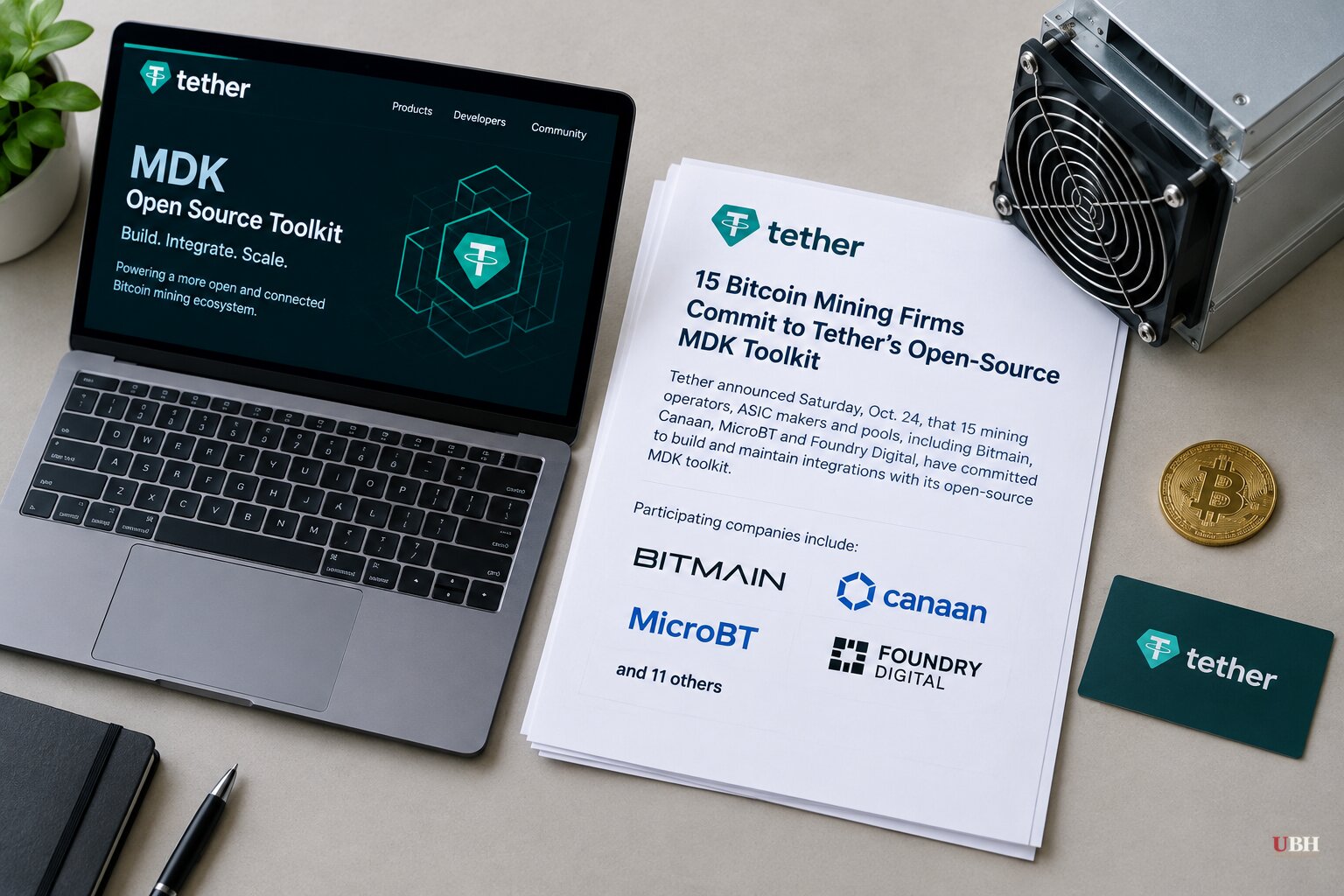
Tether said Saturday, Oct. 24, that 15 Bitcoin mining operators, ASIC manufacturers and mining pools have committed to building and maintaining integrations with its Mining Development Kit, or MDK.
MDK is an open-source framework. Tether describes it as a common layer that lets software talk to mining equipment no matter who made it.
Who signed on
Tether named Bitdeer, BITMAIN, Canaan, MicroBT, Foundry Digital, Luxor Technology, F2Pool and OCEAN among the 15. The full list of participants was not part of Tether's announcement as relayed, so seven remain unnamed.
The group spans three parts of the industry: companies that run mining sites, companies that build the machines, and the pools that coordinate the hashing power.
The problem Tether says it is solving
A large mining site can hold thousands of machines from different manufacturers. Those machines connect to different pools and are managed through separate software.
Most of that gear was not built to work together. Operators end up managing systems one at a time, and developers rebuild the same integration every time they work with a new vendor.
Tether argues that fragmentation is what holds back automation, especially AI tools meant to monitor equipment, spot faults, tune performance and eventually act on their own.
How MDK works
Each participant will maintain what Tether calls an MDK Worker. It is a translation layer that converts the company's existing hardware, pool or system interface into a common format.
Tether says companies choose which functions to expose. They do not have to replace their technology or give up control of it.
Applications built on MDK can then run across every supported system through the same interface. As more Workers appear, the reach of any given tool grows.
Tether CEO Paolo Ardoino said software will increasingly operate physical infrastructure rather than just report on it. That, he said, requires a common way for different machines to communicate.
What exists today
Tether says its own QVAC mining agent is already running on MDK. That is the only working application the company has pointed to.
MDK version 0.11 is tied to Plan ₿ Forum in Lugano, held Oct. 23-24. Tether says the first stable release, version 1.0, is planned before the end of 2026.
That leaves roughly two months between a pre-1.0 release and the stable target. The announcement describes what companies will build and maintain. It does not say how many Workers are finished, which participants have shipped one, or which functions each will open up.
What is still open
The announcement comes from Tether, which describes itself as the largest company in the digital asset industry. The commitments, the participant count and the roadmap are Tether's own account. No participant statement appears in the announcement as relayed.
No one in the announcement lays out a case against the standard. But the design leaves practical questions. Companies decide how much control to expose to outside software, and Tether's own framing points toward AI agents that could eventually act autonomously on mining equipment. How much authority operators actually hand over, and how failures get handled when an automated system makes a bad call on a site full of expensive machines, has not been addressed.
The upside Tether describes is simple. Open standards that cut custom integration work lower costs for operators and let smaller developers compete with vendor-locked software. Nobody is mandating it. The participants are private firms choosing to cooperate, which is how industry standards are supposed to form.
Whether that choice turns into real adoption will show up in the 1.0 release. Tether has set the target for the end of 2026, and the number of working Workers at that point will say more than the 15 commitments do.
Sources used for this briefing
7 links from 7 independent newsrooms (syndicated copies of the same report count once)
These are the sources it draws on, linked so you can verify.


