
Unbiased headlines. Facts, not spin.
Unbiased Headlines is an independently owned news organization. We bring you the facts, not opinions, written fresh from 110+ named sources. Sources linked so you can verify it yourself.
 finance
Notable (6/10)
Event date: October 14, 2026 ·
CCC Junk Bond Spreads Surge While Safer Credit Holds Steady, Manulife Strategist Says It's a 30-Year First
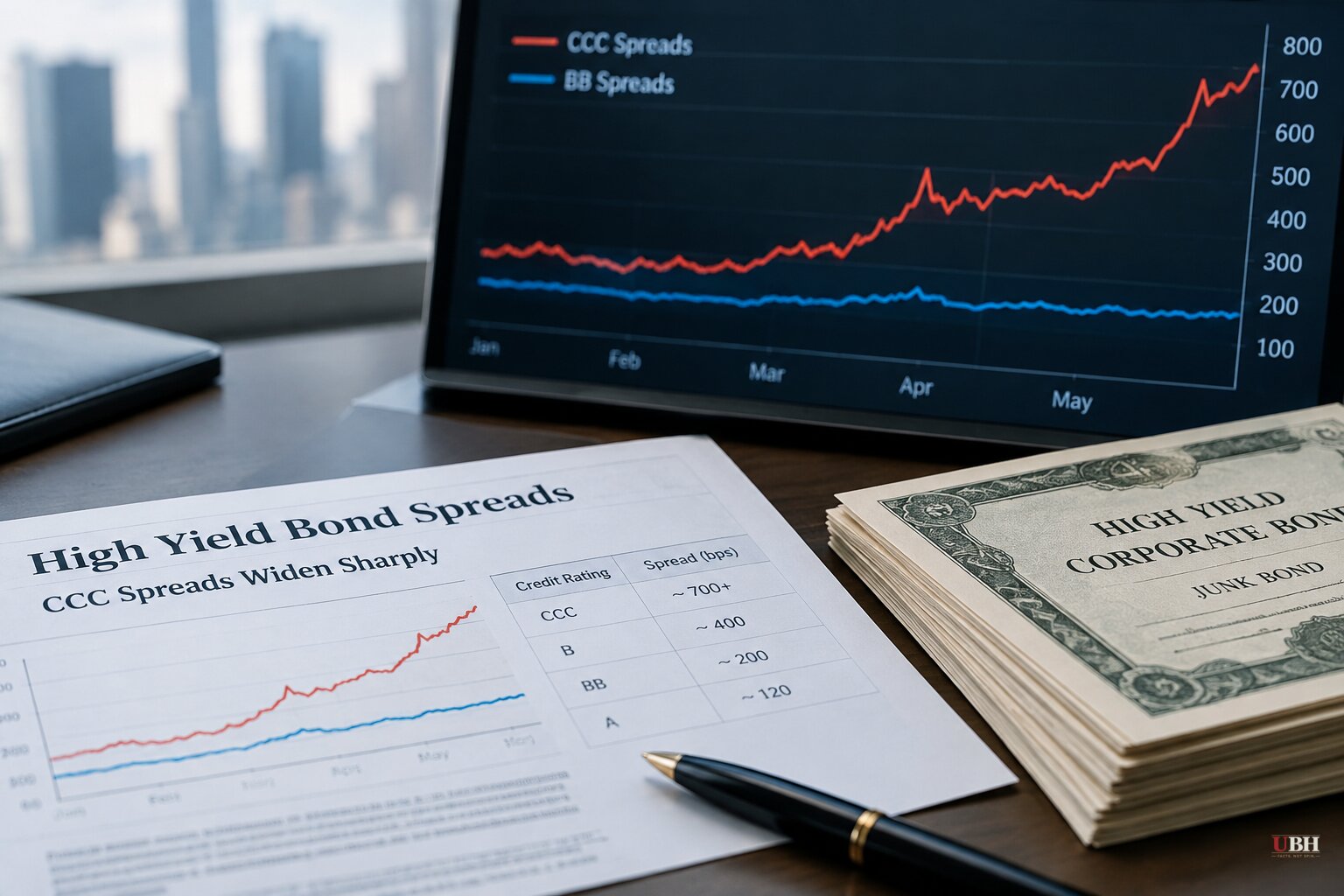
Since the AI-debt selloff began dragging down tech and neocloud names this month, a second pressure point has opened up in credit: the lowest-rated corporate bonds are being punished while almost everything above them is not.
Matt Miskin, co-chief investment strategist at Manulife John Hancock Investments, said in a Monday, Oct. 19 phone interview that this is the only time in the past 30 years that spreads on CCC-rated bonds have widened so sharply while the broader credit market stayed largely unbothered. CCC sits near the bottom of the junk-bond ladder.
"CCC spreads have widened like this in every major liquidity event that we've had in the last 30 years," Miskin said, pointing to the dot-com bust of 2000 and the 2008 financial crisis. The difference this time, he said, is that "the rest of the market is saying there is nothing wrong at all."
His read of the CCC segment: "things are starting to get bad."
Spreads Split by Credit Quality
A spread is the extra yield a company pays over a comparable Treasury. CCC spreads have jumped. Spreads on higher-quality junk, rated BB and B, and on investment-grade bonds have barely moved, according to Miskin.
He called it "the biggest dichotomy we've seen between these lower-quality companies getting to distressed levels in credit, and the broader 'risk markets' priced nearly to perfection."
That is happening while 10-year and 30-year Treasury yields have recently touched their highest levels in decades. Miskin cited fears tied to higher rates and concerns that some companies are borrowing too much, too fast, to fund the AI buildout.
Rate Pain Falls Hardest at the Bottom
Over the past few months, yields have climbed fastest on the riskiest high-yield debt, Marketplace reported Oct. 22. Companies rated CCC, such as retailer Michaels, face a tougher job paying off debt as rates keep rising.
Drew Pascarella, a finance professor at Cornell University, said defaults among high-yield issuers can come from several directions. A company might fail to adapt, as RadioShack and Toys R Us did. It might be heavily exposed to rising energy prices. Or it might simply carry too much debt.
"Not because the business is necessarily going downhill," Pascarella said, "but because the amount of money that they have to pay back is too much for what the operation can afford."
That last case is the one critics of debt-funded AI expansion point to. Borrowing against future contracts works only if the customer cash arrives on schedule.
The Case That This Is Contained
Not everyone reads the split as a warning. Nuveen, in a weekly fixed income commentary published around Oct. 19, said the credit widening "stayed concentrated in AI-linked names," which it called "a sign of idiosyncratic stress rather than broad deterioration."
Nuveen said BB-rated high yield held steady while CCC credits "bore the brunt of losses." High yield, senior loans and lower-rated collateralized loan obligations posted losses that week as AI and data center stress hit the bottom of the quality spectrum. Municipals and Treasuries led returns.
The firm said credit fundamentals "remain sound" and that spreads sit near three-year averages. "We read the move as idiosyncratic, not systemic," Nuveen wrote.
Miskin does not dismiss that possibility. He framed the central question as whether the rest of the market is complacent in the face of risks that could push borrowing costs higher still, or whether the weak spots stay contained.
Treasuries and the Fed
Treasuries have been whipsawed. In the week Nuveen covered, yields first rose on a hotter-than-expected CPI print, briefly pushing the 10-year above recent highs. They then reversed as AI-related equity weakness drove investors toward safe havens.
By the end of that week the 2-year had fallen 8 basis points to 4.71%, the 5-year 15 basis points to 4.87%, the 10-year 17 basis points to 5.08%, the 20-year 18 basis points to 5.47% and the 30-year 17 basis points to 5.42%. The long end led the move, flattening the yield curve.
Nuveen expects one more Federal Reserve rate hike by year-end, followed by an extended hold through 2027. It called that a less hawkish path than markets currently price. The firm said the outcome hinges on how the energy shock feeds through to core inflation, along with services activity and labor data.
Nuveen forecasts the 10-year Treasury at 4.95% by the end of 2026 and 4.75% by the end of 2027. It forecasts the 2-year at 4.70% and 4.50% over the same periods.
What Comes Next
The two readings make different, testable predictions. If Nuveen is right, BB, B and investment-grade spreads stay near current levels while AI-linked CCC issuers sort themselves out one by one. If Miskin's historical pattern holds, the gap closes from above, with safer credit repricing toward the bottom rung. Which way it breaks depends on the same variable both camps name: whether energy-driven inflation forces rates higher for longer.
Sources used for this briefing
4 links from 4 independent newsrooms (syndicated copies of the same report count once)
These are the sources it draws on, linked so you can verify.


