
Original briefings. Zero spin.
Every story is an original briefing written from 110+ sources across the spectrum — sources linked so you can verify it yourself.
 finance
Major Story (8/10)
Event date: August 29, 2026
finance
Major Story (8/10)
Event date: August 29, 2026
US Debt Tops $40 Trillion as Credit Markets Show Hidden Cracks Beneath a Calm Surface
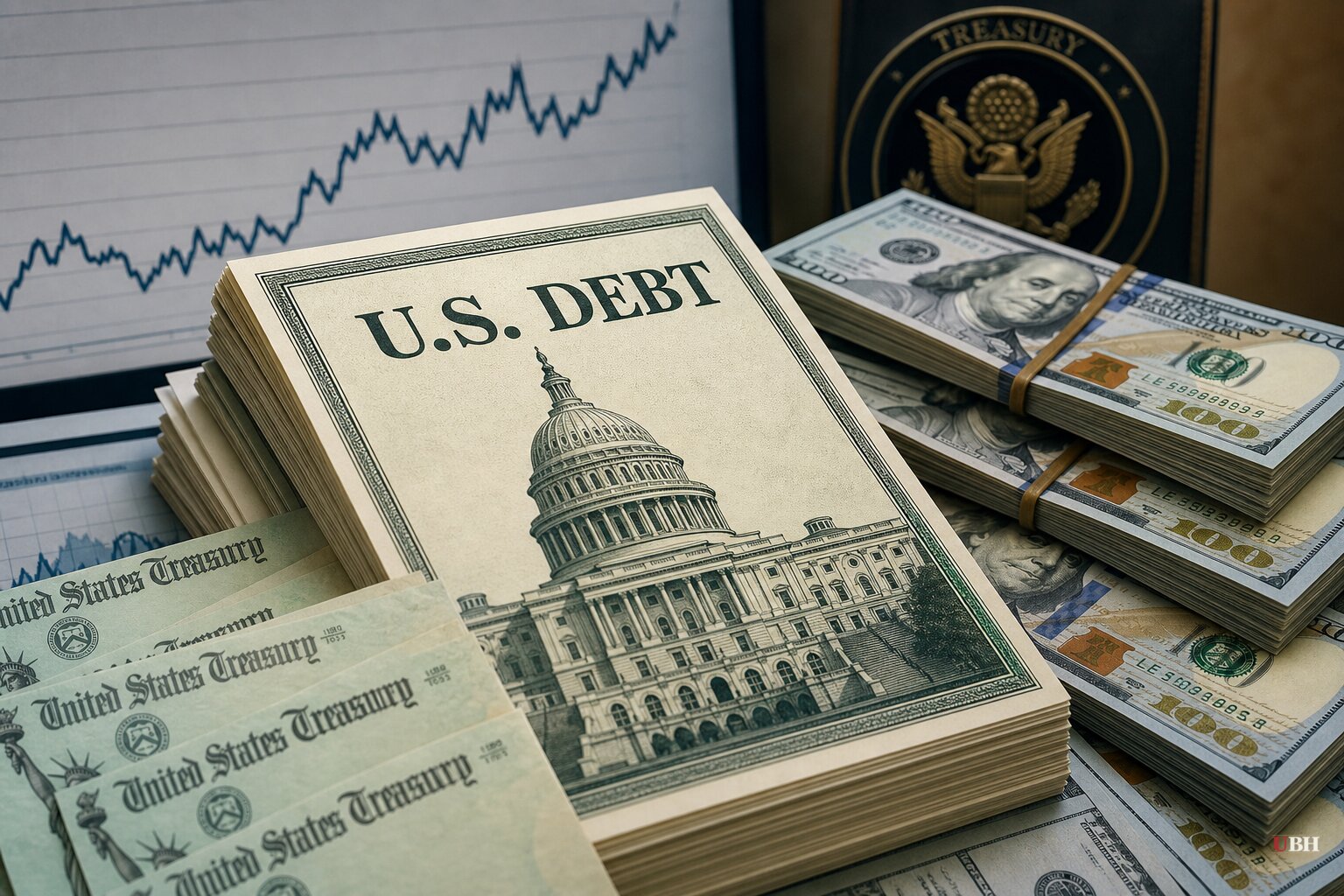
The U.S. national debt passed $40 trillion for the first time, according to Fox News, which put the figure at nearly $300,000 per household. Total public debt now exceeds 124% of GDP. Debt held by the public alone, over $32 trillion, sits near 100% of GDP, and the Congressional Budget Office projects that ratio climbing to 120% by 2036.
The monthly numbers back up the trend. The federal government posted a $432.3 billion deficit in July, the largest monthly shortfall since March 2021, according to FXStreet. That pushed the year-to-date deficit to $1.8 trillion with two months left in fiscal 2026.
Net interest payments on the debt hit $963 billion through ten months of the fiscal year, up 14% from the same period last year, FXStreet reported. The government is now paying roughly $3 billion a day in interest, approaching $100 billion a month and $1.2 trillion a year.
Why Washington Chose Short-Term Debt
Part of the problem is how the debt is structured. Treasury has leaned heavily on short-term bills instead of locking in longer rates, according to FXStreet. That means the entire debt stack has to be rolled over constantly at whatever rate prevails. Treasury Secretary Scott Bessent is reportedly running what FXStreet calls an "Operation Treasury Twist," buying back 30-year bonds while issuing more debt on the short end.
Fed Chairman Kevin Warsh, who took office in late May, faces a difficult bind. Raising rates pushes interest costs higher, while cutting rates risks reigniting inflation that would send long-term yields even higher. The 30-year Treasury yield is already at its highest level since 2001, according to FXStreet, and Bloomberg reported the 30-year bond just finished its worst stretch since 2006.
The Congressional Budget Office estimates that every dollar added to the deficit reduces private investment by 33 cents, according to Fox News, and that an additional $1 trillion in debt shrinks the long-run capital stock by 0.7% to 0.8%. That's the textbook crowding-out effect: more government borrowing competing for the same pool of money, leaving less for businesses and individuals.
Corporate Credit Looks Calm. It Isn't Entirely.
While government bond yields have been erupting, corporate credit markets have looked unusually placid, according to Bloomberg. But Bloomberg's own analysis found roughly $1 trillion in company bonds trading at spreads that are unusually wide relative to their credit rating, including about $580 billion in the U.S. and nearly $400 billion in Europe. That's a trillion dollars of debt where the market is quietly pricing in more risk than the rating agencies acknowledge.
One piece of that stress is showing up in leveraged software debt. Software broadly syndicated loans now trade roughly 300 basis points wide of the broader leveraged loan index, according to RealClearMarkets. Lenders are demanding a real premium for a sector once treated as one of the safest credits in the market. RealClearMarkets attributes the repricing to AI eroding the assumption that recurring-revenue software businesses are permanently defensible, since AI has lowered the cost of building competing products.
The timing is bad. Roughly $257 billion in leveraged loans financed buyouts between 2021 and 2023, about a quarter of it tied to technology deals, and much of that debt matures in 2028 and 2029, RealClearMarkets reported. Loans underwritten against 2021 valuations can now sit at far higher loan-to-value ratios even when the underlying business has performed fine, simply because the equity cushion has shrunk.
Retail Investors Are Being Pulled Into Private Credit
Separately, the private credit industry, once funded almost entirely by pension funds, endowments and insurers willing to lock up money for years, is now actively courting individual investors, according to Forbes. Interval funds, non-traded business development companies and evergreen vehicles are the mechanisms doing it, and the CFA Institute published research in July examining the shift.
Forbes flagged a structural mismatch: redemption gates meant to protect these funds in a downturn can instead trigger investor panic and queues, asset valuations built on models can mask real volatility, and Payment-in-Kind arrangements can make borrower distress look better on paper than it is in practice. Individual investors participating should understand that the product being sold to them is not identical in risk to what institutions bought for decades.
The Historical Parallel, and Its Limits
The Epoch Times drew a comparison between today's AI-linked financial exuberance and both the Enron collapse and the 2008 financial crisis, quoting Citigroup's then-CEO Chuck Prince's 2007 line that "as long as the music is playing, you've got to get up and dance," four months before Citigroup disclosed billions in mortgage-related losses. The piece also cites Ben Bernanke's 2005 statement that the U.S. had "never had a decline in house prices on a nationwide basis."
The comparison serves as a warning about complacency. Nobody in these sources claims AI spending or private credit expansion will collapse on any specific timeline, and unlike Enron, there's no accusation of fraud driving today's dynamics. The open question is whether the same market incentives that kept the 2007 dancing going, and that are now keeping trillions in AI infrastructure spending flowing, will hold up once software buyout debt starts hitting its 2028-2029 refinancing wall and Warsh's Fed decides whether to start shrinking its balance sheet. Warsh's task force report on that question is expected in early 2027.
Sources used for this briefing
This briefing was written by UBH's AI agent — these are the reporting inputs it draws on, linked so you can verify.


