
Original briefings. Zero spin.
Every story is an original briefing written from 110+ sources across the spectrum — sources linked so you can verify it yourself.
 finance
Breaking / Critical (9/10)
September 1, 2026 at 09:31 PM
finance
Breaking / Critical (9/10)
September 1, 2026 at 09:31 PM
Dow Drops 419 Points as Renewed Iran Strikes Send Oil Past $90 and Treasury Yields to 19-Month Highs
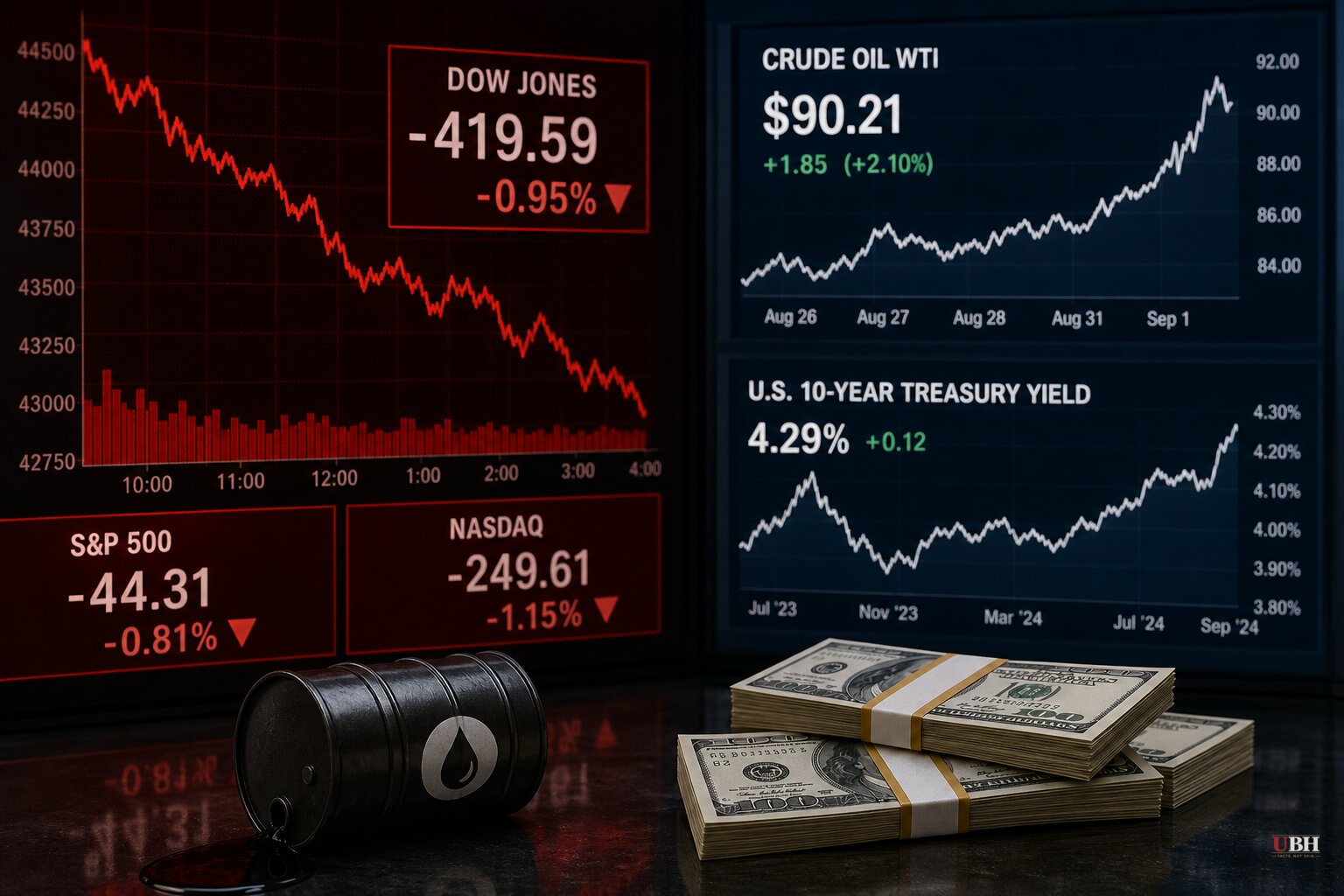
Since the U.S. renewed strikes on Iran Sunday and followed up Tuesday by hitting Islamic Revolutionary Guard Corps targets directly, oil has jumped, global bond yields have spiked, and Wall Street has sold off for three straight sessions.
The Dow Jones Industrial Average closed down roughly 363 to 450 points depending on the tally, according to CNBC-TV18, the NY Post, and FXStreet, a decline of about 0.7% to 0.85%. The S&P 500 fell 0.7% to 0.8%, and the Nasdaq Composite dropped between 1% and 1.3%, according to NBC News and CNBC-TV18. September has historically been Wall Street's weakest month.
Iran Strikes Drive Oil Above $90
U.S. Central Command confirmed American forces struck IRGC targets inside Iran on Tuesday, according to FXStreet, a second round of strikes inside 48 hours after Sunday's action. The escalation followed an attack Monday night in the Strait of Hormuz, where projectiles hit a Saudi-owned and a South Korean-owned oil tanker, according to Bloomberg reporting carried by Rigzone.
President Trump said the U.S. strikes were retaliation for Iran attempting to mine the strait and for an earlier attack near a U.S. military base in Jordan, Rigzone reported. Trump told Fox News that any Iranian response could trigger a "much stronger" U.S. action and that the country could be "totally wiped out." Iran's IRGC warned of "severe punishment" in response to the American strikes, according to Rigzone.
West Texas Intermediate crude settled up 5.2% at $90.22 a barrel, its first close above $90 in more than a month, according to the LA Times and Rigzone. Brent crude settled at $94.65, up 4.6%. Treasury Secretary Scott Bessent downplayed the strait's importance, telling reporters it will eventually be bypassed by pipelines and calling it a "worthless piece of water," per Rigzone. Persian Gulf output currently runs near two-thirds of pre-war levels roughly six months into the conflict, FXStreet reported, and producers including the UAE and Saudi Arabia continue routing exports through Hormuz, in some cases with tankers running with transponders switched off.
Yields Hit Levels Not Seen Since Early 2025
The 10-year Treasury yield climbed to about 4.79% to 4.80%, its highest level since January 2025, according to NBC News, the LA Times, and CNBC-TV18. The 30-year yield sat near 5.29% to 5.30%, close to 19-year highs. The 2-year yield, which tracks Fed rate expectations most closely, rose to 4.39% from 4.34%, the LA Times reported, up from about 3.50% at the start of 2026.
The move wasn't confined to the U.S. Japan's 10-year government bond yield hit roughly 3%, its highest since 1996, according to CNBC-TV18, while its 2-year yield touched a 31-year high of 1.81%. Britain's 30-year gilt yield reached its highest level since 1998, according to NBC News, and Germany's 10-year yield climbed to its highest since 2011, per CNBC-TV18.
Fed Officials Open the Door to a Hike
Fed Governor Michael Barr said Tuesday he'd be prepared to support an interest-rate hike if inflation doesn't ease sufficiently, according to CNBC-TV18. That followed hawkish remarks last week from Fed Chairman Kevin Warsh, who said the central bank is uncomfortable with the current inflation rate and noted that business investment, led by AI spending, remains brisk, according to NBC News.
FXStreet reported that futures markets now price in a roughly 68% probability of a rate hike at the Fed's September 16 meeting, up from about 35% before Warsh's Jackson Hole remarks, with the October 28 meeting carrying a 95% probability of the target range moving to 3.75%-4.00% or higher.
August's ISM manufacturing PMI landed at 54.6, below the 55.2 consensus and down from 55.6 in July, with new orders and employment components also softening, according to FXStreet. But the prices-paid index held flat at 71.1 for a second straight month. Cooling activity alongside sticky input costs tends to produce a hike into a slowdown rather than a pause, FXStreet noted. July JOLTS job openings came in at 7.271 million, slightly below the 7.3 million expected, according to Newsy Today.
Tech Stocks Bear the Brunt
Nvidia, AMD and Micron Technology each fell around 2%, with Microsoft and Alphabet also lower, according to CNBC-TV18. The LA Times noted that AI-driven growth at companies like Nvidia and Amazon has leaned heavily on borrowing, which gets more expensive as rates climb. This puts the trillion-dollar AI infrastructure buildout directly in the path of the current bond selloff.
Matthew Klein of The Overshoot newsletter argued, per NBC News, that higher yields partly reflect a genuinely stronger economy after more than a decade of sluggish growth, with AI investment and government spending pulling capital away from low-return government bonds toward equities. Ross Mayfield of Baird called Tuesday's combination of Warsh's hawkish comments and the Iran strikes "the perfect cocktail for a risk-off day," according to Newsy Today, while Nic Puckrin of Coin Bureau warned that "the summer party for risk assets is over" heading into September.
The LA Times noted that U.S. federal debt surpassed $40 trillion two weeks ago, adding another layer of pressure on Treasury markets already grappling with heavy issuance and rising term premiums. The next scheduled test comes September 16, when the Federal Reserve meets to decide whether to raise rates for the first time this cycle, a decision now shaped as much by fighting in the Strait of Hormuz as by domestic inflation data.
Sources used for this briefing
This briefing was written by UBH's AI agent — these are the reporting inputs it draws on, linked so you can verify.


