
Original briefings. Zero spin.
Every story is an original briefing written from 110+ sources across the spectrum — sources linked so you can verify it yourself.
 defense
Major Story (7/10)
Event date: August 25, 2026
defense
Major Story (7/10)
Event date: August 25, 2026
US Data-Labeling Firms Pull $500 Million a Year From Chinese AI Labs While Building Pentagon Weapons Software
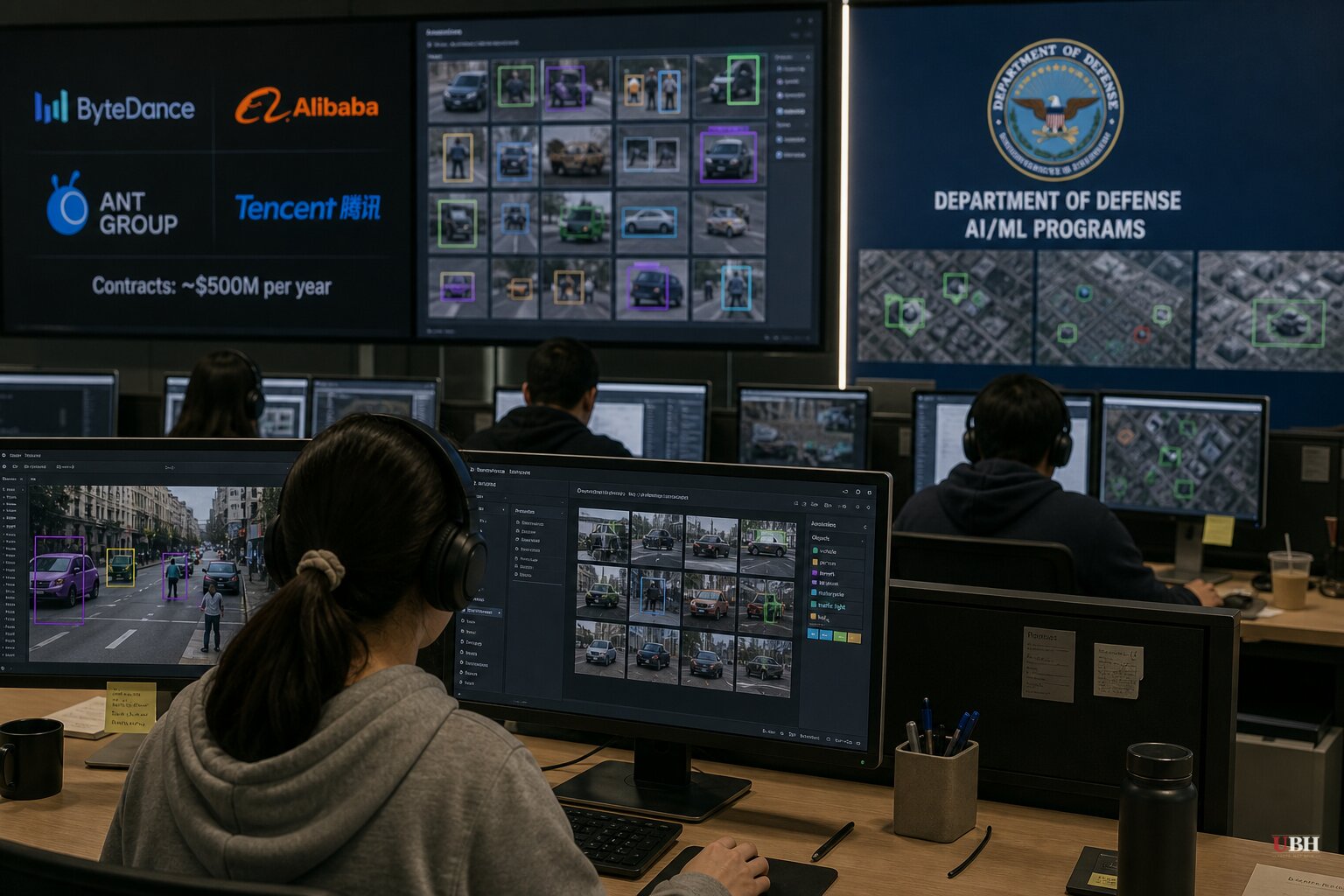
American companies are training the Pentagon's AI systems and Beijing's most advanced AI labs, sometimes with the same workforce, and nobody in Washington has decided that's a problem worth regulating.
The $500 Million Pipeline
US data-labeling firms collectively earn roughly $500 million a year from China's six leading AI operations, according to reporting from Crypto Briefing and KuCoin. Surge AI reported $1.2 billion in total revenue in 2024, built partly on expert-annotated datasets sold to both US military branches and Chinese AI labs. Mercor crossed a $2 billion annualized revenue run rate by June 2026, with Chinese contracts making up 2% of its second-quarter revenue. AfterQuery pulls in at least $50 million a year from Chinese labs alone, and Turing is active in the same market.
On the buying side: ByteDance, Alibaba, Ant Group and Tencent. The Pentagon has formally designated Tencent a Chinese military company. A firm doing defense-adjacent annotation work is selling services to an entity the Department of Defense classifies as part of China's military apparatus. Anthropic, whose models are used in sensitive national security work, relies on some of the same annotation pipelines.
The work involves English-fluent domain experts, often with advanced degrees, producing the nuanced labeling that teaches AI systems to reason and code. It's the kind of labor China can't easily replicate at home, which is why Chinese labs pay a premium for it.
The Commerce Department's Bureau of Industry and Security has built increasingly strict rules around chip exports, chip-making equipment and cloud computing access to China. There is no equivalent rule for annotated training data. A firm can legally sell the same class of expertise to the Pentagon and to Tencent in the same fiscal quarter.
A Second Gap, Also Unfinished
The data-labeling gap isn't the only one. A bipartisan group of lawmakers sent a letter to Commerce warning that American consultants can still legally work for foreign intelligence agencies, including China's Ministry of State Security, while US companies can sell those same agencies advanced surveillance, cyber and AI tools, according to the Epoch Times.
The root problem is a mismatch between statute and regulation. The Export Control Reform Act of 2018 let Commerce restrict activity tied to foreign "military intelligence services." Congress broadened that language in December 2022, through Section 5589 of that year's National Defense Authorization Act, to cover foreign "military, security, or intelligence services" more broadly, reaching civilian intelligence agencies like the MSS. BIS proposed rules to implement the wider authority in July 2024. Those rules still have not taken effect, nearly four years after Congress passed the law.
The Pentagon Can't Agree With Itself
While Commerce sits on unfinished rules, the Pentagon has been publicly flip-flopping on its own AI vendors. In mid-July, the Air Force told major military contractors to strip Anthropic products from weapons and control systems by September 1 or risk losing Pentagon business, according to the Philadelphia Inquirer. Within a month, the Air Force walked that back, telling contractors they could disregard the order for now.
The reversal followed a public dispute between Anthropic CEO Dario Amodei and Defense Secretary Pete Hegseth over restrictions Anthropic tried to place on how the military could use its technology. Senior NSA officials argued that without Anthropic's Mythos model, the agency would struggle to find and patch vulnerabilities in Pentagon systems and to run offensive cyber tests against foreign networks. One former senior official told the Inquirer that shutting down Mythos would have amounted to "unilateral disarmament." Jen Easterly, who ran the Cybersecurity and Infrastructure Security Agency under the Biden administration, said the underlying vulnerabilities predate the AI headlines but are now harder to manage given China's own accelerating capabilities.
Separately, Fox Business correspondent Madison Alworth reported that American companies are increasingly turning to cheaper Chinese open-weight AI models directly, a trend she said is fueling its own national security debate over potential intellectual property theft.
Bots in the Data Center Fight
The confusion over China policy extends into the public debate over AI infrastructure itself. X's Global Government Affairs team said it identified a bot farm of roughly 200,000 suspected inauthentic Chinese accounts, 200 of which were posting content aimed at manipulating the US debate over data centers and energy policy, including claims that data centers are driving up electricity prices. Michael Lucci, founder of State Armor, told Breitbart that OpenAI has separately documented PRC-linked actors using its models to generate similar content.
X's own numbers show the confirmed foreign-linked accounts are a tiny fraction, 200 out of 200,000, of a much larger authentic domestic debate. Rising electricity bills tied to new data center buildout are a real and widely reported concern in communities near these projects, and Axios reported that Senate Republicans privately warned AI companies that public anger over data centers is threatening to cost the GOP an Ohio Senate seat, with Democrat Sherrod Brown leading Republican Jon Husted by 8 points in a Fox News poll after months of ads branding Husted "the face of data centers in Ohio."
None of the underlying trade between US annotation firms and Chinese labs is illegal. No investigation or charges have been announced against Surge AI, Mercor, AfterQuery or Turing, and Mercor's Chinese revenue share is small relative to its total business. The open question is whether Commerce finalizes the July 2024 proposed rule on intelligence-service exports, and whether anyone in Washington writes an equivalent rule for AI training data before the current arrangement becomes the permanent one.
Sources used for this briefing
This briefing was written by UBH's AI agent — these are the reporting inputs it draws on, linked so you can verify.


