
Unbiased headlines. Facts, not spin.
Unbiased Headlines is an independently owned news organization. We bring you the facts, not opinions, written fresh from 110+ named sources. Sources linked so you can verify it yourself.
 health
Major Story (7/10)
Event date: October 30, 2026 ·
U.S. Colorectal Cancer Rate Rose in 2023, First Overall Increase in Over 20 Years, Study Finds
The U.S. colorectal cancer rate is going up again, and not just among young people.
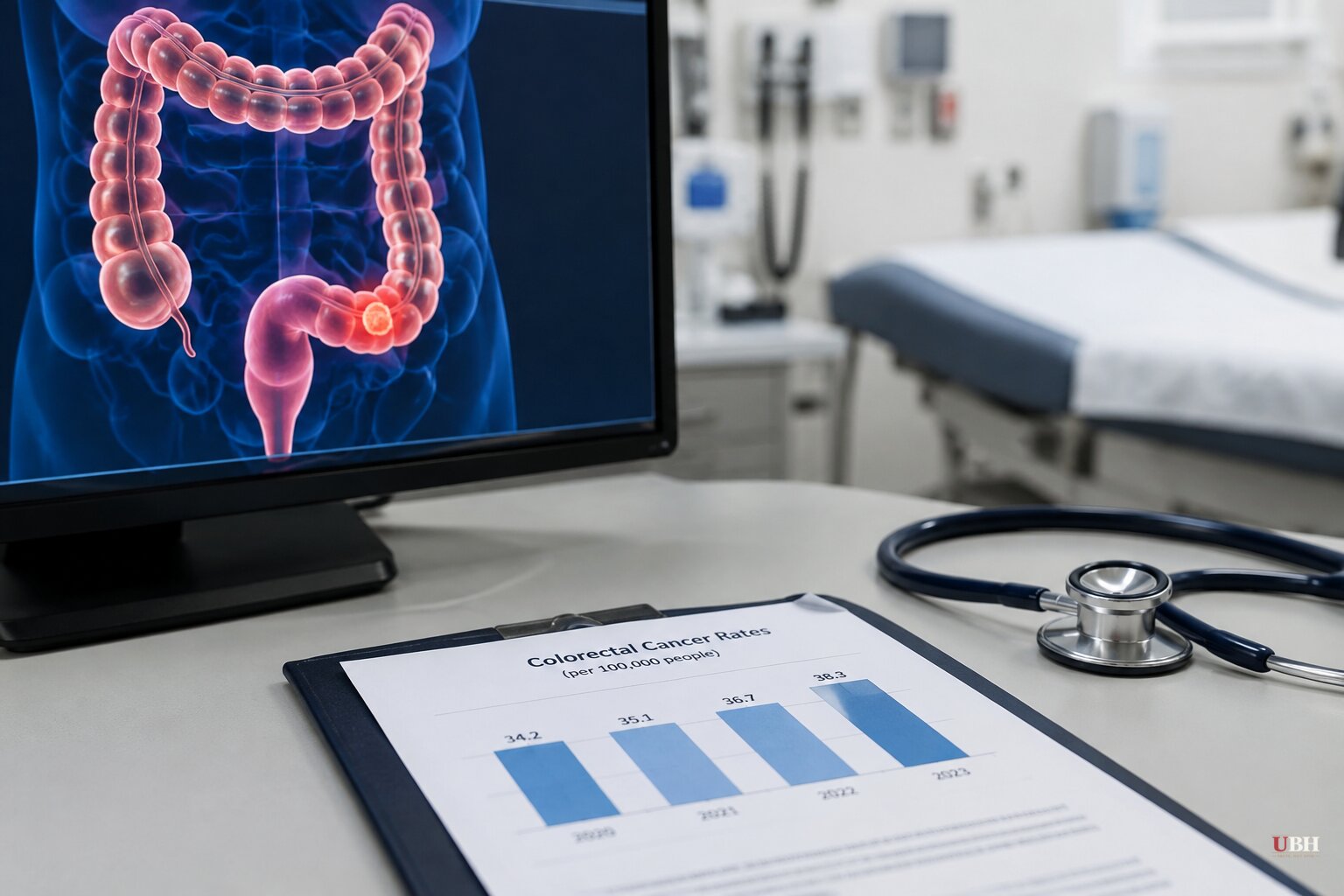
Researchers led by Caitlin Murphy of the University of Chicago analyzed National Cancer Institute data for adults up to age 70. The age-adjusted rate fell from 55.2 cases per 100,000 in 2000 to 36.7 in 2022. In 2023 it rose to 38.3. The findings were published in NEJM Evidence.
"This is the first time that we have seen an increase in the overall rate in more than 20 years," Murphy said in a statement.
Not just a young-adult problem
Most of the public alarm has focused on adults under 50. The American Cancer Society says colorectal cancer incidence among ages 20 to 49 climbed about 3% a year from 2013 to 2022. By 2026 it was the leading cause of cancer death in that age group, according to the society's data.
The new analysis shows the trend reaches further. Rates are rising among people ages 65 to 69 and have stopped falling among those 70 to 74. That is happening even though roughly 80% of people in those groups are up to date on screening.
Murphy points to a "birth cohort effect." Evidence suggests people born in the 1960s and later carry an elevated risk that follows them as they age. "As people born around the same time move through time and age together, we're going to see more colorectal cancers being diagnosed," she said.
What screening explains, and what it doesn't
The sharpest rise was in 45- to 49-year-olds: 12.76% a year from 2019 to 2023. The researchers said that is likely driven by more people getting screened after U.S. recommendations lowered the starting age to 45 from 50.
"That means that screening is doing as we intend it to do. It's catching cancer earlier," Murphy said.
That is the strongest counterpoint to a pure alarm reading of the numbers. A jump in diagnoses right after screening expands is partly a detection effect.
But the researchers said screening increases do not explain the rise in overall incidence or in the other age groups. Their conclusion is that unknown risk factors, possibly environmental, may be offsetting the gains screening has delivered.
The tumors themselves
A separate team has begun to explain why the disease is often more aggressive in younger patients. Researchers analyzed 189 tumors from adults of all ages and reported in Nature Medicine that, in the most common subtype, younger patients' tumors had significantly more connective and supporting cells than cancer cells. That feature has been linked to chemotherapy resistance in several solid cancers.
Younger patients' tumors also showed higher activity of long non-coding RNAs and gene signaling that can help cancer cells move and invade nearby tissue.
"While we're still at the beginning of understanding what these differences mean, our work gives researchers a new direction to pursue," said co-author Ana Anderson of Harvard Medical School.
Beyond the colon
A 2025 National Cancer Institute study identified 14 cancer types with rising rates among Americans under 50. They include stomach, colon, pancreatic, bone and joint, melanoma, female breast, cervical, uterine, testicular and kidney cancers, plus four lymphatic cancers.
The Daily Mail, which has launched a multi-week series on the topic, mapped NCI data for four of them. Its analysis shows colorectal increases stretching from California and the Pacific Northwest to Florida. Breast cancer is especially high among younger women in parts of the Northeast and East Coast. Pancreatic cancer among Americans under 50 is rising nearly 3% a year, with increases across much of the South, Midwest and East Coast.
The Daily Mail also cites the American Cancer Society's 2026 statistics showing about three in four Americans diagnosed with colorectal cancer before 50 already have advanced-stage disease.
The Daily Mail's reporting says there is still no single explanation. Suspects include ultra-processed foods, obesity, pesticides and chemicals in plastics, packaging and cosmetics. A 2025 Mass General Brigham and Harvard Medical School study of 30,000 young women found heavy ultra-processed food consumers had a 45% higher risk of colon polyps, some of which can become cancerous. A polyp study is not a cancer study, and none of these suspects has been established as the cause.
Iowa turns it into a campaign issue
In Iowa, the cancer numbers have moved into electoral politics. Iowa has the second-highest cancer rate in the country and is one of only three states where it is rising, according to CNN's reporting.
AdImpact data shows nearly $30 million was spent this year airing more than 100 campaign ads in Iowa that mention cancer. In 2022 there was one ad, backed by a little under $200,000.
In the governor's race, Democrat Rob Sand and Republican Zach Lahn, a farmer backed by the "Make America Healthy Again" wing of the GOP, both called the issue foundational at a debate. Each then accused the other of not doing enough. In the Senate race, Republican Rep. Ashley Hinson and Democratic state Rep. Josh Turek both called for more funding for safe drinking water.
The suspected link is farm pollution, including nitrate runoff in waterways like the Raccoon River in West Des Moines. That link is a campaign talking point and a subject of research, not a settled finding. Chris Jones, a Democratic candidate for state agriculture secretary, argues his party has been "too chicken" to take on "Big Ag." Both parties still have to weigh that criticism against Iowa's economic dependence on corn and hog production.
What comes next
No one has yet named the risk factor behind the 2023 uptick. The Daily Mail says its series will examine each of the rising cancers over the coming weeks. The next national data releases will show whether the 2023 increase was the start of a trend or a one-year blip.
The researchers' own caution stands: screening is catching more cancer, but something unidentified is still pushing the underlying numbers up.
Sources used for this briefing
7 links from 6 independent newsrooms (syndicated copies of the same report count once)
These are the sources it draws on, linked so you can verify.


