
Unbiased headlines. Facts, not spin.
Unbiased Headlines is an independently owned news organization. We bring you the facts, not opinions, written fresh from 110+ named sources. Sources linked so you can verify it yourself.
 health
Notable (6/10)
Event date: November 5, 2026 ·
Nature Study Links X-Chromosome Gene ZFX to Autism Gene Network and Possible Male-Female Gap
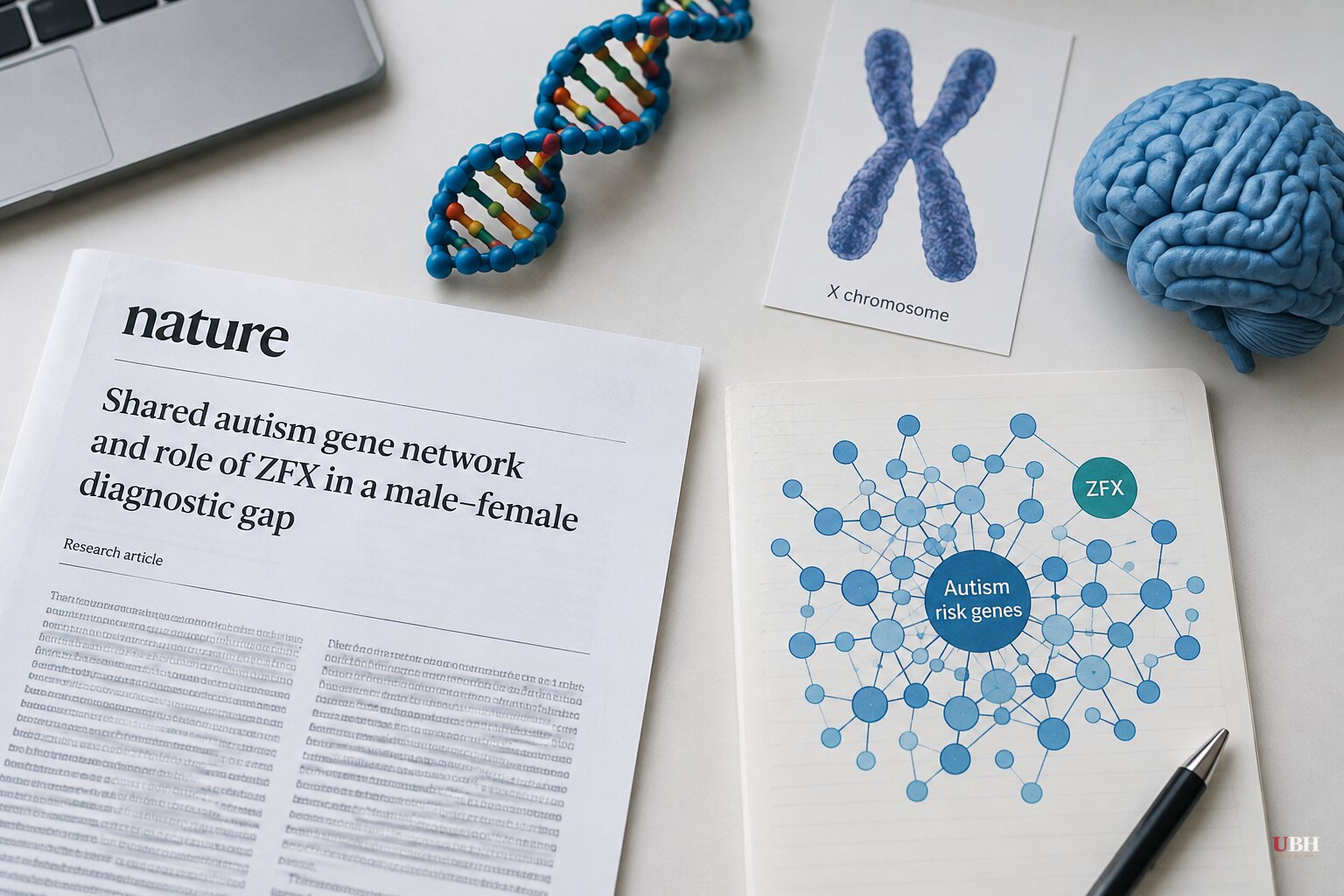
Hundreds of genes have been tied to autism. Scientists have never settled what they have in common.
A team led by researchers at Boston Children's Hospital now reports an answer in the journal Nature: many of them feed into the same biological network.
What the Nature study found
The researchers dialed down autism-associated genes one at a time in human cell models. Lead author Rebecca Andersen, Ph.D., expected the genes to sort into distinct groups based on their effects.
They didn't. "When I started this project, I thought that by disrupting several autism-associated genes one at a time, we would be able to group subsets of them together," Andersen told Newsweek. Instead, nearly all the disruptions produced similar shifts in overall gene expression, especially in other autism-linked genes.
Andersen calls the effect "transcriptomic convergence." In the team's experiments, 27 other autism-implicated genes grew quieter in at least 10 of the disruptions. Follow-up work in brain organoids, clumps of lab-grown tissue, backed up the pattern.
"Disrupting one of them can have rippling effects that disrupt many others," Andersen said, and that "begins to explain how so many different genes can play a role in autism."
The ZFX gene and the sex gap
Mapping the regulatory links pointed the team to ZFX, a gene on the X chromosome. It encodes a protein that switches on other genes, including many tied to autism.
Most genes on one of a female's two X chromosomes are silenced. ZFX escapes that silencing and typically stays active on both copies. The researchers propose that this higher baseline activity in female brains helps keep the network running when other genes are disrupted.
The Y chromosome carries a similar gene, ZFY, but it is a weaker activator. The team also reanalyzed existing data from donated brain tissue and found reduced ZFX activity in excitatory neurons from autistic males.
Autism is diagnosed about four to five times more often in males than females by Newsweek's account. New Atlas puts the ratio at three to four. The exact figure varies by source and population.
The findings fit a long-standing idea called the female protective effect. A 2014 genetic study found that autistic women carried more autism-linked genetic changes than autistic men, which suggests females may need a heavier genetic load to reach the same threshold.
Limits of the work
The study does not prove ZFX is the whole explanation. The experiments relied on a single male-derived stem-cell line. Comparing cells from men and women, and testing directly whether the extra ZFX dose protects, is the step that would build the case.
Shebna N. Osanmoh, a psychiatric mental health nurse practitioner at Savant Care who was not involved, said the results could help explain why people with different mutations share similar traits. "It does not, however, tell us how [a] child may progress or what kind of interventions they may require," she told Newsweek.
Other genetic work lands the same week
Separately, a University of Toronto and Memorial Sloan Kettering team reported finding overlooked stretches of DNA called microexons, fragments only three to 27 DNA letters long that influence how proteins work in the brain. Benjamin Blencowe of Toronto's Donnelly Centre and Quaid Morris of Memorial Sloan Kettering co-led the project.
Their tool scanned more than 100 terabytes of public RNA data, covering 4,790 human tissue samples and 47,380 single nuclei from the cortex. It identified 1,514 human microexons that no catalog had listed. Of those, 292 are used differently in nerve cells than elsewhere. A matching search in mice found 1,115 more.
The work matters because genetic testing identifies a cause in only about 15 percent of autism cases, according to the researchers. The microexon results are computer predictions checked against thousands of family genomes. No clinical test exists yet.
A third item came Nov. 5, when the Brain & Behavior Research Foundation posted a summary of University of California, San Francisco work on high-impact autism mutations. The foundation says the research tested a method for systematically mapping how such mutations rewire protein interactions, and that the approach could serve as a platform for testing new therapies.
Where the debate over causes stands
The National Autistic Society stated on Sept. 15, 2026, after reviewing 83 research papers, that autism is genetic. The group's position is that people are born autistic and remain so for life.
Autistic advocate and artist Loveartpix, writing Oct. 20 in Autism Spectrum News, cited a population study of more than 2 million people across five countries that put heritability near 80%. The writer argued that it is time to end the vaccine debate, saying persistent claims blaming vaccines shape how autistic people are treated. The writer also said no treatment has been shown through robust evidence to turn an autistic person into a non-autistic one.
That same advocate notes that autism is genetically complex, with potentially thousands of contributing genes and, less commonly, prenatal factors alongside them.
None of the new studies addresses treatment directly. The immediate open question for the ZFX work is whether female-derived cells show the same protective effect when the gene network is disrupted.
Sources used for this briefing
6 links from 5 independent newsrooms (syndicated copies of the same report count once)
These are the sources it draws on, linked so you can verify.


