
Unbiased headlines. Facts, not spin.
Unbiased Headlines is an independently owned news organization. We bring you the facts, not opinions, written fresh from 110+ named sources. Sources linked so you can verify it yourself.
 health
Notable (6/10)
NIH Study: Higher Blood Levels of PFOA and PFOS Tied to 67% and 93% Higher Rates of ER-Negative Breast Cancer
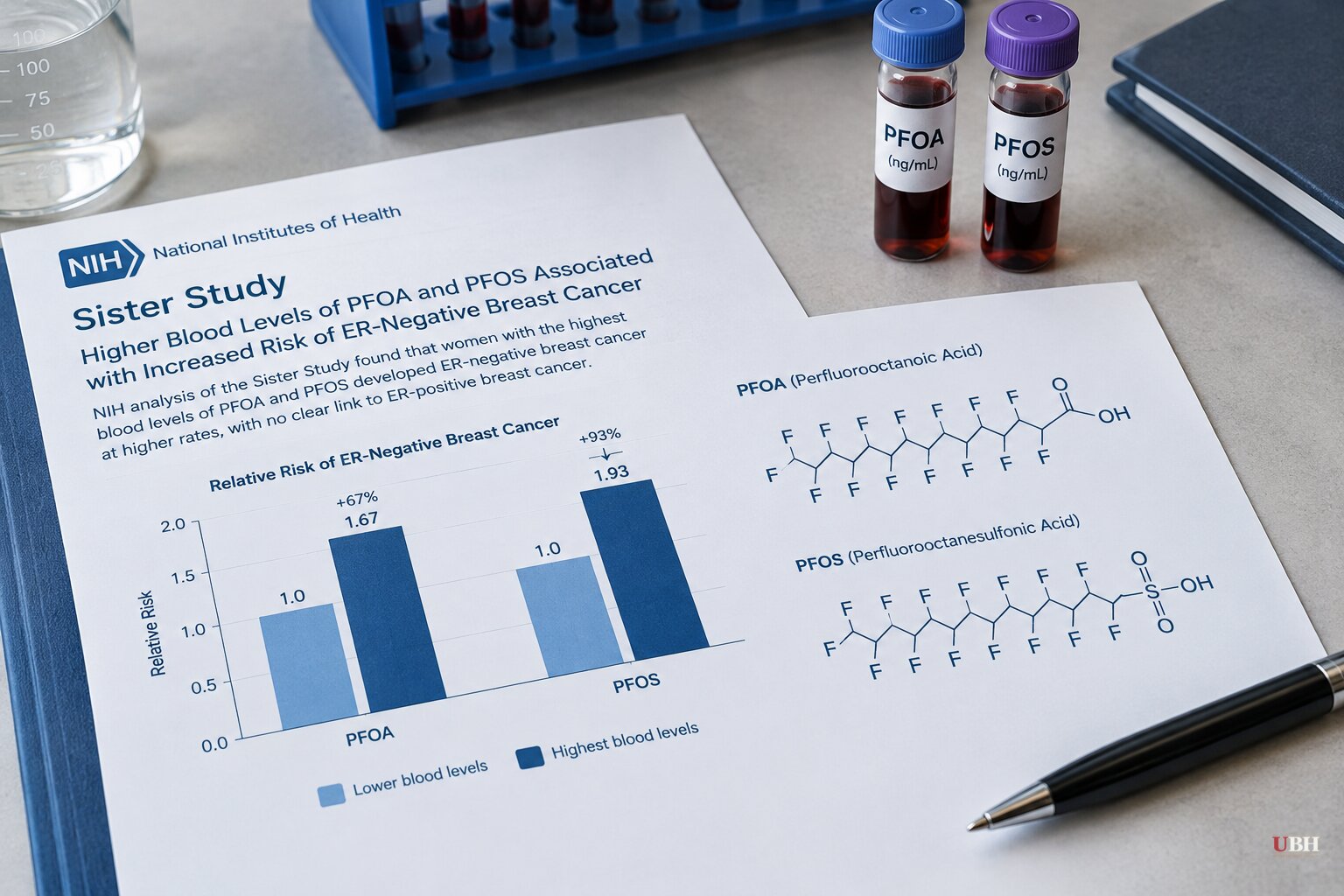
Women with higher blood levels of two so-called forever chemicals developed a more aggressive type of breast cancer at higher rates, according to a National Institutes of Health study published in the Journal of Clinical Oncology and announced Thursday, Nov. 5.
The chemicals are PFOA (perfluorooctanoic acid) and PFOS (perfluorooctanesulfonic acid). Both belong to the PFAS family, used in common consumer products, which breaks down poorly in the environment and can stay in the body for years.
What the study found
Researchers led by NIH Stadtman Investigator Alexandra White, Ph.D., drew on the Sister Study, a cohort run by NIH's National Institute of Environmental Health Sciences. It enrolled 50,884 breast cancer-free women ages 35 to 74 in the U.S. and Puerto Rico between 2003 and 2009. Every participant had a full or half-sister diagnosed with breast cancer.
The team measured 17 PFAS in blood collected years before any diagnosis. They compared 1,609 women who went on to develop breast cancer with a comparison sample of 2,269 women.
The numbers for estrogen receptor-negative (ER-negative) breast cancer:
- PFOA: the highest-exposure group had a 67% higher rate than the lowest (hazard ratio 1.67, 95% confidence interval 1.10 to 2.53).
- PFOS: the highest-exposure group had a 93% higher rate, nearly double (hazard ratio 1.93, 95% confidence interval 1.15 to 3.22).
No clear association appeared between either chemical and breast cancer risk overall. The signal showed up only in the ER-negative subtype.
NIH stressed that these figures describe relative differences between groups, not any individual woman's chance of getting the disease.
The meta-analysis
The authors also pooled seven studies. For PFOA, the pooled relative risk was 1.30 (95% confidence interval 1.05 to 1.62). For PFOS it was 1.20, but the confidence interval of 0.91 to 1.58 includes 1.0, so that estimate does not show a clear association by itself.
White said the findings, which the team confirmed in the meta-analysis, indicate that "certain legacy PFAS, including PFOA and PFOS, are associated with a higher risk of ER-negative breast cancer, a more aggressive tumor type with few known risk factors." Earlier work, including an analysis of the Prostate, Lung, Colorectal, and Ovarian Cancer Screening Trial and a French study, also reported links between PFOS, PFOA and ER-negative tumors.
ER-negative tumors lack the receptors that let estrogen help cancer cells grow. NIH says they tend to be more aggressive and carry worse outcomes than estrogen-responsive cancers, and that scientists know less about what raises the risk.
Mechanism and limits
Because the association concentrated in hormone receptor-negative tumors, White and her colleagues wrote that PFAS "may act through nonhormonal mechanisms." They pointed to epigenetic alterations and immunosuppression as possibilities, and noted that many PFAS are only weak endocrine disruptors. That remains a hypothesis. The study did not test it.
The design is observational. It shows an association in a specific group of women, all with a close relative who had breast cancer. It does not prove the chemicals caused any tumor, and the study does not establish whether the pattern holds in more heavily exposed populations.
Reaction and advice
HHS Secretary Robert F. Kennedy Jr. said in a statement: "This NIH study links two forever chemicals to a higher risk of ER-negative breast cancer and demands further investigation. Under President Trump's leadership, we will pursue the evidence, confront environmental health risks, and give women the information they need to protect their health." The announcement did not name a funding amount, program or timeline for that follow-up.
White told MedPage Today that many factors shape a woman's breast cancer risk and that these chemicals "may be one contributor" to ER-negative risk specifically. For women worried about exposure, she said, "reducing exposure to sources such as contaminated water would be a very reasonable step."
First author Che-Jung Chang, Ph.D., a former NIH research fellow now at the research organization DLH, said exposure to PFAS is "still potentially modifiable," meaning people can take steps to reduce it.
The replacement problem
PFOA and PFOS have been phased out of industry and largely replaced by other PFAS. Most people still carry measurable levels of the older compounds. White said the research focus should shift toward the replacements now in wider use.
"From a public health perspective, we probably want to start shifting our focus to the health effects of these replacement PFAS compounds that are being used more today," she told MedPage Today.
The study ties cancer rates to chemicals that are already being retired, while the health effects of the ones taking their place remain far less documented.
Sources used for this briefing
7 links from 7 independent newsrooms (syndicated copies of the same report count once)
These are the sources it draws on, linked so you can verify.


