
Unbiased headlines. Facts, not spin.
Unbiased Headlines is an independently owned news organization. We bring you the facts, not opinions, written fresh from 110+ named sources. Sources linked so you can verify it yourself.
 health
Major Story (7/10)
CMS Finalizes 2.31% Medicare Physician Pay Cut for 2027, Steeper Than July Proposal
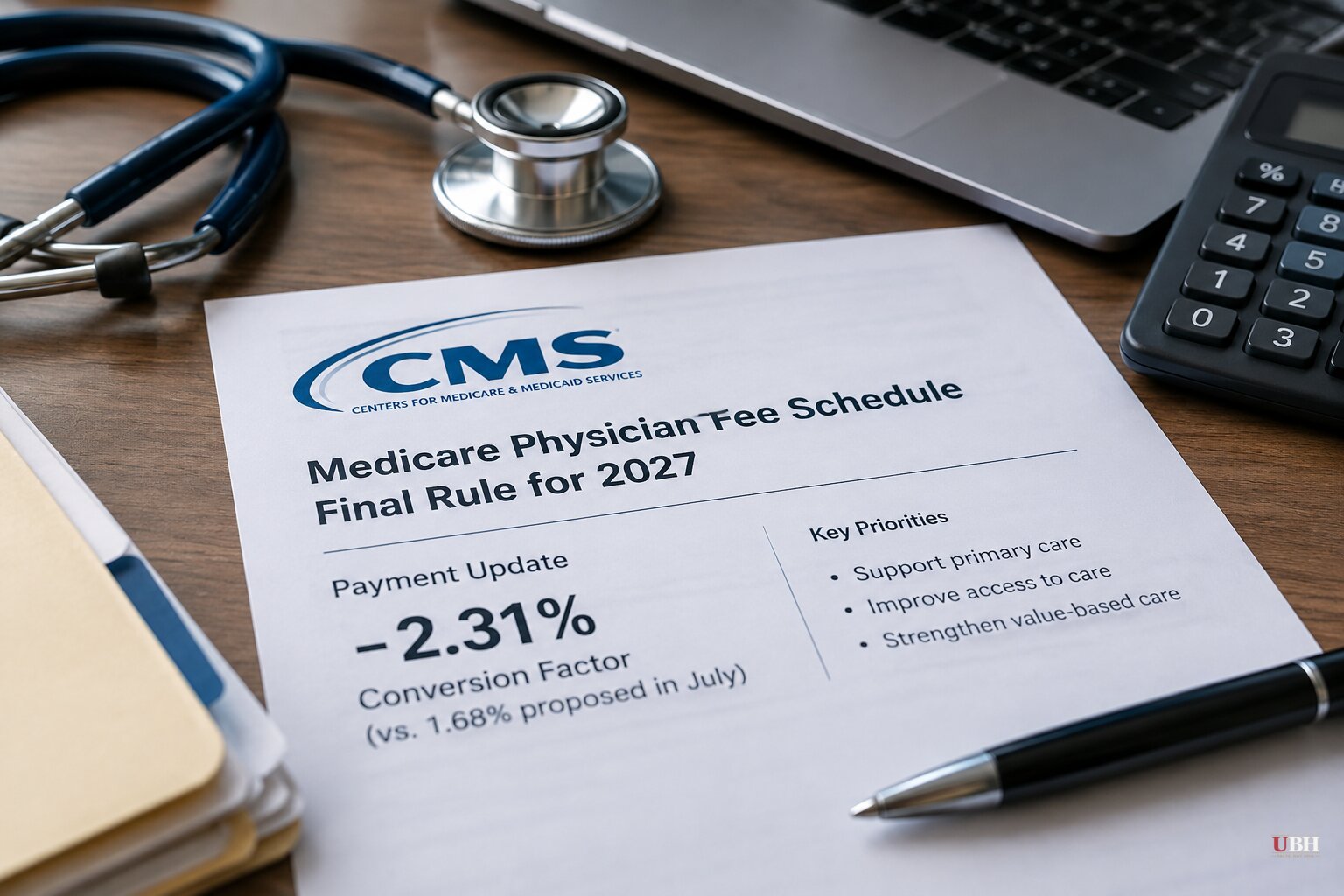
The Centers for Medicare & Medicaid Services finalized its 2027 Medicare Physician Fee Schedule on Wednesday, Nov. 4. The conversion factor, the multiplier that turns a service's value into a dollar payment, drops 2.31% for physicians outside advanced alternative payment models (APMs). It drops 1.83% for those inside them.
That is worse than what CMS floated in July. The proposed cuts were 1.68% and 1.19%.
The American College of Cardiology puts the final numbers slightly differently. It calculates the factor at $32.6286 for non-APM clinicians, a 2.36% decline from 2026. For qualifying APM participants, it calculates $32.9548, down 1.86%.
Why the check shrinks even with a statutory raise
CMS says the statute gives qualifying APM participants a 0.75% update and everyone else 0.25%. The agency also applies an estimated -0.12% adjustment tied to changes in work relative value units. The bigger driver is the expiration of a one-year 2.50% conversion factor increase that applied for 2026. CMS says that means current law effectively requires a 2.50% reduction in Medicare payment under the fee schedule compared to 2026. The net result is still a cut of more than 2% for most clinicians.
The rule runs 2,468 pages. It takes effect Jan. 1, 2027.
What CMS says it is buying
HHS Secretary Robert F. Kennedy Jr. framed the rule as a change in what Medicare pays for. "Medicare should reward clinicians for keeping people healthy," he said in a statement. "We are putting prevention and primary care at the center of Medicare, closing payment loopholes, and cracking down on waste."
CMS describes the rule as a move away from volume-based "sick care." Several pieces back that up:
- New payments for coaching, group visits and behavioral health integration.
- A higher BASIC track shared-savings rate for accountable care organizations (ACOs), plus the option for ACOs to waive patient cost sharing.
- Three new MIPS Value Pathways, covering diabetes, hypertension and hospitalists.
- An end to the traditional Merit-based Incentive Payment System reporting option beginning with the 2031 performance period. That is two more years of transition than the July proposal allowed. MIPS Value Pathways already cover approximately 98% of clinicians, according to CMS.
- A two-year delay in a requirement that only clinical staff directly employed by the billing practice may furnish remote physiologic or therapeutic monitoring services, which the telemedicine lobby praised.
CMS also says it is cracking down on duplicate billing. The same-day services policy is the most visible example. CMS proposed paying the most expensive service, surgical or evaluation and management, at 100% when two or more services are performed on the same day, with other services that day paid at 50%. After public comment, CMS made two significant modifications. It limited the payment reduction to same-day 0-day global procedures rather than also including 10- and 90-day global procedures. And the other services that day will be paid at 80% rather than the proposed 50%. Medical Economics reports the final version softens the same-day visit penalty compared with the proposal.
Where doctors push back
Physician groups did not accept the trade. The American Academy of Neurology said it is "deeply concerned with year-over-year cuts to physician payments" and will work with Congress to avert this one. It wants an inflationary adjustment tied to the Medicare Economic Index.
William Harvey, MD, president of the American College of Rheumatology, said "the continued erosion of Medicare physician payments" threatens the stability of practices and patient access. He pointed in particular to rural and underserved communities.
Anders Gilberg of the Medical Group Management Association said "Congress must intervene to prevent further harm by immediately fixing cuts to the conversion factor, along with changes to modifier 25."
Cardiology got no relief. CMS estimates the rule changes cardiology payments by 0%, though the ACC notes individual practices will see different results depending on patient and service mix. ACC President Roxana Mehran, MD, said the college is "deeply disappointed." She cited inadequate recognition of inflation, rollout of the Ambulatory Specialty Model without additional testing, reduced payment for key cardiovascular services and restrictions on remote physiologic monitoring.
Not everyone is unhappy. Accountable care groups praised the rule's ACO provisions, while medical groups and specialty societies focused on the cuts. Mara McDermott, CEO of Accountable for Health, which represents ACOs, said the rule establishes a 32% payment increase for qualifying visits by clinicians in the Medicare Shared Savings Program and the LEAD Model, and raises from 50% to 75% the credit ACOs receive for savings achieved in prior years. The split follows the money. The rule favors clinicians in coordinated, risk-bearing arrangements and squeezes those paid per service.
Hospitals get a raise
The companion Hospital Outpatient Prospective Payment System and Ambulatory Surgical Center rule goes the other direction. It raises OPPS rates 2.3%. That is a 3.2% market basket update minus a 0.9% productivity adjustment.
So hospital outpatient departments get an increase while the doctors who staff them face a cut.
What happens next
The cuts take effect Jan. 1, 2027, and the physician groups quoted are pointing at Congress. The AAN, ACR and MGMA all call for congressional action, and Jerry Penso, MD, president and CEO of the American Medical Group Association, said "Congress must enact lasting reforms now, before access to care suffers." He noted members are absorbing reductions to physician and clinician reimbursement and outpatient drug reimbursement at the same time they face a trillion dollars in pending Medicaid cuts.
The pressure lands on a Congress just elected in the midterm cycle. Medical Economics reports a record number of physicians won election or re-election. Whether any legislative vehicle emerges before the new year is unresolved. Kennedy's department is defending a rule whose stated goal is to cut waste and redirect Medicare dollars toward prevention. The doctors who will absorb the cut argue the payment formula, not their care, is what is broken.
Sources used for this briefing
7 links from 7 independent newsrooms (syndicated copies of the same report count once)
These are the sources it draws on, linked so you can verify.


