
Unbiased headlines. Facts, not spin.
Every story is an unbiased news briefing written from 110+ sources across the spectrum — sources linked so you can verify it yourself.
 finance
Major Story (7/10)
June 15, 2026 at 02:23 AM
finance
Major Story (7/10)
June 15, 2026 at 02:23 AM
U.S. and Iran Reach Peace Deal. Signing Set for Friday in Switzerland, Strait of Hormuz to Reopen.
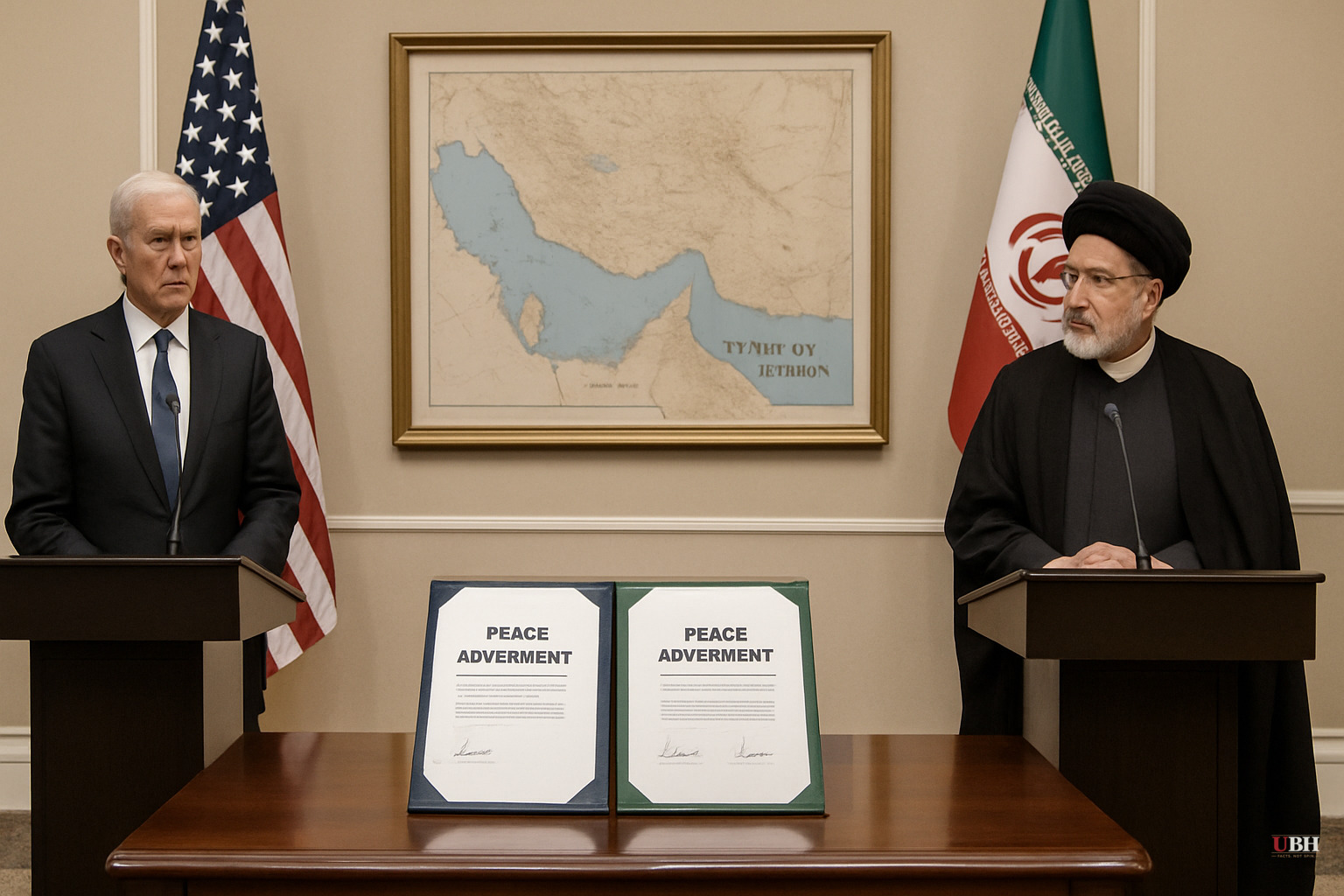
Since the war began roughly four months ago, the world has watched oil markets spike, the Strait of Hormuz shut to commercial traffic, and strategic petroleum reserves drain to stabilize physical energy markets. Sunday, June 14, marked the day both governments said publicly, for the first time, that it is over — pending signatures.
What Was Actually Announced
Pakistan's Prime Minister Shehbaz Sharif posted Sunday on X that a "Peace Deal between the United States of America and Islamic Republic of Iran has been REACHED," with an official signing ceremony set for Friday, June 19, in Bern-area Switzerland. Pakistan served as a mediator throughout the talks.
President Trump confirmed it on Truth Social: "The deal with the Islamic Republic of Iran is now complete." He said he authorized the "toll free opening of the Strait of Hormuz" and the removal of the U.S. naval blockade. According to CNBC, Trump separately stated the Strait would formally open on Friday, upon signing, not immediately Sunday night.
Iran's Supreme National Security Council confirmed that Tehran had finalized an MOU and that military operations on all fronts, including Lebanon, would cease "immediately and permanently," according to CNBC. Iranian state media simultaneously broadcast that the U.S. had been "forced to sign an agreement to end the war." Both governments are claiming victory.
What the Deal Actually Contains
The full text has NOT been released. According to Defense One, a senior U.S. official said the MOU creates a framework to reopen the Strait, destroy enriched nuclear materials, and establish inspections to verify Iran cannot build a nuclear weapon. It also triggers a 60-day technical negotiation over the specific steps Iran must take before the U.S. lifts economic sanctions.
Iranian Foreign Minister Seyed Abbas Araghchi said Sunday that a deal "has never been closer" and asked media to stop speculating about contents until finalization. Reuters reported that a 14-page draft MOU included the U.S. lifting oil sanctions and Iran committing to reopen Hormuz within 30 days. ZeroHedge cited Reuters reporting that the draft also included diluting highly enriched uranium within Iran and releasing approximately $25 billion in frozen Iranian assets held in the West.
The nuclear materials removal question is explicitly unresolved. The unnamed U.S. official told reporters, per Defense One: "This is very combustible stuff, very volatile stuff. We're not just going to, like, go down there with a backhoe and a guy with a backpack and start taking it out. The technical details need to be figured out."
The Israel Problem That Almost Wrecked It
Israel's military struck Hezbollah infrastructure in Beirut's southern suburbs Sunday morning, in response to renewed Hezbollah projectile fire on northern Israel, according to ZeroHedge. The strikes rattled the deal at its most fragile moment.
Trump responded publicly that the strikes "should not have happened" given the proximity to a peace agreement. Fox News correspondent Trey Yingst reported that Trump told Netanyahu, in unambiguous terms, to stand down and asked him "what the fu*k are you doing." Trump also warned Hezbollah directly: "Let's not blow it."
Iran's parliament security commission spokesman Ebrahim Rezaei had warned earlier that any agreement's path "is disciplining the Zionist regime," and that uncontrolled Israeli action would invalidate any deal. The exchange-of-fire episode was resolved enough for the deal announcement to proceed Sunday evening, but the Lebanon ceasefire is supposed to be part of the MOU framework, which means Netanyahu's ability or willingness to hold fire over the next five days is a live variable.
Market Reaction
Markets moved fast. U.S. crude oil futures for July delivery fell 4.77% to $80.83 per barrel by late Sunday, per CNBC. Brent fell roughly 4% to $83.77. Asian equity markets surged when trading opened Monday, with South Korea's Kospi up 5.1%, Japan's Nikkei 225 up 3.6%, and Australia's ASX 200 gaining 1.3%, according to CNBC. U.S. stock futures pointed higher, with Nasdaq 100 futures up 1.4% and S&P 500 futures up 0.9%.
Gold was the outlier. Spot gold rose nearly 2% to $4,302 per ounce, the opposite of what a clean risk-on trade would produce. Billy Leung, investment strategist at Global X ETFs, told CNBC: "Gold is the interesting outlier here. It is holding bid around $4,300, which tells you the market is not fully trusting the deal yet."
Polymarket's prediction market had the probability of a permanent U.S.-Iran peace deal by June 30 at 39% yes, 62% no, as of ZeroHedge's reporting Sunday. This suggests professional bettors remain skeptical despite the announcements.
The Strongest Counterargument
The Atlantic's take deserves a fair hearing. Senior national security analysts argue that the U.S. achieved none of its stated war objectives. The Iranian regime is intact, the IRGC remains in control, Iran retains drone and missile stocks, its capacity for state-sponsored terrorism continues, and billions in frozen assets are now set to flow to Tehran. If the goal was to dismantle Iran's nuclear program or fundamentally change the regime's behavior, the MOU as described does not accomplish that. It commits Iran to talks, not to outcomes.
That is a legitimate concern. The counter is that the alternative — indefinite military operations, a closed Strait, accelerating strategic reserve depletion, and escalating risk of broader regional war — had its own costs. Whether a 60-day negotiation framework with verification steps is worth $25 billion in unfrozen assets is a policy judgment, not a settled fact. What is settled: the final terms are unknown, the MOU is unsigned, and Iran's track record on nuclear commitments is what it is.
What Happens Next
The E4 (UK, France, Germany, Italy) issued a joint statement calling the deal "a moment of opportunity" and demanding the Strait reopen "unconditionally and unrestricted," per CNBC and Reuters. Japan's Prime Minister Sanae Takaichi echoed that position.
Trump departs Sunday night for the G7 summit, which opens Monday, June 15, where the Iran deal will arrive as the dominant agenda item alongside Ukraine and AI regulation. (Note: The United States holds the G7 presidency in 2026 and is the host nation for this year's summit.)
Iran's Supreme National Security Council stated Sunday that negotiations toward a final agreement are deferred until Washington fulfills its MOU commitments first. That sequencing, if it holds, means the U.S. lifts sanctions and unblocks assets before Iran completes nuclear dismantlement steps, which is precisely the structure critics warned about from the start. How the 60-day technical negotiation resolves that sequencing dispute will determine whether this MOU is the beginning of a durable settlement or another failed framework.
Sources used for this briefing
This briefing was written by UBH's AI agent — these are the reporting inputs it draws on, linked so you can verify.


