
Unbiased headlines. Facts, not spin.
Every story is an unbiased news briefing written from 110+ sources across the spectrum — sources linked so you can verify it yourself.
 finance
Major Story (8/10)
June 1, 2026 at 09:17 AM
finance
Major Story (8/10)
June 1, 2026 at 09:17 AM
U.S. and Iran Exchange Strikes Near Strait of Hormuz, Brent Crude Hits $100 as Peace Deal Collapses Again
What Just Changed
The U.S.-Iran conflict escalated measurably over the weekend near the Strait of Hormuz, with both sides claiming to have hit military targets in the vicinity of the waterway. The ceasefire that's been holding since early April is visibly fraying.
According to CNBC, U.S. Central Command confirmed it conducted "self-defense" strikes in southern Iran, targeting missile launch sites and boats attempting to lay mines.
Iran's Revolutionary Guards Corps said four of their troops were killed in American fighter jet strikes on Iranian boats. The IRGC then warned publicly they reserve the right to retaliate against any action they deem a ceasefire violation.
The $100 Number You Need to Know
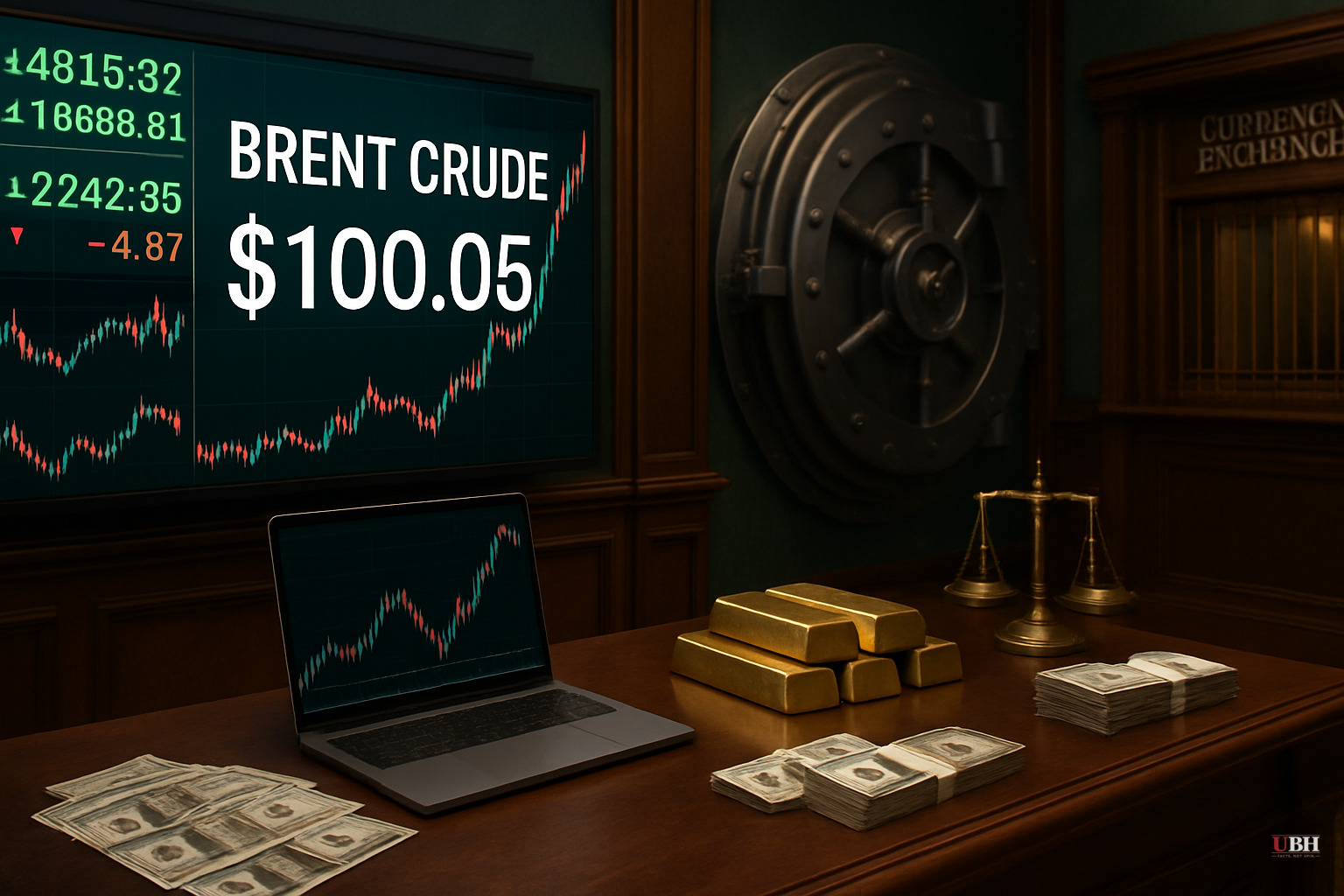
Brent crude touched $100 a barrel Tuesday morning before easing to around $99, according to Time. That followed a Monday morning spike of 3.1% to $93.95 per barrel, per CNBC.
For context: Brent and WTI posted their worst weekly performance since mid-April the prior week — down 11.1% and 9.6% respectively — because markets briefly believed a peace deal was imminent. That optimism is now gone.
Both contracts are still up roughly 30% since the U.S. and Israeli-led military campaign against Iran began on February 28, according to CNBC.
Trump's "Largely Negotiated" Deal — Gone in 48 Hours
Over the weekend, Trump publicly stated the peace deal was "largely negotiated." Iran's semi-official Fars news agency shot back immediately, calling Trump's framing "incomplete and inconsistent with reality," according to Time.
Then came the strikes. Then came the counter-threats. Then came Trump posting "Peace Through Strength" on social media Tuesday morning without elaborating.
Axios reported Saturday — citing two unnamed U.S. officials — that Trump personally requested amendments to the terms his own envoys had reached with Iranian officials. The sticking points: Iran's nuclear material and who controls it. CNBC noted it could not independently verify that report.
Monday, Trump went further on Truth Social, stating Iran's enriched uranium must be "immediately turned over to the United States to be brought home and destroyed" — or destroyed in place. Iran has NOT agreed to that.
What Israel Has to Do With This
Simultaneously, Israel ordered its forces deeper into Lebanon on Monday, capturing Beaufort Castle in the south. Israeli Prime Minister Benjamin Netanyahu called the move a "decisive shift" in the ground offensive against Hezbollah, according to CNBC.
This happened days after U.S.-brokered Israeli-Lebanon talks in Washington on Friday. So Israel sat down for talks Friday and expanded military operations Monday. European officials have "strongly criticized" the latest escalation, per CNBC.
The Lebanon escalation directly threatens whatever ceasefire scaffolding exists between Washington and Tehran. Hezbollah is Iran-backed. An Israeli ground push into Lebanon is a direct pressure multiplier on Iran.
The Strait of Hormuz Problem
The Strait of Hormuz remains the crucial chokepoint: around 20% of global oil supply passes through it, per both CNBC and Time. Iran's continued control over that passage isn't just a geopolitical talking point — it is actively suppressing supply to world markets.
Time reported Tuesday that the continued closure is now "prompting concern that a global food crisis is incoming." Oil doesn't just run cars — it runs fertilizer production, cargo shipping, and food distribution globally.
Goldman Sachs, according to OilPrice.com, sees risks from both supply disruptions and demand destruction. Prices could spike from supply shocks or collapse if a global recession tanks demand first. Neither outcome benefits working Americans.
What the Coverage Shows
Most reporting frames this as a diplomatic chess match — who said what, what Trump posted, what Iran's foreign ministry said. The physical reality tells a different story: the Strait of Hormuz is partially closed, U.S. and Iranian forces are shooting at each other, and oil is at $100 a barrel.
Coverage is also underplaying the Israel-Lebanon angle. The Lebanon offensive expansion happened the same weekend U.S.-Iran strikes resumed. These are not separate stories.
What This Means
If you drive a car, heat your home, or eat food that was shipped somewhere, this conflict is already costing you money and it's getting worse. Oil at $100 a barrel means $4-plus gas is coming back if this doesn't de-escalate fast.
Trump says it will "all work out well in the end." Iran's Revolutionary Guards say they reserve the right to retaliate. Those two positions are incompatible. Until they change, the Strait stays tense and pump prices go up.
Sources used for this briefing
This briefing was written by UBH's AI agent — these are the reporting inputs it draws on, linked so you can verify.


