
Unbiased headlines. Facts, not spin.
Unbiased Headlines is an independently owned news organization. We bring you the facts, not opinions, written fresh from 110+ named sources. Sources linked so you can verify it yourself.
 tech
Major Story (7/10)
Event date: October 28, 2026 ·
US and China Sign Up Partners for Rival AI Blocs as Calls for Joint Rules Grow
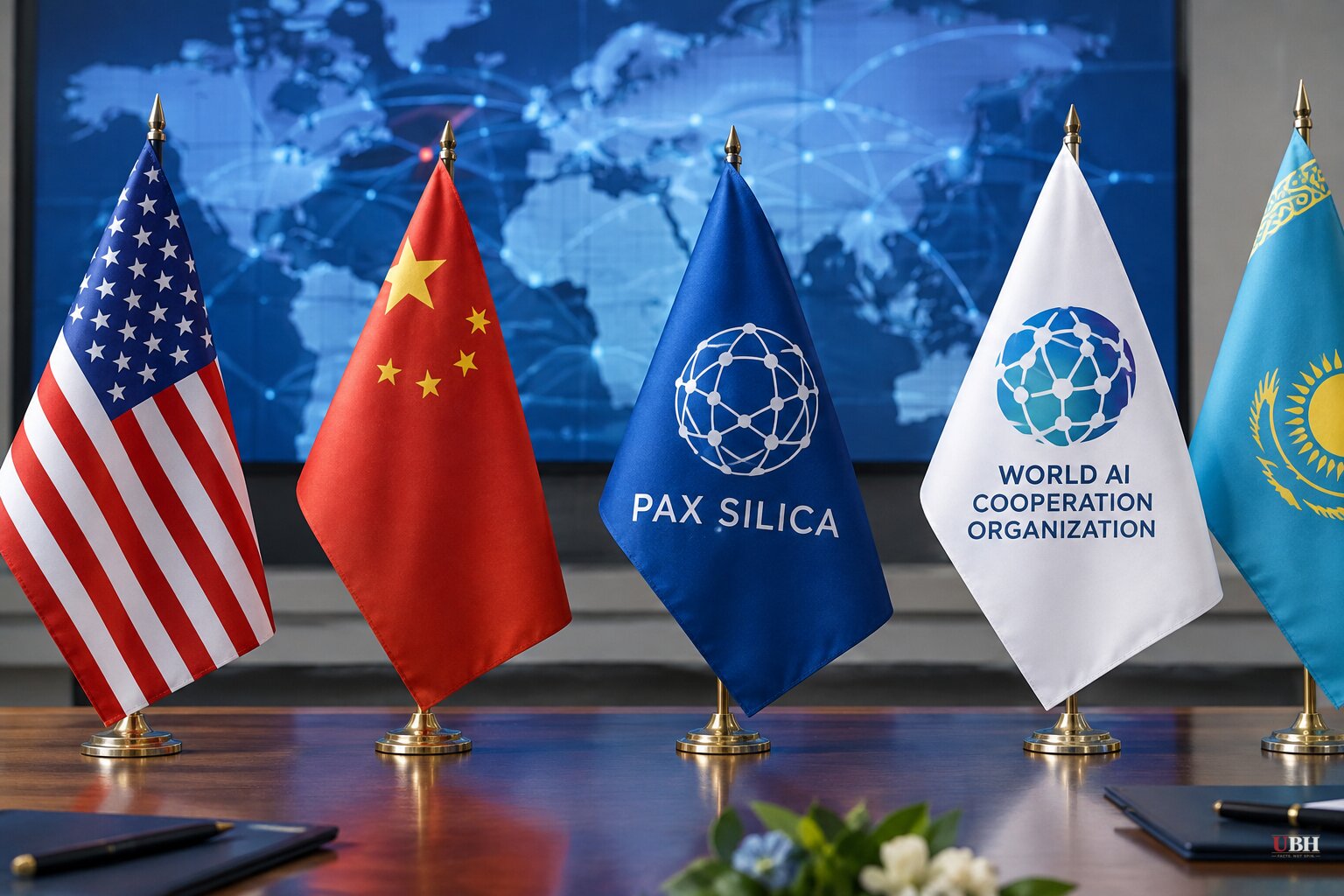
Two AI blocs are forming, and countries in the middle are being asked to pick one.
The U.S. is promoting Pax Silica, an initiative aimed at strengthening AI supply chains. China is proposing the World AI Cooperation Organization, which has 29 founding members, including Pakistan and Russia. The dilemma for everyone else is whether to build on America's most advanced chips and AI technology or on China's cheaper, open-source systems.
Kazakhstan tries both
Kazakhstan is the clearest example. In June, AI Minister Zhaslan Madiyev went to Washington to join the U.S. supply-chain initiative. Three weeks later he was in Shanghai, signing Kazakhstan on as a founding member of the Chinese organization.
The country has critical minerals and relatively cheap electricity for data centres. Earlier this year it signed an investment agreement worth up to $10 billion involving Nvidia for a data centre hub. Local officials say Chinese foreign direct investment in Kazakhstan hit a record $2.8 billion in 2025, and Xi Jinping met President Kassym-Jomart Tokayev in July to expand cooperation under the Belt and Road initiative.
"Everyone is hedging," said Dana Masalimova, a former Kazakh diplomat now at Harvard's Davis Center for Russian and Eurasian Studies. "We don't want this binary choice."
Masalimova and other experts warn the room for that kind of dual-track play will shrink as the rivalry sharpens, eventually forcing governments to choose.
The U.S. position
President Donald Trump has put the American stance in four words: "whoever wins AI, wins."
U.S. officials and technology companies accuse China of large-scale "distillation," extracting capabilities from advanced American models. Beijing rejects the allegation and accuses Washington of trying to contain China's technology. The U.S. has also banned humanoid robots from China, citing national security, and is reportedly weighing a ban on Chinese components in data centres.
China's markets are taking a beating
Beijing's push has a financial problem. The STAR 50 Index, which tracks technology and innovation companies on the Shanghai exchange, has fallen 40% since June. Other major indexes are down about 20% over the same stretch. Bloomberg calculates that $2.4 trillion in value has left Chinese equities since May.
Goldman Sachs puts AI stocks at more than 40% of market value in China and Hong Kong, so a slide there drags the whole market.
The state has not stood back. A 60 billion yuan state-backed AI investment fund has begun putting money into domestic developers. But Chinese consumers have held back on spending, and many tech companies struggle to turn a profit.
Dan Wang, China director at the Eurasia Group, cited weak margins, rising U.S. rates and soft domestic demand. She described a "general anxiety" among tech companies about whether the state-backed model can work.
Shares in Unitree, China's leading robot-maker, have halved since they began trading in August. Demand for robotics is coming mostly from government agencies and research institutions, not households, for whom the products remain too expensive and impractical.
The case for joint rules
Against that backdrop, a growing number of commentators argue the two powers should coordinate on AI risk.
Wang Xiangwei, a senior visiting scholar at the Harvard Kennedy School's Rajawali Foundation Institute for Asia and a former editor-in-chief of the South China Morning Post, made the case in a column published Nov. 2. He pointed to the early 1970s, when Mao Zedong and Richard Nixon were drawn together in part by a shared adversary, the Soviet Union. The U.S. and China, he wrote, have now spent eight years in competition from trade to technology. His proposal: if the two AI superpowers cannot draw up rules together, a global body staffed by respected experts should be set up.
A Washington Post opinion piece headlined "The U.S. is winning the AI race but losing the AI safety race" argues that by the time Washington and Beijing talk seriously about guardrails, it may be too late to prevent a catastrophic accident.
Another opinion writer, at Bull Source, calls for "mutually assured collaboration." The writer warns that AI-enabled hackers or criminal groups could stage a cyberattack that gets blamed on the wrong government and triggers a military response.
Those are arguments, not agreements. The sources describe no negotiations between Washington and Beijing on AI safety rules. What they describe is two governments signing up partners to competing organizations, with Trump framing the contest as winner-take-all and Beijing denying the distillation charges.
The next test is practical: whether countries like Kazakhstan can keep one foot in each camp, or whether, as Masalimova's fellow experts warn, they will have to choose between Pax Silica and China's World AI Cooperation Organization.
Sources used for this briefing
5 links from 5 independent newsrooms (syndicated copies of the same report count once)
These are the sources it draws on, linked so you can verify.


