
Unbiased headlines. Facts, not spin.
Unbiased Headlines is an independently owned news organization. We bring you the facts, not opinions, written fresh from 110+ named sources. Sources linked so you can verify it yourself.
 tech
Notable (6/10)
Event date: October 31, 2026 ·
Google's Suncatcher Satellite Runs an AI Prompt in Orbit and Returns a Haiku
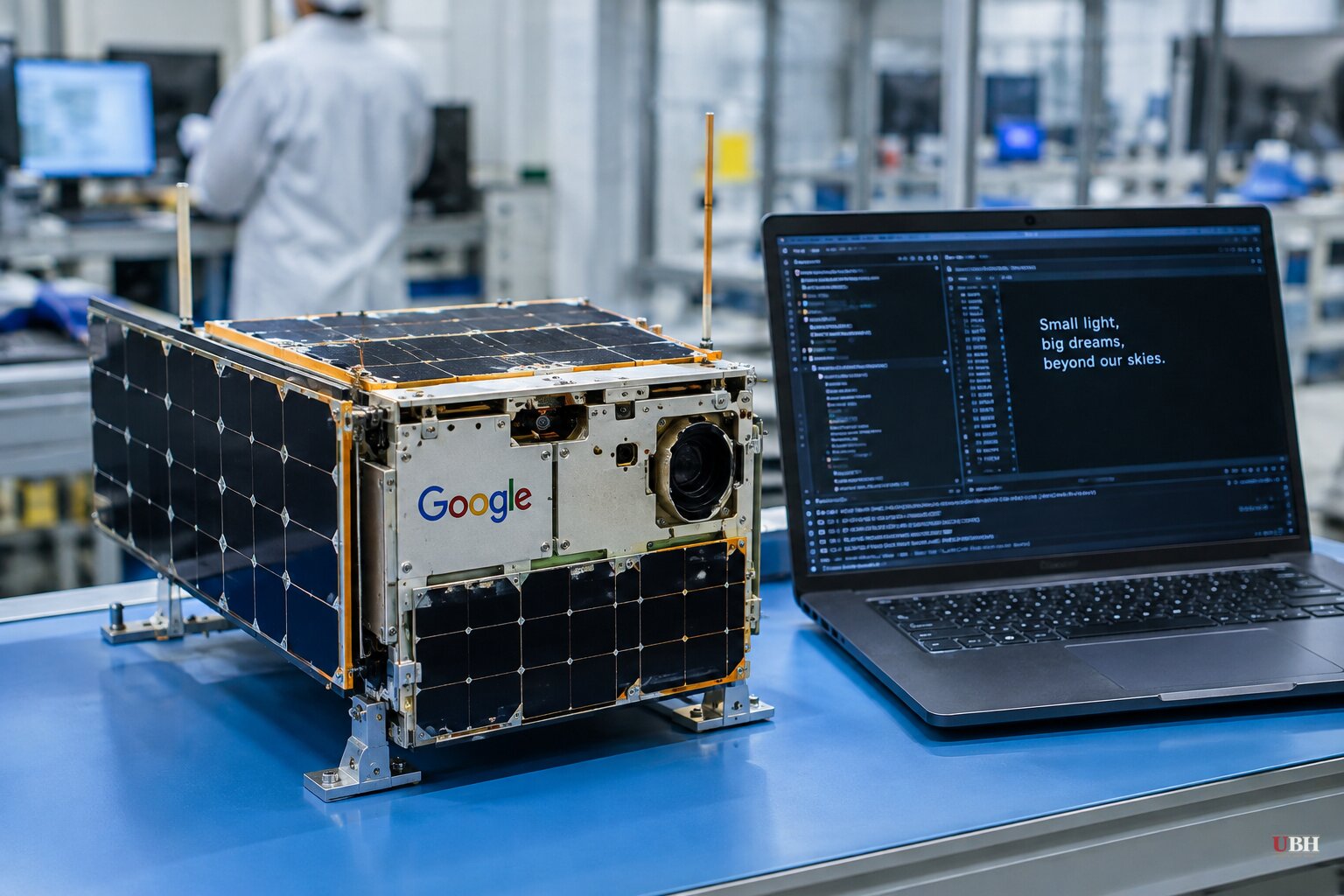
Google says it has run an AI model on one of its data-center-class chips in orbit and gotten an answer back to Earth. The answer was a haiku.
The company disclosed the result Oct. 30 in a blog post by Travis Beals, a senior director at Google. CEO Sundar Pichai followed on X, calling it a "'hello world' milestone for Project Suncatcher."
What the satellite did
The prototype launched Oct. 1 on a SpaceX Falcon 9 on the Transporter-18 rideshare mission, alongside more than 100 other spacecraft. Google built it with Planet.
It carries four of Google's Tensor Processing Units, the custom chips the company uses for AI workloads. Beals said the team spent weeks on a commissioning checklist that included powering up the host computer and TPU trays and running early machine learning tests. A Google spokesperson told TechCrunch the satellite is working normally.
Then came the prompt. During a ground-station pass, engineers uplinked a request to Gemma 4, an open model from Google DeepMind that was loaded on the satellite before launch. The request: write a haiku about being in space. The reply was downlinked as the satellite passed over Svalbard, Norway:
"Blue marble below / Data streams in silent grace / Starlight feeds my core."
The team then tried space-themed limericks and prompts asking the model to report the technical status of the payload systems.
A narrow claim
Google's claim is specific. Beals called it "the first-ever AI response from a data center class TPU in orbit." He did not say it was the first AI model of any kind to run in space.
What the satellite did was inference: running an already trained model on a new input. It was not training. Google's post contains no speed, efficiency or throughput figures.
The power problem
The satellite generates up to 1 kilowatt of electricity. That is enough to run one of the four TPUs at a time, for about 20 minutes, according to TechCrunch. Those windows also have to line up with ground-station contact.
Omar Sanseviero, who works on Gemma at Google DeepMind, wrote on X that the model ran on stored solar energy.
One chip, 20 minutes, one poem. That is a long way from a data center.
The tests that matter
The haiku shows the hardware turned on and talked. It does not show it can survive.
Beals wrote that Google will "continue with a series of tests to evaluate how TPUs perform under thermal stress and radiation exposure in orbit." Cosmic rays and solar particles can cause bit flips, where a value in memory changes and corrupts data without tripping ordinary checks.
Google has already blasted its chips in particle accelerators on the ground. Those tests suggested radiation is less of a problem for running models than for training them, according to TechCrunch. The Register reported that the lab work found high-bandwidth memory especially sensitive.
Ground simulations cannot fully reproduce months of orbital heating, deep cooling and random particle strikes. That gap is what the satellite is meant to measure.
Skeptics and rivals
Google is not alone, and not everyone is convinced. Startup Starcloud raised $250 million in August for orbital data centers, according to The Next Web's account.
SpaceX, the company that launched Google's satellite, has told investors its own orbital data centers may never work, TechCrunch reported. TechCrunch also reported that Google's longer-term plans depend on SpaceX making its Starship rocket fully reusable. Neither Google's post nor its announcement addresses that dependency.
Google's stated goal is to find out whether space-based compute is possible at all. The idea behind Suncatcher is that orbiting computers could run on near-constant sunlight rather than on strained ground power supplies. Nothing in the announcement says the economics work, and Google has not published cost figures.
What comes next
Google announced the launch in September. The next milestone it has named is "twin interconnected satellites in 2027," which TechCrunch reported will generate more power and test laser links between spacecraft.
"Our chips have officially earned their space wings," Beals wrote.
Whether those chips keep producing reliable answers after sustained radiation and thermal stress is the open question. Google has not said when it will publish results from that testing.
Sources used for this briefing
7 links from 6 independent newsrooms (syndicated copies of the same report count once)
These are the sources it draws on, linked so you can verify.


