
Unbiased headlines. Facts, not spin.
Unbiased Headlines is an independently owned news organization. We bring you the facts, not opinions, written fresh from 110+ named sources. Sources linked so you can verify it yourself.
 tech
Major Story (8/10)
Event date: October 31, 2026 ·
Alphabet Search Falls Below Half of Revenue as Google Cites AI Mode and Currency for the Slowdown
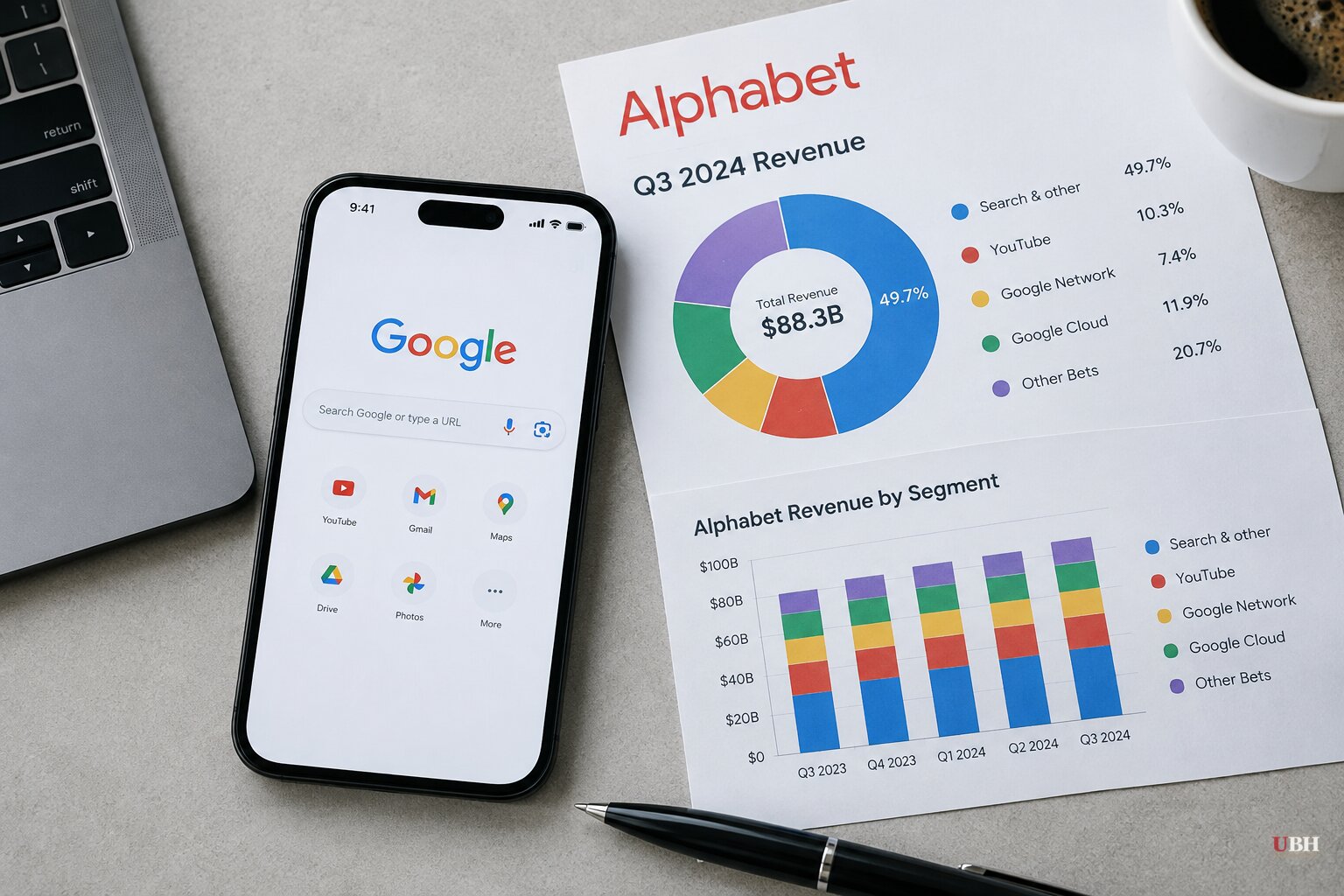
Since Alphabet reported third-quarter results on Oct. 28 and the stock fell 12.6% on Oct. 29, the detail in the filing has shifted the debate from spending to the product that pays for it: Search.
Google Search and other revenue grew 12% to $63.35 billion, below the $64.85 billion analysts expected. That was the second straight quarterly miss for the segment. Growth has slowed from 19% in the first quarter and 17% in the second.
Search made up about 49.7% of Alphabet's $127.58 billion in revenue. A year earlier it was 55.3%, or $56.57 billion of $102.35 billion. It is the first quarter in which the core business came in under half of the total, according to Dealroom's calculation from the company's figures.
Usage up, revenue per query in question
Alphabet said search query growth was the strongest in five years. Revenue did not keep pace.
Chief Business Officer Philipp Schindler told investors on the earnings call that rapid growth in AI Mode, Google's conversational search feature, weighed on results because of "the lower monetization we were seeing in AI Mode." CEO Sundar Pichai said AI Mode queries run about three times longer than traditional searches, and one in five globally uses voice, images or documents.
Alphabet executives also gave a second explanation. They said foreign exchange was the biggest factor behind the slowdown in search revenue, and that the currency hit would be larger in the fourth quarter.
Schindler said Gemini is helping the ads business. He called the third-quarter update to product listing ads the "biggest update to product listing ads in a decade," and said Gemini models helped advertisers generate more than 1.5 billion campaign assets, up more than sevenfold from a year earlier.
Gene Munster of Deepwater Asset Management told CNBC's "Fast Money" that if personalized AI bots take off, they "will become for a lot of people the starting point of commerce, which impacts where Google is." Analysts at UBS, per the same coverage, expected the results to prompt a broader debate about AI's effect on search.
Cash burn and borrowing
Free cash flow was negative $9.07 billion, against the roughly negative $2.7 billion analysts forecast. The second quarter was negative $5.9 billion, the first negative quarter since Alphabet went public in 2004.
Capital spending was a record $51.36 billion. That was still below the $55.09 billion analysts expected, so the cash shortfall is not simply a case of spending running over forecasts.
Operating income of $40.58 billion also missed the $43.19 billion estimate. Net income fell to $26.17 billion from $34.98 billion a year earlier. Investing.com analyst Thomas Monteiro said the headline miss was driven largely by financial rather than operating losses, but added: "operating profit also came up short and that matters more." He said that until now, AI spending hit cash flow, but this quarter it began showing up in profits too.
Long-term debt reached $125.1 billion, up from $21.6 billion a year earlier. Alphabet has paused share buybacks in 2026 and, according to The Motley Fool's reading of the filings, raised $40 billion in the third quarter alone through debt and equity. The company has disclosed purchase commitments above $1 trillion, including $924 billion in infrastructure and energy obligations and $152 billion in leases.
Management's answer
Alphabet held its 2026 capex guidance at $195 billion to $205 billion. CFO Anat Ashkenazi said spending will "increase significantly" in 2027. Several accounts put the figure above $300 billion, though the company has not published a 2027 number.
Ashkenazi defended the build-out directly. "Throughout this investment cycle, we expect to generate an attractive ROIC that remains meaningfully above our cost of capital and anticipate generating strong cash flow from operations," she said on the call.
The Cloud numbers are the evidence management points to. Cloud revenue rose 103% to $30.71 billion from $15.16 billion, and Cloud operating income rose to $11.12 billion from $3.59 billion. New Cloud chief Thomas Kurian cited "extraordinary demand" from AI labs, financial institutions and enterprises.
The Motley Fool noted that Berkshire Hathaway initiated a position in Alphabet last year that has grown to its fourth-largest marketable equity holding. It presented that as support for the long-term return thesis.
Where the stock stands
The Oct. 29 drop erased roughly $500 billion in market value, taking it from about $3.97 trillion to $3.46 trillion, according to the BBC's figures. The previous record one-day decline was 11.63% in March 2020.
The selling did not reverse on Friday. GOOGL closed Oct. 30 at $279.84, down 1.40%, with a market value of about $3.42 trillion.
The next test is the fourth-quarter call, where Alphabet is expected to put a number on 2027 capital spending. Executives have already said currency will weigh more heavily on Search revenue in that quarter.
Sources used for this briefing
7 links from 7 independent newsrooms (syndicated copies of the same report count once)
These are the sources it draws on, linked so you can verify.


