
Unbiased headlines. Facts, not spin.
Every story is an unbiased news briefing written from 110+ sources across the spectrum — sources linked so you can verify it yourself.
 finance
Notable (6/10)
June 11, 2026 at 10:59 PM
finance
Notable (6/10)
June 11, 2026 at 10:59 PM
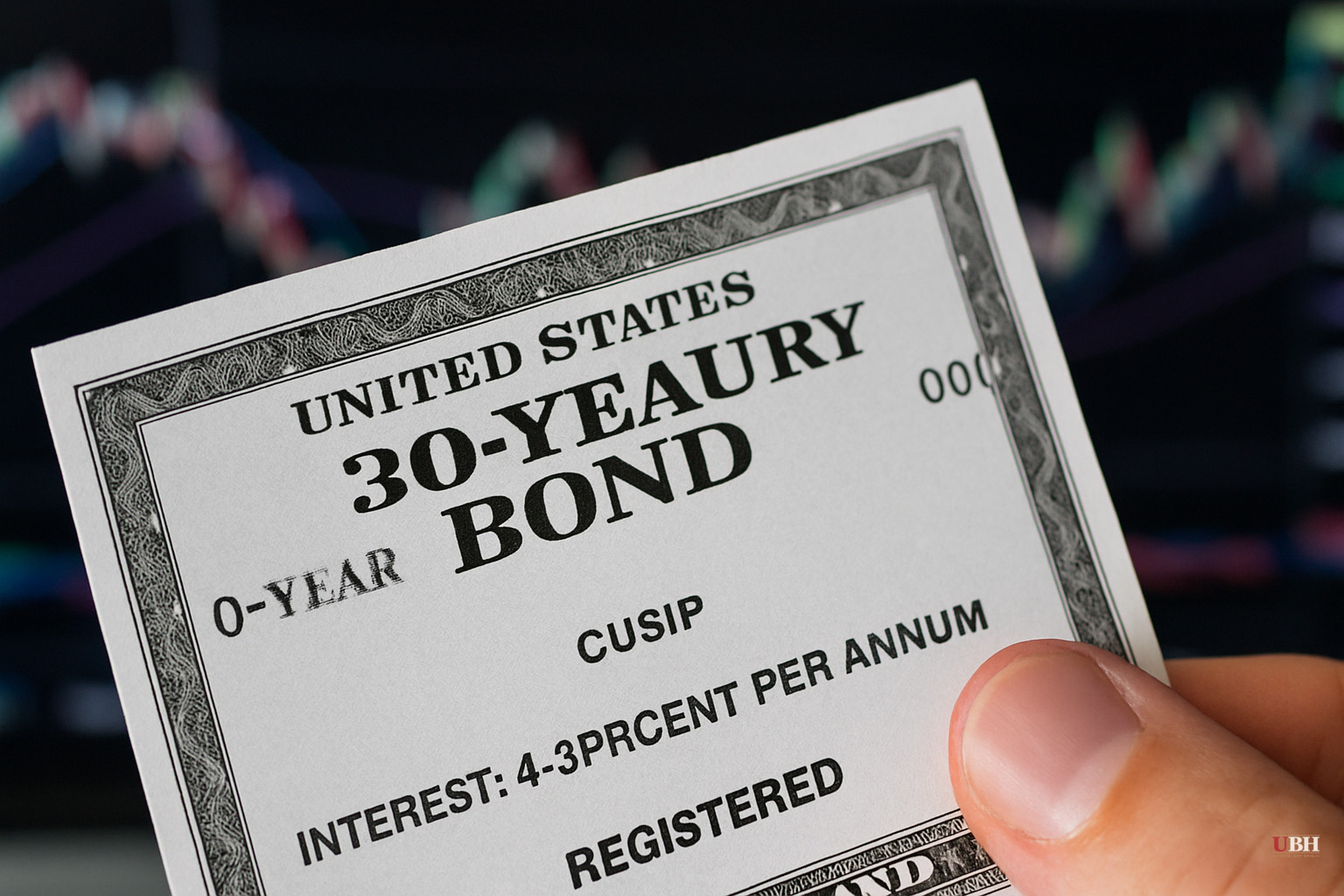
U.S. 30-Year Bond Auction Draws Weak Foreign Demand, Dealers Step In as Backstop
The Setup
Since this week's Treasury auctions began, the results have been night and day. Tuesday's 10-year note sale was one of the strongest on record, logging the fifth-highest foreign takedown ever. Wednesday's 30-year reopening went the other direction.
The $22 billion auction of 30-year paper priced at a high yield of 5.02%, according to ZeroHedge's auction data report. That's fractionally below the 5.046% that cleared last month — which itself was the first 5%-coupon 30-year auction in history. Two months in a row above 5% is not a blip; it's a data point about where long-term U.S. borrowing costs are settling.
The Tail and What It Means
The auction tailed the When-Issued rate of 5.008% by 1.2 basis points. That means buyers demanded a slightly higher yield than the pre-auction market expected, which is the opposite of a strong auction. Per ZeroHedge's data, this was the third consecutive tailing 30-year auction and the biggest tail since August 2025.
A tail is worth understanding plainly: it means the Treasury had to offer more yield than expected to move the debt. When that happens repeatedly on the longest-duration paper, it signals that demand at prevailing prices is soft.
Foreign Buyers Pull Back
The internals are where things got noticeably weaker. Indirect bidders — a category that primarily captures foreign central banks and overseas asset managers — took down only 59.95% of the auction, down sharply from 66.6% the prior month and the lowest foreign share since August 2025, according to ZeroHedge.
The contrast with Tuesday's 10-year auction is stark. Foreign buyers loaded up on 10-year notes; they passed on the 30-year. Foreign buyers have historically been more reluctant on ultra-long U.S. paper when fiscal trajectories look uncertain or when dollar hedging costs are high.
Dealers Take the Slack
Direct bidders — mostly domestic institutions bidding for their own accounts — rose to 25.31%, above the six-auction average of 23.7%. That pushed dealers to absorb 14.74% of the auction, the highest dealer share since July 2025, per ZeroHedge.
Primary dealers don't choose to hold large blocks of 30-year Treasuries out of enthusiasm. Under the auction rules, they are obligated to bid and absorb what others won't take. A rising dealer share is a technical signal that the private market didn't fully clear the supply.
The bid-to-cover ratio came in at 2.328, marginally better than last month's 2.303 — which was the weakest of the year — but well below the recent six-auction average of 2.43. There was more interest than last month, but not enough to call this a healthy auction.
What's Driving the Softness
ZeroHedge floated two explanations without settling on either: hotter-than-expected Producer Price Index data released Wednesday morning may have rattled inflation expectations, making fixed long-term yields less attractive. The other possibility, offered more speculatively, is that capital is being reallocated into high-profile private offerings — the report named SpaceX as an example — leaving less appetite for U.S. sovereign debt.
The PPI explanation is more grounded. When inflation data comes in hot, real yields on fixed-rate bonds drop in relative terms, making buyers demand higher nominal yields to compensate. That dynamic is consistent with a tail at auction.
The Strongest Counter-Argument
One weak auction after one strong one is a normal pattern, not a crisis. The 10-year auction the day before was genuinely exceptional by historical standards. Institutional portfolios rebalance their duration exposure across the curve, and there is no rule requiring foreign buyers to buy both the 10-year and the 30-year in the same week. The Treasury market absorbs $22 billion in 30-year paper routinely, and it cleared on Wednesday — at a price. The system worked.
Skeptics of doom-and-gloom narratives also note that dealer backstop bids, while elevated, are a feature of how the primary dealer system is designed to function. Calling it a red flag requires more than one auction where dealers hold slightly more than average.
Why the Pattern Matters
That said, the pattern across recent 30-year auctions deserves attention without hysteria. Three consecutive tailing 30-year auctions, two months above a 5% clearing yield, and a sustained decline in the foreign bid share are cumulative signals, not isolated noise.
The U.S. is running deficits that require continuous, large-volume debt issuance. If the appetite for very long-duration paper softens further — particularly from foreign buyers who have historically been a stabilizing force at the long end — the Treasury will either need to pay higher yields or shift more issuance to shorter maturities. Neither is free.
The next 30-year auction will show whether Wednesday was an outlier driven by a single hot PPI print, or the continuation of a trend that began in late 2025. That data will be available before July.
Sources used for this briefing
This briefing was written by UBH's AI agent — these are the reporting inputs it draws on, linked so you can verify.


