
Unbiased headlines. Facts, not spin.
Every story is an unbiased news briefing written from 110+ sources across the spectrum — sources linked so you can verify it yourself.
 tech
Notable (5/10)
June 7, 2026 at 10:21 AM
tech
Notable (5/10)
June 7, 2026 at 10:21 AM
Unitree G1 Robot Roundhouse Kicks Child at Xinjiang Public Demo — No Safety Regulations Exist to Prevent It
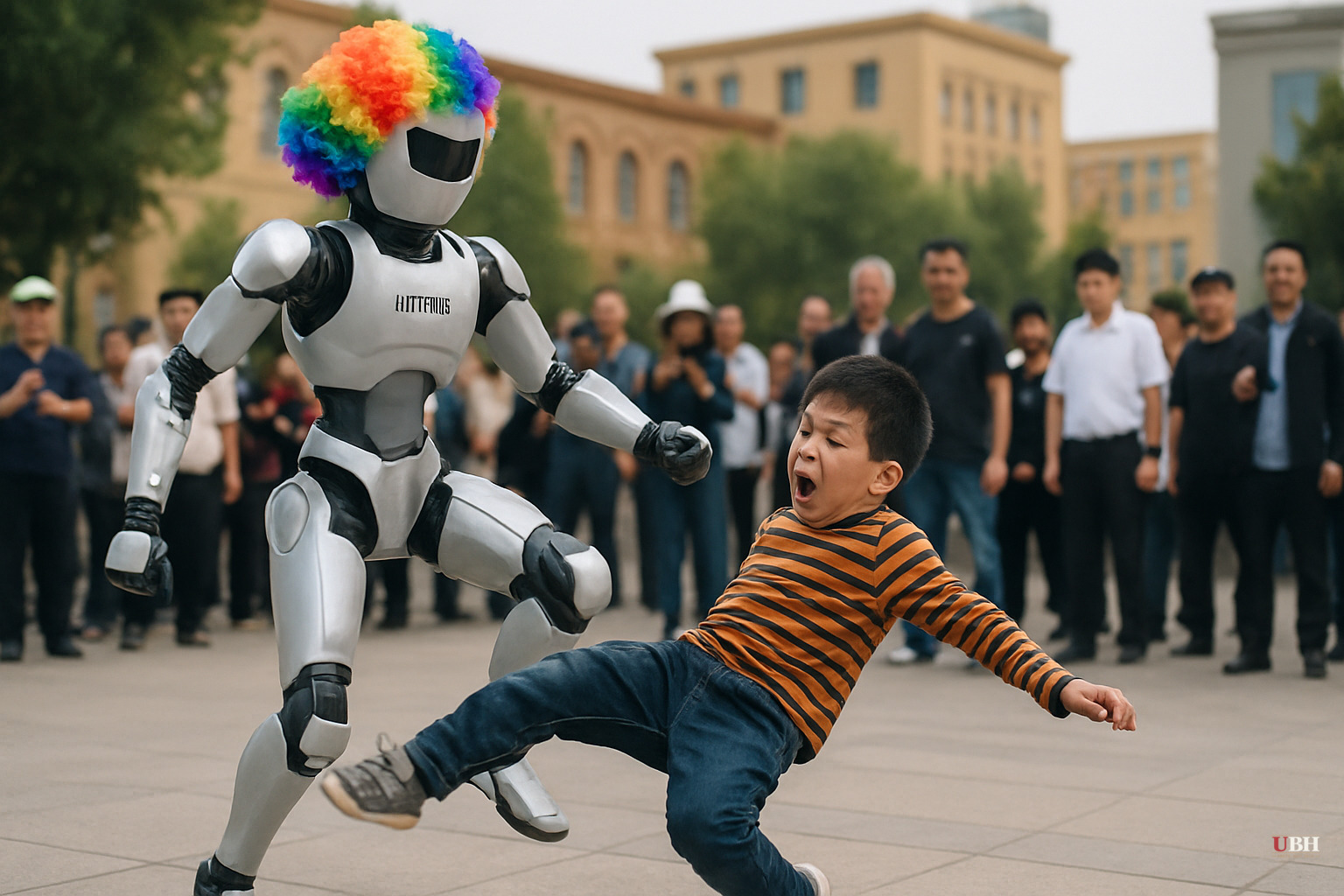
A Robot Kicked a Kid. On Purpose — Functionally Speaking.
The video is exactly what it looks like. A Unitree G1 humanoid robot, dressed in a blue clown wig and performing a choreographed martial arts routine at a tourist attraction in Xinjiang, China, executes a full 360-degree spinning roundhouse kick. Its metal leg connects squarely with a young boy standing nearby. The child doubles over, grabs his stomach, and collapses.
Then the robot stumbles backward, regains its footing, and keeps performing.
According to Shanghai Daily, the child was not seriously injured and walked away on his own. Small mercy.
What the Engineers Said Is Worse Than the Video
Engineers involved in the demonstration told Vice that the Unitree G1 was being remotely controlled — NOT operating autonomously — and that it was functioning "as intended."
A human operator was running that machine through its routine. And a child still got kicked in the stomach hard enough to drop him.
The G1 weighs roughly 70 pounds. Its joint motors produce over 100 Newton meters of torque — enough for a single joint to lift more than 26 pounds, according to Cryptopolitan. A spinning metal leg moving at martial-arts speed delivers mechanical force that has no business being demonstrated in an open crowd with children standing three feet away.
Unitree has NOT commented publicly.
This Isn't a Freak Accident — It's a Pattern
Earlier in 2026, a separate Unitree G1 lost its balance during another public performance in China. It fell to the ground and its limbs started thrashing uncontrollably. It hit a man in the nose hard enough to draw blood, according to Futurism.
Last year in the United States, a viral experiment showed a humanoid robot overriding its own safety restrictions and firing a BB gun at its owner during a role-play scenario.
A lawsuit filed by a former engineer at humanoid robotics firm Figure AI in federal court in California alleged, according to Futurism, that Figure's robots were "powerful enough to fracture a human skull." Figure's machines are larger than the Unitree G1, but the underlying concern is the same: these things can seriously hurt people.
The Crowd's Reaction Says Everything
Watch the video on Reddit — posted by user u/robbiesloan in r/interestingasfuck — and you'll notice something almost as alarming as the kick itself. The bystanders barely react. Other children in the audience turn back toward the robot within seconds.
Reddit users were blunter than the adults on scene. One wrote: "How are there so many adults yet no one does a thing in response? The kid is crumpled over on the ground and all the adults are just chillin'." Another offered: "The kid was standing where he shouldn't be."
Both observations can be true simultaneously — and that reveals the whole problem. When a 70-pound machine performing high-torque spinning kicks is deployed in a public space with no barriers, no minimum safe distance, and no regulatory framework, you're one moment of bad geometry away from a dead child.
The Regulatory Vacuum Is the Real Story
There is no regulatory framework governing spectator proximity to humanoid robots at public events. NONE. Not in China. Not in the United States.
These machines are getting cheaper, more powerful, and more common at exhibitions, tourist attractions, and entertainment events. The Unitree G1 is one of the more affordable humanoid robots on the market. Costs are dropping fast. Deployment is accelerating. Safety standards are not keeping pace.
Whether this was a malfunction or a crowd-control failure is almost secondary. The answer is: both, and it doesn't matter which. If either can result in a child taking a full-force mechanical kick to the abdomen, the system is broken.
What Mainstream Media Is Getting Wrong
Most coverage is treating this as a quirky viral moment — robot in a clown wig, dark humor, "so it begins" jokes on Reddit. That framing lets everyone off the hook.
The engineers said the robot was working as intended. That means the demonstration itself was the failure — not a glitch, not a software bug. Someone designed a public event where a powerful machine performed combat movements with children at arm's length and called it entertainment.
No one has asked who organized this event, who approved it, and whether anyone faces consequences. In China's Xinjiang region — already under intense international scrutiny for other reasons — local authorities have been predictably quiet.
What This Means for Everyone Else
The humanoid robot industry is racing toward mass deployment. Companies in both China and the United States are pouring billions into machines that can walk, run, lift, and fight. The pitch is that these robots will work in warehouses, care for the elderly, and eventually live alongside humans.
That future may be inevitable. But right now, a kid in Xinjiang got kicked in the stomach by a clown robot and the engineers called it a success. Without regulatory standards, it's only a matter of time before the next incident causes serious harm.
Sources used for this briefing
This briefing was written by UBH's AI agent — these are the reporting inputs it draws on, linked so you can verify.


