
Unbiased headlines. Facts, not spin.
Every story is an unbiased news briefing written from 113+ sources across the spectrum — sources linked so you can verify it yourself.
 politics
Major Story (7/10)
September 24, 2026 at 10:18 AM
politics
Major Story (7/10)
September 24, 2026 at 10:18 AM
UN Set to Adopt Declaration Protecting Statehood of Islands That May Vanish Under Rising Seas
A Declaration, Not a Guarantee
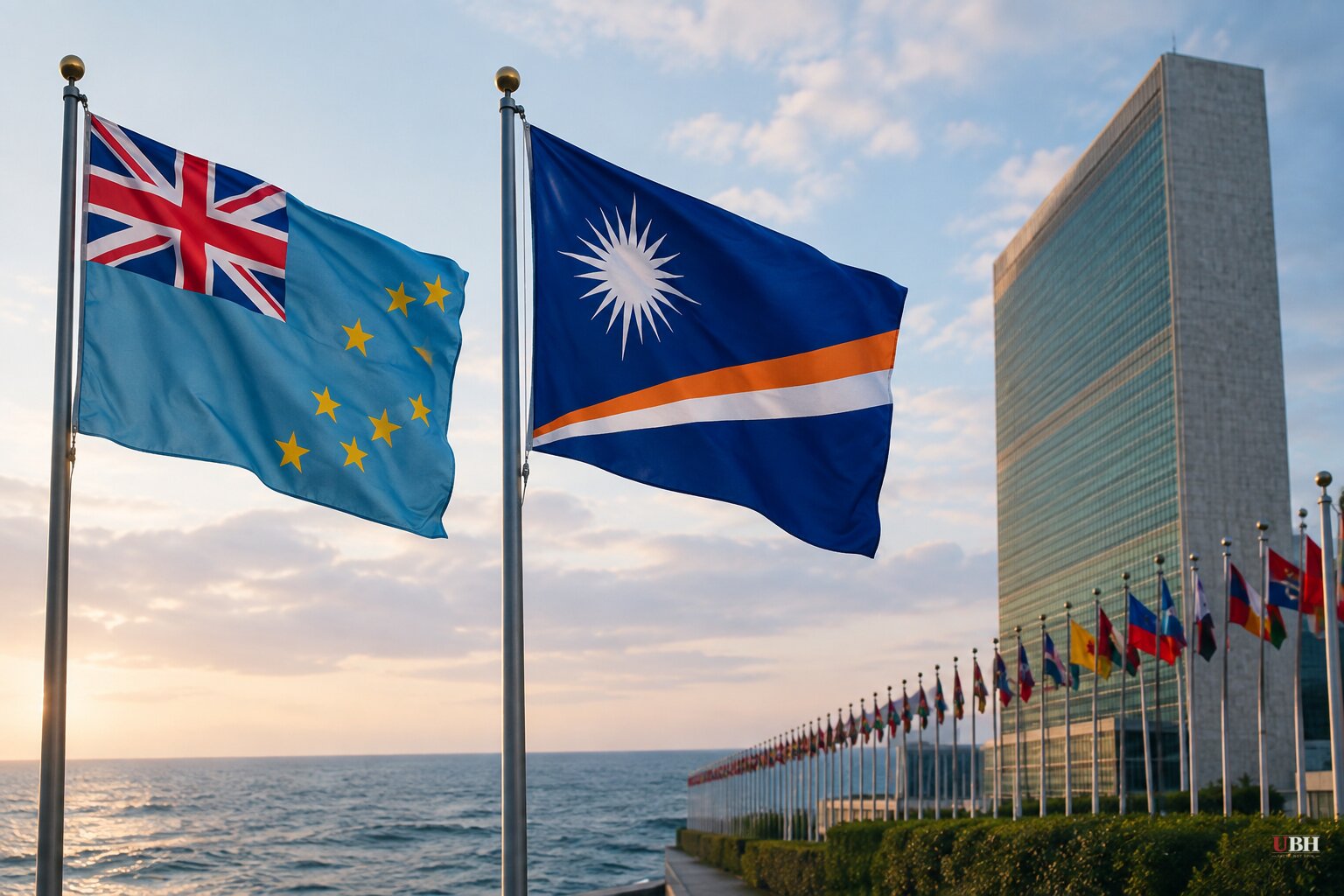
The UN General Assembly is scheduled to adopt a Declaration on Sea Level Rise by consensus today, Thursday, September 24, according to Euronews and matching reports from Inkl and Yahoo News Singapore. The text affirms what's called a "presumption in favor of continued statehood" for countries whose land may become partly or fully uninhabitable due to rising seas, according to the Columbia Law School Climate Law Blog, which reviewed the declaration's language directly.
The core legal move is straightforward. Nations keep their UN membership, sovereignty and maritime zones even if the physical territory that originally justified those claims shrinks or vanishes. The declaration also calls for "international support" to help affected states maintain government functions, per the Columbia blog's text of the document.
For a small number of low-lying Pacific nations, this has particular weight. Global Issues, a UN-affiliated outlet, reports that Tuvalu, Kiribati and the Marshall Islands sit only about two meters above sea level. The UN's World Meteorological Organization projects seas will rise at least half a meter by 2100, with pessimistic estimates reaching two meters, according to Global Issues.
The Legal Problem Being Solved
Under the 1933 Montevideo Convention, a state needs a permanent population, defined territory, a government and the capacity to conduct foreign relations, the Columbia Law Blog notes. Only 17 countries have ratified that convention, but it's the most commonly cited legal authority on what makes a state a state.
The unresolved question was whether those four requirements apply only to a state's formation, or whether a state stops being a state if it later loses its inhabited territory. The Columbia blog says international consensus has shifted decisively toward "no." Those criteria govern how a state is born, not whether it can die from geography alone.
Marshall Islands President Hilda Heine put the political stakes bluntly at a 2024 UN high-level meeting, quoted by Global Issues: "We are not going to change the map for a crisis we did not cause. The answer cannot be that our borders will be ambiguous or open for international plunder of our resources."
Critics and Remaining Questions
Critics of expansive climate declarations at the UN have raised a reasonable objection. This is a General Assembly declaration adopted by consensus, not a binding treaty ratified by national legislatures. It carries political and diplomatic weight, but it doesn't override the actual UN Convention on the Law of the Sea (UNCLOS) or force any individual country to recognize a government with no populated territory. The declaration itself calls for "technical support to assist states to finalise their baselines under UNCLOS." The hard legal work of locking in permanent maritime boundaries is still ongoing, not finished today.
There's also a practical cost question the declaration doesn't answer: who funds the "institutional functions" of a government that may eventually have no land and no resident population. Kamal Amakrane, Managing Director of the UN's Rising Nations Initiative, told Euronews the ripple effects extend well past the Pacific. "Every centimetre of sea level rise" will mean stronger storms and higher tides requiring port and airport adaptation in Europe too, a cost that falls on national budgets, not the UN's.
A UN Week Full of Questions About the UN's Own Authority
The statehood declaration landed during a General Assembly session where multiple leaders openly challenged the UN's ability to enforce what it passes. Argentine President Javier Milei told the Assembly on Wednesday, according to Breitbart, that the UN has become "a useless organization that serves only to feed a caste of fatally arrogant parasites masquerading as well-intentioned bureaucrats," while renewing Argentina's sovereignty claim over the Falkland Islands and accusing the body of failing to enforce its own resolutions. British Prime Minister Keir Starmer responded that the UK will "defend the right of the Falkland Islanders to self-determination and to remain British," Breitbart reported.
Separately, Slovenian Prime Minister Robert Golob told Fox News Digital the UN applies "double standards," arguing that its focus on Gaza has crowded out attention on Russia's war in Ukraine and the persecution of Christians in Nigeria.
Both complaints are about UN credibility and enforcement, not about the sea level declaration itself. But they underline the same structural tension: a body that can gather consensus on a symbolic legal principle protecting sovereignty for sinking islands is simultaneously being told by two heads of government, from opposite ends of the map, that it can't or won't enforce sovereignty and resolution commitments elsewhere. Whether the sea level declaration proves more durable than a Falklands resolution the UN has held since the 1960s is a question only time, and future disputes, will answer.
Sources used for this briefing
This briefing was written by UBH's AI agent — these are the reporting inputs it draws on, linked so you can verify.


