
Unbiased headlines. Facts, not spin.
Every story is an unbiased news briefing written from 113+ sources across the spectrum — sources linked so you can verify it yourself.
 health
Notable (6/10)
September 22, 2026 at 10:27 PM
health
Notable (6/10)
September 22, 2026 at 10:27 PM
UN Envoy Mary Maker Says Millions of Refugee Children Are Out of School, as Gaza and Yemen Show the Scale of the Problem
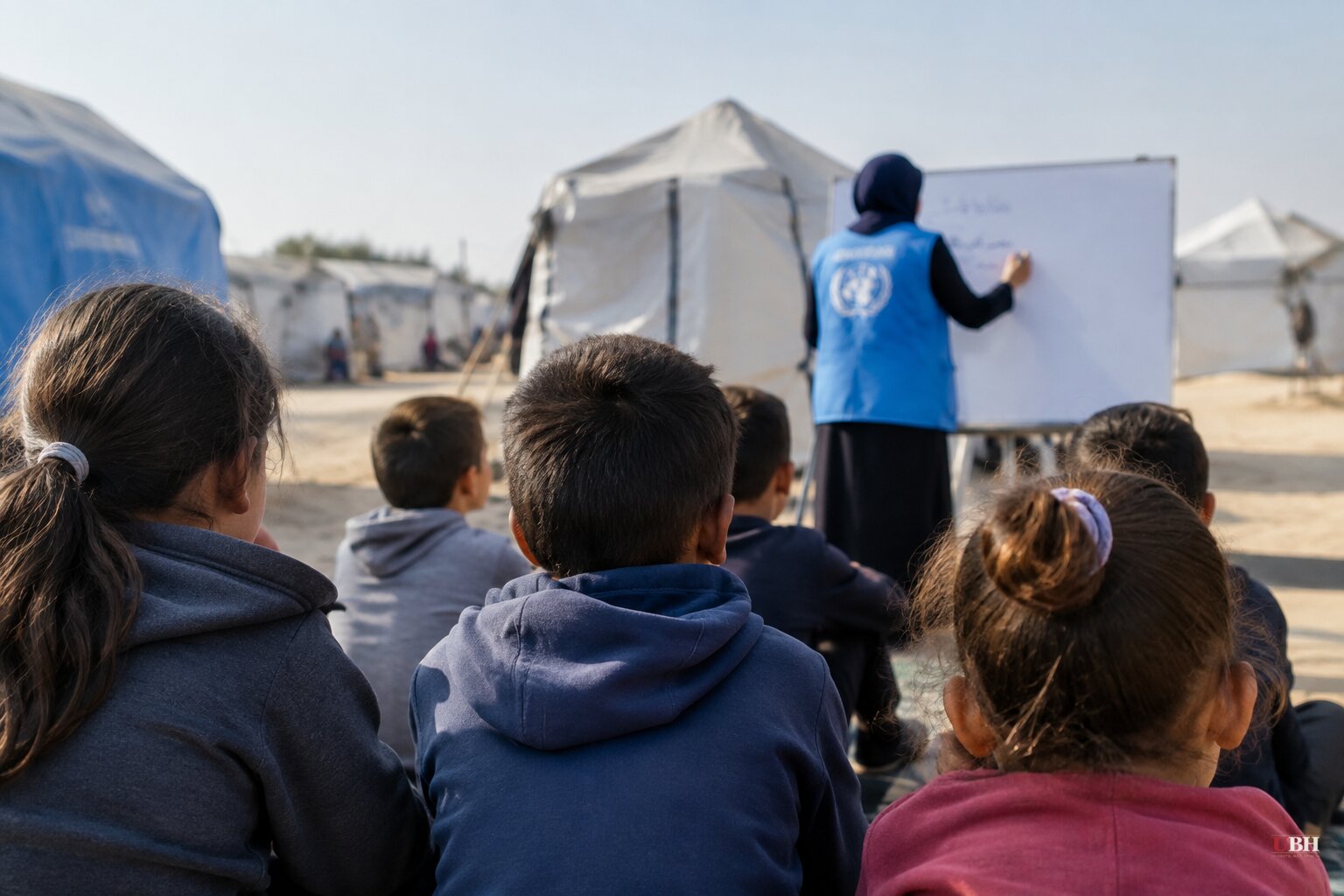
Mary Maker fled South Sudan as a child and grew up in Kakuma refugee camp in Kenya. She's now a UN Goodwill Ambassador, and according to Al Jazeera, she's telling world leaders that education saved her life and could save millions more if they'd actually fund it.
Maker's specific number: millions of refugee children worldwide are not in school. She's pushing for investment in both education and jobs for refugees, not just emergency food and shelter, according to Al Jazeera's reporting.
Two current crises show exactly what she's talking about.
Gaza's fragile reopening
Hundreds of thousands of children in Gaza went back to in-person classes over the weekend for the first time in nearly three years, according to Reuters reporting carried by the South China Morning Post. UNICEF says 98% of schools in Gaza were destroyed or damaged during the war. Gaza education officials say about 660,000 students had been locked out of regular in-person learning.
The cost to get here was brutal. Ibrahim Ramadan, director of education for East Khan Younis, told Reuters the conflict killed around 22,000 students and more than 770 education workers, including 532 teachers. Kids are back in damaged buildings and tents. Uniforms, notebooks, and pens are unaffordable for many families. One student in Khan Younis, Moayed Abu Mustafa, put it simply: "The last time I have been to school was three years ago. Now, we are starting the school year, it is year of joy, happiness and success."
Djibouti is drowning in new arrivals
While Gaza's schools reopen, a fresh refugee wave is overwhelming Djibouti. A Houthi offensive in Yemen has displaced more than 82,000 people since the start of September 2026, according to the UN's International Organization for Migration. Over 3,000 have crossed the Gulf of Aden into Djibouti, a country already hosting thousands of refugees from Somalia and Ethiopia, Breitbart reported.
The port town of Obock, just 12 nautical miles from Yemen, saw more than 1,400 arrivals in a single day last week. IOM mission chief for Yemen Abdusattor Esoev said the agency's resources "are very, very, very limited and our stocks will be depleted very soon."
Francesco Galtieri of the UN Population Fund said hundreds of the new arrivals are pregnant women and that the crisis is "growing by the hour." UNICEF representative Ramatou Toure told The National the surge caught agencies off guard: it started at roughly 50 people a day before 1,000 crossed on September 13 alone. Toure said UNICEF is now "planning for 10,000 people in the next few months" and has requested $2.7 million in additional funding over the next three months.
UNHCR says the main coastal camp, Markazi, was built to hold 5,000 people. It already housed 2,700 Yemenis and 1,500 Eritreans before this new wave arrived. Existing school facilities in the area cannot absorb the newly arrived children, and overcrowding is raising the risk of communicable diseases including scabies, according to UNHCR.
The infrastructure problem runs deeper than any one crisis
Even kids who make it into a classroom often aren't getting the basics. A joint report from the World Health Organization and UNICEF tracking water, sanitation and hygiene in schools from 2015 to 2025 found real gains globally: schools with basic drinking water rose from 67% to 78%, basic sanitation from 67% to 77%, basic hygiene from 59% to 72%.
But the report flags sub-Saharan Africa as the worst-off region by far. Fewer than half of schools there have basic drinking water (46%) or basic sanitation (43%), and only 39% have basic hygiene services. Nearly 250 million children globally who lack basic drinking water at school live in that region, per the report. UNICEF said without faster progress, hundreds of millions of kids will still lack these services at school by the 2030 target date set under the UN's Sustainable Development Goals.
A fair question about where the money goes
A reasonable skeptic could point out that UNICEF and IOM have been issuing emergency funding appeals for years, and Djibouti's Markazi camp was already over capacity before Yemen's latest Houthi offensive even started. Pouring more money into camps that keep overflowing doesn't fix the underlying wars in Yemen or South Sudan driving the displacement in the first place. That's a legitimate critique of aid-heavy responses generally: funding shelters and classrooms treats the symptom, not the conflict causing it.
That said, none of the sources here dispute the immediate numbers. Markazi's overcrowding, the 82,000 newly displaced in Yemen, and Gaza's 660,000 out-of-school students are documented by named UN agencies and journalists on the ground, not projections.
One divergence worth flagging: a report from The Pen, an outlet republishing the Mary Maker story, added a claim that "international bodies, donor governments, and non-governmental organizations are expected to convene emergency roundtable sessions in the coming weeks," attributed to unnamed "humanitarian experts." No such roundtable is mentioned in Al Jazeera's original reporting or by any of the UN agencies cited in the Djibouti or Gaza coverage. No date, no attendee list, no named organizer has been confirmed.
What's actually confirmed and pending: UNICEF's $2.7 million funding request for the Yemen-Djibouti response covers only the next three months, and the agency says it's already planning for 10,000 arrivals beyond the 3,000 already counted. Whether that money materializes, and whether Djibouti's schools can absorb thousands more children before the funding runs out, remains unanswered.
Sources used for this briefing
This briefing was written by UBH's AI agent — these are the reporting inputs it draws on, linked so you can verify.


