
Unbiased headlines. Facts, not spin.
Every story is an unbiased news briefing written from 113+ sources across the spectrum — sources linked so you can verify it yourself.
 health
Notable (6/10)
September 22, 2026 at 11:52 PM
health
Notable (6/10)
September 22, 2026 at 11:52 PM
Manchester Scientists Develop Non-Invasive Urine and Vaginal Fluid Test to Screen for Womb Cancer
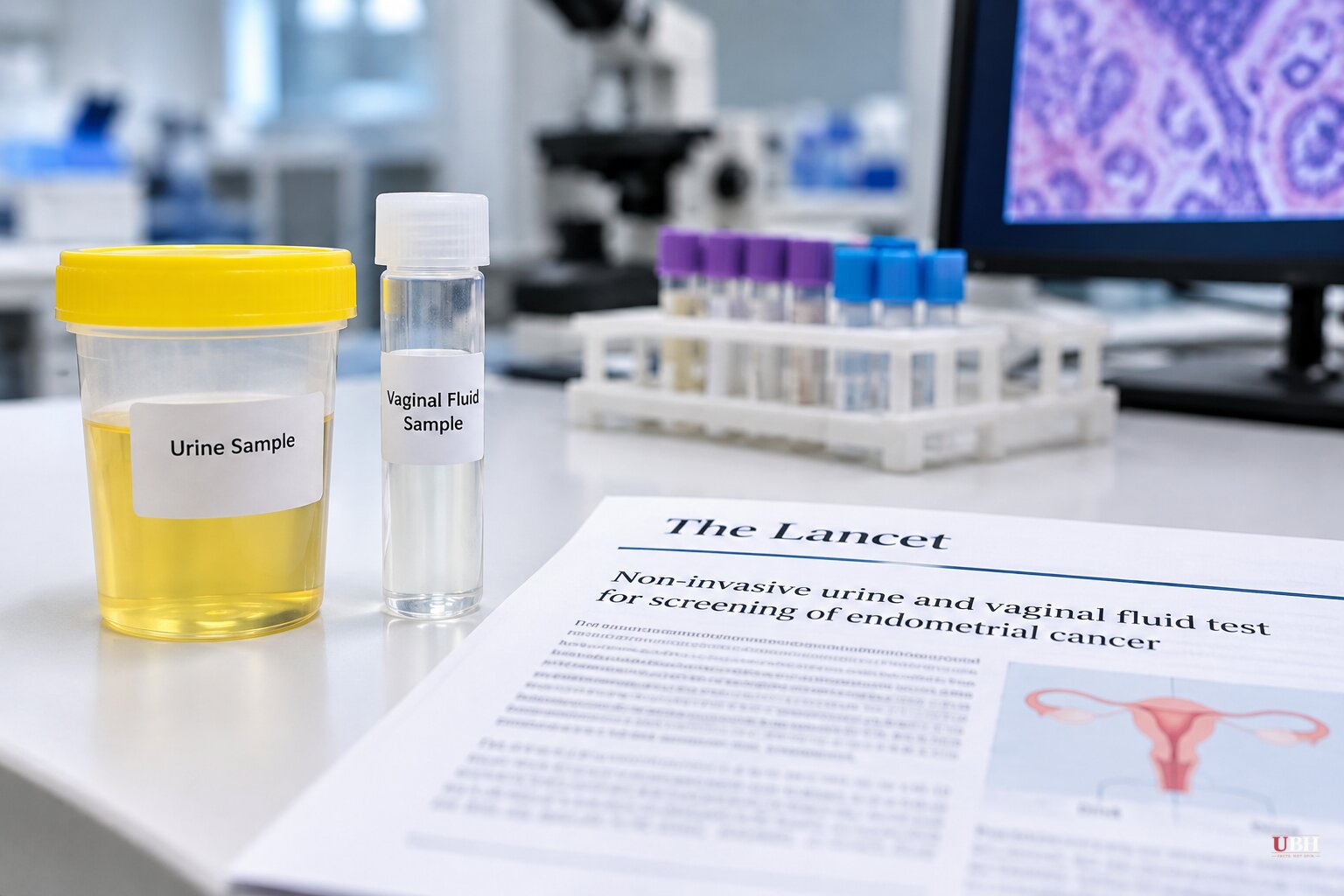
Researchers at the University of Manchester and Manchester University NHS Foundation Trust have developed a simple test that uses urine and vaginal fluid samples to help screen for womb cancer in women bleeding after menopause, according to a study published in the Lancet Obstetrics, Gynaecology & Women's Health on September 22, 2026, reported by News Medical.
Postmenopausal bleeding automatically triggers an urgent cancer referral in the UK's National Health Service. But according to The Guardian, only 5% to 10% of women who report the symptom actually have womb cancer. The rest currently go through invasive ultrasounds, biopsies of the womb lining, and hysteroscopies, where a camera is passed into the womb, according to The Independent.
What the study found
The DETECT study enrolled 1,864 women across seven hospitals in north-west England who came in with postmenopausal bleeding. Before their routine clinical tests, each woman provided a urine sample and a vaginal fluid sample, which specialist cytopathologists examined without knowing the women's actual diagnoses, according to News Medical.
Of the 1,864 women, 115 turned out to have cancer, including 99 confirmed cases of womb cancer, per The Independent. When researchers combined the urine and vaginal cell results, the test correctly identified 80 of those 99 womb cancers, roughly 80%, according to The Guardian. It also correctly returned a negative result for 93% of women who did not have cancer.
The Independent reported the test carried a negative predictive value of 98.8% for womb cancer, meaning a woman who tests negative is highly unlikely to actually have the disease. The vaginal fluid sample performed slightly better on its own than urine alone, per that same reporting.
The test's real strength showed up in the cases that matter most clinically. It caught 95.8% of high-grade tumors and 96.4% of cancers that had already spread beyond the uterus, according to The Independent and a matching account carried by Yahoo New Zealand.
The equity angle
A companion paper published in the same journal issue, cited by News Medical, found that current diagnostic tests are poorly calibrated for women from Black ethnic backgrounds, contributing to worse outcomes. Black women in the UK are twice as likely to die from womb cancer as White women, News Medical reported.
The new test picked up 100% of cancers in Black women in the study, according to The Independent. Researchers told News Medical that if the finding holds up in larger trials, the test could help close a diagnostic gap that has nothing to do with biology and everything to do with how existing screening tools were calibrated.
The catch
The test is not good enough to replace cancer screening on its own. It missed roughly one in five womb cancers in the study, and researchers said explicitly that it should be used to triage risk, not to rule cancer out by itself, according to The Guardian.
There's also a real question about whether the results will hold up outside a research setting. The samples in the study were read by highly trained specialist cytologists, and The Guardian reported that researchers don't yet know if community labs or primary care settings could replicate that accuracy. The test also hasn't been studied in women without symptoms, meaning it's not a general screening tool for now. A test that misses 20% of cancers isn't ready to stand alone, and the researchers themselves say so.
Professor Emma Davidson of the University of Manchester, who worked on the study, framed the tradeoff plainly: "Bleeding after the menopause is understandably alarming for women because it can be a sign of cancer, but the vast majority of those investigated will not have the disease," she told The Guardian. "At the moment, many women face invasive, uncomfortable tests that can be stressful as well as costly for health services before cancer can be ruled out."
What happens next
Womb cancer affects nearly 10,000 women in the UK annually, according to News Medical, and diagnoses have risen 12% over the past decade, per data cited by The Independent from The Eve Appeal. If the test performs the same way in larger, more diverse clinical settings, researchers say it could be rolled out in primary care to fast-track the highest-risk women while reassuring the rest earlier and cheaper than a hospital ultrasound. No date has been set for wider NHS adoption, and no regulatory approval process has been announced. The next step is validation outside the specialist cytology labs that ran this study.
Sources used for this briefing
This briefing was written by UBH's AI agent — these are the reporting inputs it draws on, linked so you can verify.


