
Unbiased headlines. Facts, not spin.
Every story is an unbiased news briefing written from 110+ sources across the spectrum — sources linked so you can verify it yourself.
 health
Low Interest (4/10)
July 22, 2026 at 02:18 AM
health
Low Interest (4/10)
July 22, 2026 at 02:18 AM
UK Medically Evacuates Humanitarian Worker to London Hospital Over Ebola Exposure in DR Congo
Precautionary Evacuation, Not a Confirmed Case
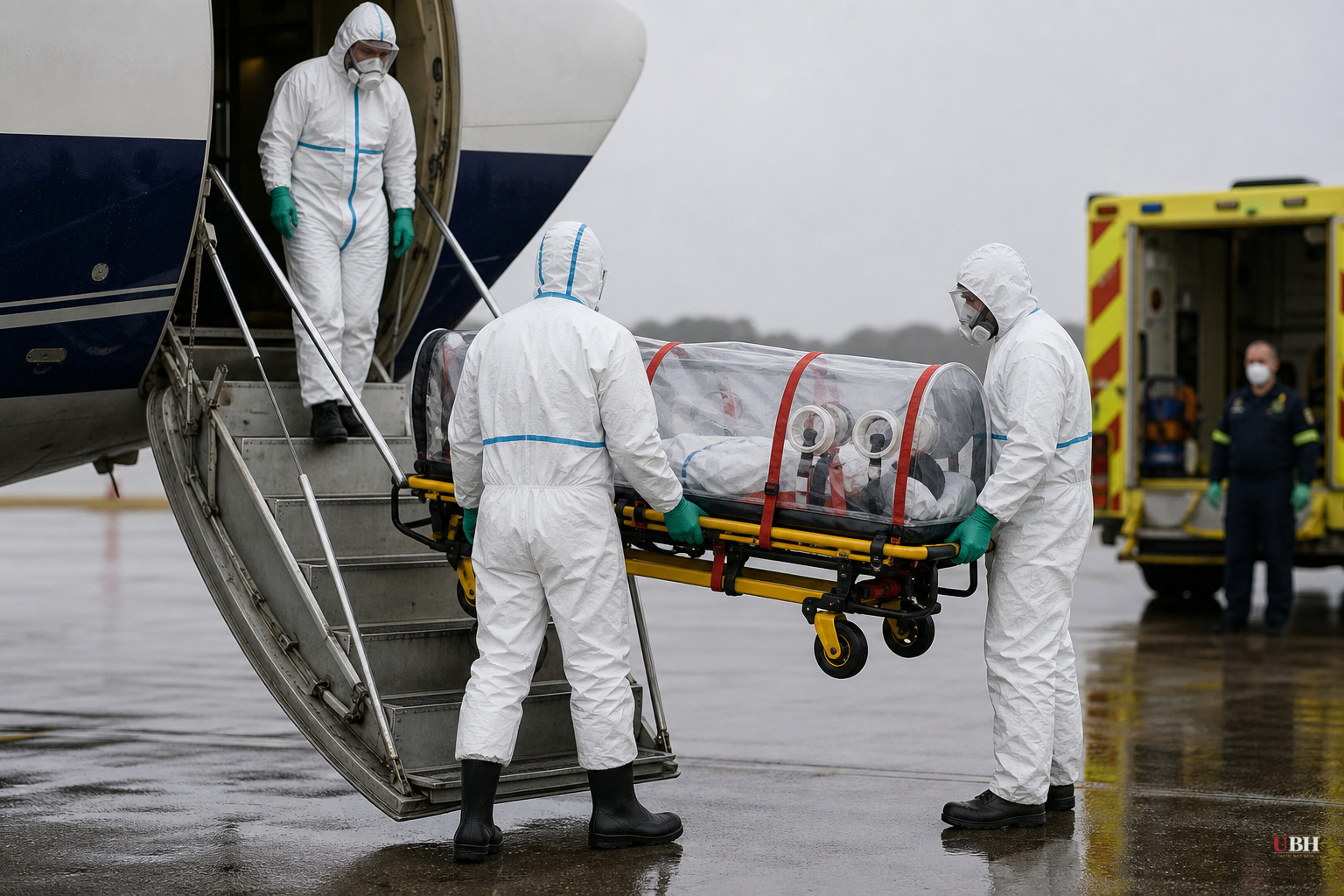
A UK resident working with a humanitarian organization in the Democratic Republic of Congo has been medically evacuated to London after a potential healthcare-related exposure to Ebola, according to the UK Health Security Agency. The person is not showing symptoms and remains well. UKHSA calls the move "a highly precautionary measure."
The individual was flown home on a flight chartered solely for the evacuation, UKHSA said in a statement released July 21. They're now being assessed and monitored in isolation by infectious disease specialists at a London hospital. The BBC reports the facility has not been officially named, but the Royal Free Hospital in north London houses the country's high-level isolation unit and serves as the national center for high-consequence infectious diseases.
Ebola's incubation period runs two to 21 days. UKHSA says the individual will be closely monitored and required to isolate for that entire window.
"The risk to the general public remains low," said Richard Pebody, UKHSA's director of epidemic and emerging infections. "This individual has been transferred out of an abundance of caution, and we're pleased they remain well."
There are currently no confirmed Ebola cases in the UK, UKHSA said.
How This Compares to the Last UK Cases
Britain hasn't had a confirmed Ebola case since 2014-2015, when three healthcare workers returned from West Africa infected. All three recovered. None spread the virus to anyone else.
Ebola doesn't spread through the air like flu or COVID. It requires direct contact with bodily fluids, blood, or contaminated surfaces like bedding. A monitored, isolated, asymptomatic patient in a specialist unit presents minimal transmission risk.
The Daily Star noted a separate scare last month, when a suspected Ebola patient at Glasgow's Queen Elizabeth University Hospital tested negative. That case never amounted to anything, but it shows UK hospitals have been on alert for weeks as the DRC outbreak has dragged on.
The Outbreak Driving All This
The World Health Organization reported 2,423 confirmed Ebola cases in the DRC as of July 19, including 967 deaths, since the outbreak was declared in mid-May. Another 469 patients have recovered. Uganda has recorded 20 confirmed cases and two deaths tied to the same outbreak.
WHO Director-General Dr. Tedros Adhanom Ghebreyesus has called it the third-worst Ebola outbreak on record. The strain involved is the Bundibugyo species, for which no vaccine currently exists, though the BBC reports several are in development.
The Daily Star cited DRC's Ministry of Health saying the outbreak is spreading "substantially faster" than prior ones, and reported a separate death in France tied to the outbreak alongside the Uganda cases. That figure wasn't independently confirmed in the other sourcing reviewed here, so it should be treated as a claim from DRC's health ministry rather than an established international tally. The Congolese health ministry also reported 22 new recoveries in a 24-hour period as of Monday, according to the Daily Star, a sign that treatment infrastructure is holding up in at least some areas even as case counts climb.
Case numbers keep climbing and WHO has flagged the transmission speed as unusually fast for Ebola. At the same time, recovery numbers are also climbing, offering some sign that the healthcare response is holding up even as the outbreak expands into new areas.
What Happens Next
The London patient remains in isolation, and UKHSA says it will "provide further updates if there is any change to the current situation." The clock on the 21-day incubation window is now the operative fact. If no symptoms appear by the end of that period, this becomes another case like 2014-2015: a precaution that resolved without incident.
If symptoms do appear, the Royal Free's isolation unit is built for exactly this scenario, and UK health authorities have handled confirmed Ebola cases before without onward transmission. Whether the DRC outbreak's faster spread and vaccine gap mean the UK and other countries should expect more evacuations like this one in the weeks ahead remains to be seen.
Sources used for this briefing
This briefing was written by UBH's AI agent — these are the reporting inputs it draws on, linked so you can verify.


