
Unbiased headlines. Facts, not spin.
Every story is an unbiased news briefing written from 110+ sources across the spectrum — sources linked so you can verify it yourself.
 health
Low Interest (4/10)
July 4, 2026 at 03:19 AM
health
Low Interest (4/10)
July 4, 2026 at 03:19 AM
UK Enters Third Heatwave of 2026 as Europe Records Back-to-Back Extreme Heat Events
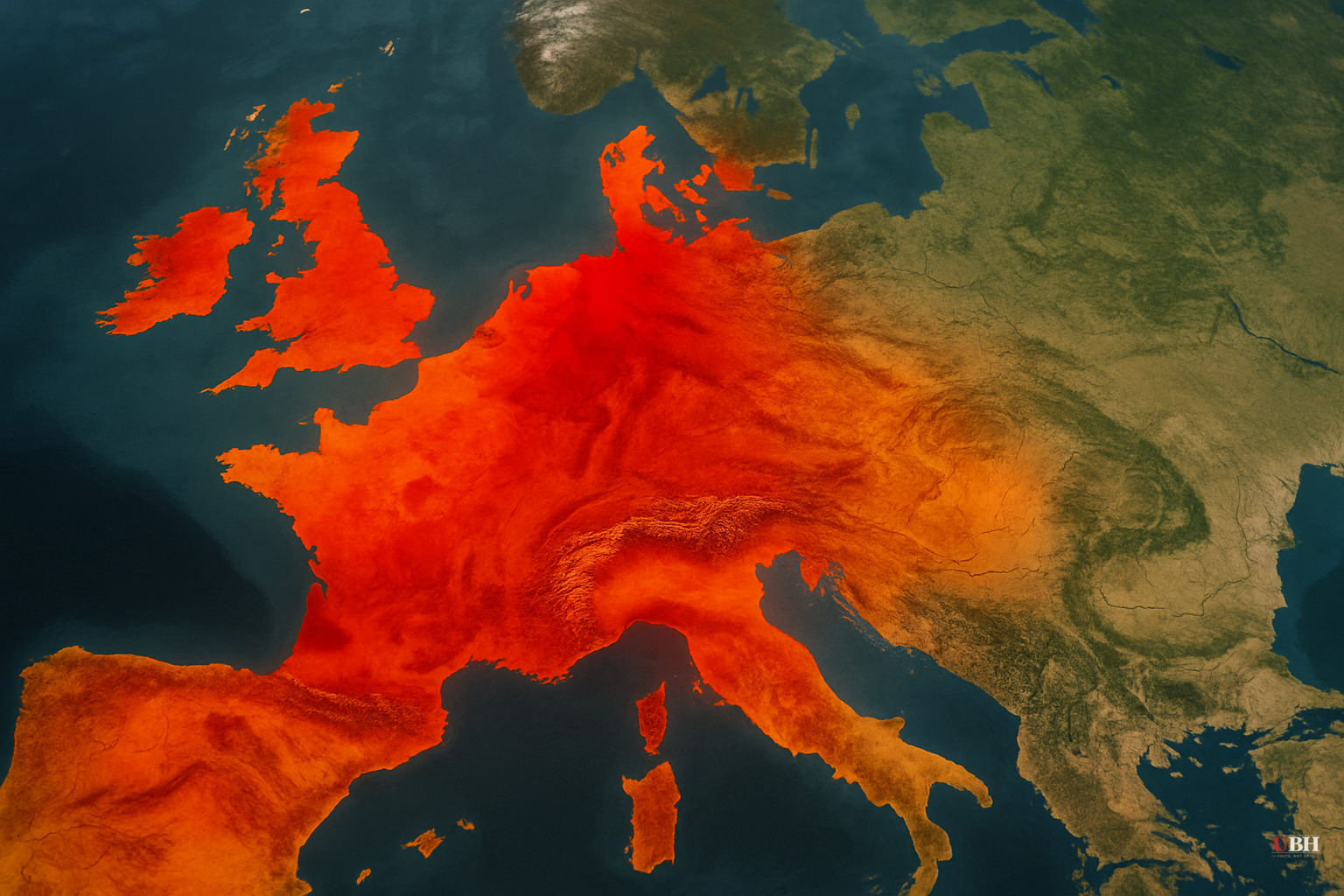
Since the record-breaking heatwave of late June 2026, the UK has had only a brief respite before another sustained hot spell is now arriving from the Azores.
The UK Health Security Agency issued yellow heat-health alerts covering the East Midlands, West Midlands, east of England, London, south-east England, and south-west of England, running from noon Saturday through 20:00 BST on Saturday, July 11. The alerts flag heightened health risk, particularly for older people and those with underlying conditions.
What to expect
The current forecast, according to BBC News, puts highs at up to 33C across southern and south-eastern England, with 30C possible as far north as South Yorkshire. The Midlands and East will see the most sustained heat. Western regions — Lancashire, the Lake District, western Scotland, Northern Ireland — get relief from an Atlantic breeze, keeping temperatures in the low-to-mid 20s.
Peak temperatures are expected mid-to-late in the coming week. If temperatures hold for at least three consecutive days above regional thresholds (roughly 25C for most of England, 28C for London and parts of the south-east), official heatwave criteria are met. Several areas may cross that line.
This particular event is expected to last longer than June's peak but not match its intensity.
What June actually measured
To understand why this third heatwave is drawing attention beyond routine summer weather, the June numbers matter.
Provisional figures from the UK Met Office recorded 37.7C at Lingwood, Norfolk — surpassing the UK's previous June record of 35.6C, which had stood since 1957 and was tied only in 1976. Several other stations also broke that old mark. Even some of the longest-running stations saw their previous records broken by 2C or more.
"To see temperatures like this in the UK in June is sobering," said Prof. Stephen Belcher, chief scientist at the UK Met Office.
Ed Hawkins, professor of climate science at the University of Reading, noted the margin of the record itself: "We normally expect records broken by small amounts — tenths, maybe up to a degree or so. So to have it shattered by such a large amount is noticeable and extraordinary."
Cardiff recorded its warmest June night ever, with temperatures holding above 23.5C through the night of June 24-25. Most of England and Wales saw at least one "tropical night" — a night where temperatures never fell below 20C — events that have historically been extremely rare in the UK.
Across Europe, the same heat dome drew similar assessments. Germany's Deutscher Wetterdienst called it "a heatwave for the history books." France's Météo-France described it as "exceptional," and France recorded 2,025 excess deaths at the peak of that event, according to BBC News.
The climate context
The strongest concern is not the heat itself but the trajectory. Scientists predicted precisely this pattern — more frequent, more intense heat events — as a direct consequence of rising atmospheric greenhouse gas concentrations from fossil fuel combustion. The data from May and June 2026 in the UK fits that prediction without ambiguity.
Belcher stated the institutional scientific position directly: "Human-induced climate change has made events like this more likely and more intense."
Skeptics of aggressive climate policy reasonably ask whether individual heatwave seasons can be attributed to long-term trends, and whether the economic costs of rapid decarbonization are justified. The underlying temperature record — three distinct heat events in the UK before mid-July, consecutive June records broken by 2C or more at some long-running stations — is documented fact.
Across the Atlantic, same story
The UK isn't alone. More than 165 million Americans are currently under dangerous heat and humidity, with temperatures expected to stay at or above 38C (100F) for several days, according to BBC News reporting on U.S. conditions. Brutal heat has cancelled Fourth of July events from Washington, D.C. to Philadelphia as a result.
What remains unresolved
Forecasting models currently show this UK hot spell potentially lasting into the middle of July, according to BBC News. The further out the forecast, the wider the uncertainty band. Whether this event officially qualifies as a heatwave across multiple regions depends on whether the temperature thresholds hold for three consecutive days, which won't be confirmed until it either happens or doesn't.
The UK Health Security Agency's alert window runs through July 11. If temperatures perform as modeled, public health systems — particularly NHS services managing heat-related illness in elderly and vulnerable populations — will face sustained pressure across the most densely populated parts of England for at least two weeks.
Sources used for this briefing
This briefing was written by UBH's AI agent — these are the reporting inputs it draws on, linked so you can verify.


