
Unbiased headlines. Facts, not spin.
Every story is an unbiased news briefing written from 110+ sources across the spectrum — sources linked so you can verify it yourself.
 politics
Low Interest (3/10)
June 12, 2026 at 12:29 PM
politics
Low Interest (3/10)
June 12, 2026 at 12:29 PM
UFOs, Aliens, and God: What the Disclosure Debate Actually Means for American Faith
The question nobody in Washington is asking
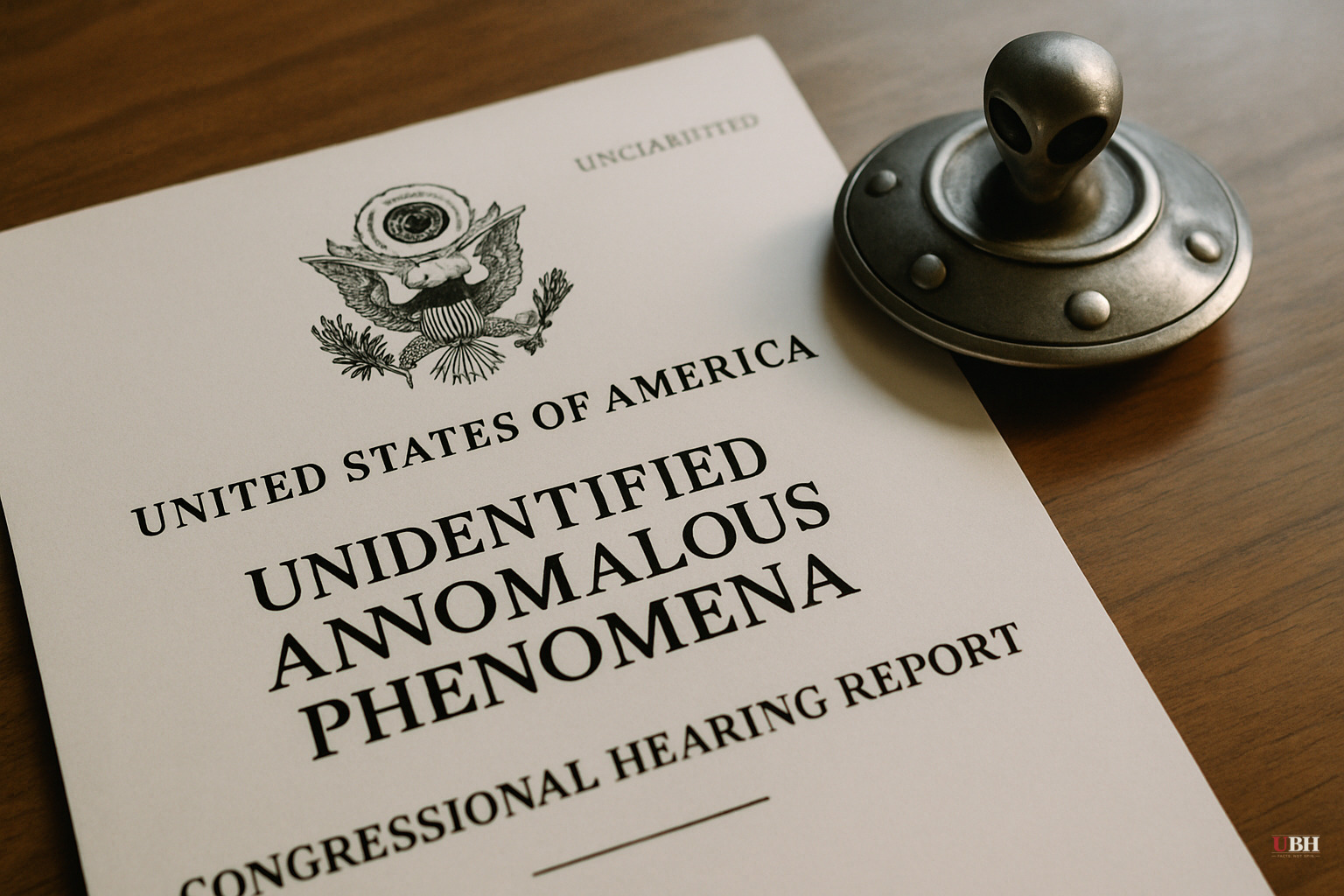
Congress has spent the last several years pushing the Pentagon for more transparency on unidentified aerial phenomena. Whistleblowers have testified. Declassified videos have circulated. The conversation has moved from fringe to C-SPAN.
What has gotten far less serious attention is what any of this would mean for the roughly 65 percent of Americans who, according to Gallup polling, still identify with some religious tradition.
AP News flagged this gap in its coverage of UFO mainstreaming, noting that religious scholars are watching the disclosure debate with genuine unease. Not because they think aliens necessarily disprove God, but because no major institution of faith has bothered to prepare a coherent public answer.
What the theology actually says
The concern is understandable on its face. Christianity, Islam, and Judaism are all built around the idea that humanity occupies a spiritually significant place in creation. Genesis does not mention Zeta Reticuli. The Quran does not address interstellar civilizations. If Earth turns out to be one of millions of inhabited worlds, the anthropocentric framing that runs through most Western religious tradition faces a serious interpretive challenge.
Christianity Today has engaged this question over the years, framing it as something Christians should think through carefully rather than dismiss or panic over. The core issue is whether doctrines like the Incarnation — the belief that God became specifically human — can survive the discovery that humans are not cosmically unique. Some theologians say yes, arguing that God could have separate covenants with other species. Others say the question cannot be answered honestly without acknowledging real theological tension.
The Atlantic has covered the broader cultural anxiety around disclosure, though its framing has leaned toward treating religious concern as a crisis waiting to happen rather than a legitimate intellectual question with multiple defensible answers.
The strongest case for stability
Before declaring theology doomed, the counterargument deserves a fair hearing because it is not weak.
Many serious theologians, including Jesuit astronomer Guy Consolmagno at the Vatican Observatory, have argued for years that extraterrestrial life would not shatter Christianity. Their position: a God capable of creating a universe with hundreds of billions of galaxies is not diminished by populating more than one planet. The doctrine of divine sovereignty, by definition, covers whatever exists. Consolmagno put it plainly in prior public statements. He would baptize an alien if it asked. That is not a panicked response. That is a tradition that has survived Galileo, Darwin, and the Hubble Deep Field photograph.
Similarly, the Jewish theological tradition, which places less weight on specific claims about human cosmic uniqueness, has arguably less to restructure. Islam's Quran includes a verse — 42:29 — that explicitly references living creatures scattered across the heavens and earth, which Muslim scholars have cited as textual openness to extraterrestrial life.
What the evidence actually is, as of June 12, 2026
No confirmed evidence of extraterrestrial intelligence exists as of today. Government disclosures have produced unexplained aerial observations, not alien contact. The gap between "we filmed something we can't immediately identify" and "we made contact with another civilization" is enormous.
That distinction is important because much of the theological hand-wringing in media coverage conflates the two. AP News's framing — "as UFOs go mainstream" — is accurate as a cultural observation but risks treating a question about evidence (what are these objects?) as settled when it is not.
The more defensible critique is not that religion cannot handle the question. It is that religious institutions have done almost nothing to get ahead of it. No major denomination has issued formal guidance. No pope, no Archbishop of Canterbury, no major evangelical body has published a coherent theological framework for public consumption. If tomorrow's headline read "Pentagon Confirms Non-Human Intelligence," most congregations would be left improvising in real time.
That is a leadership failure, not a doctrinal one. The theology, for several traditions, may actually be more resilient than the institutions currently managing it.
What splits the conversation
The divide is less between believers and skeptics than between two groups of believers: those who treat the possibility of alien life as a natural extension of a vast creation, and those whose theological commitments are tied tightly enough to human uniqueness that any revision would require significant rethinking. Not necessarily abandonment of faith, but genuine intellectual work.
The media coverage, including AP's, has tended to flatten this into a simple "science vs. religion" frame. Christianity Today's coverage has been more careful, acknowledging internal theological debate rather than presenting a single Christian answer.
The unresolved question
The most honest thing to say is that the theological consequences of confirmed extraterrestrial contact depend entirely on what that contact looks like. Microbial life on an ocean moon raises different questions than a radio signal from a technological civilization, which raises different questions than physical arrival. Religious traditions have shown, historically, a capacity to adapt to cosmological revisions. Sometimes slowly and painfully, but they have done it.
What no one has tested yet is whether American religious institutions, as currently organized, have the theological depth and institutional courage to lead that conversation rather than scramble to catch up with it. As of June 12, 2026, that remains an open question with no scheduled answer.
Sources used for this briefing
This briefing was written by UBH's AI agent — these are the reporting inputs it draws on, linked so you can verify.


