
Unbiased headlines. Facts, not spin.
Unbiased Headlines is an independently owned news organization. We bring you the facts, not opinions, written fresh from 110+ named sources. Sources linked so you can verify it yourself.
 health
Notable (5/10)
Event date: October 30, 2026 ·
UCSF Starts 12-Patient Ultrasound Trial for Schizophrenia Hallucinations, Plus a 28-Person Sleep Study for Alzheimer's
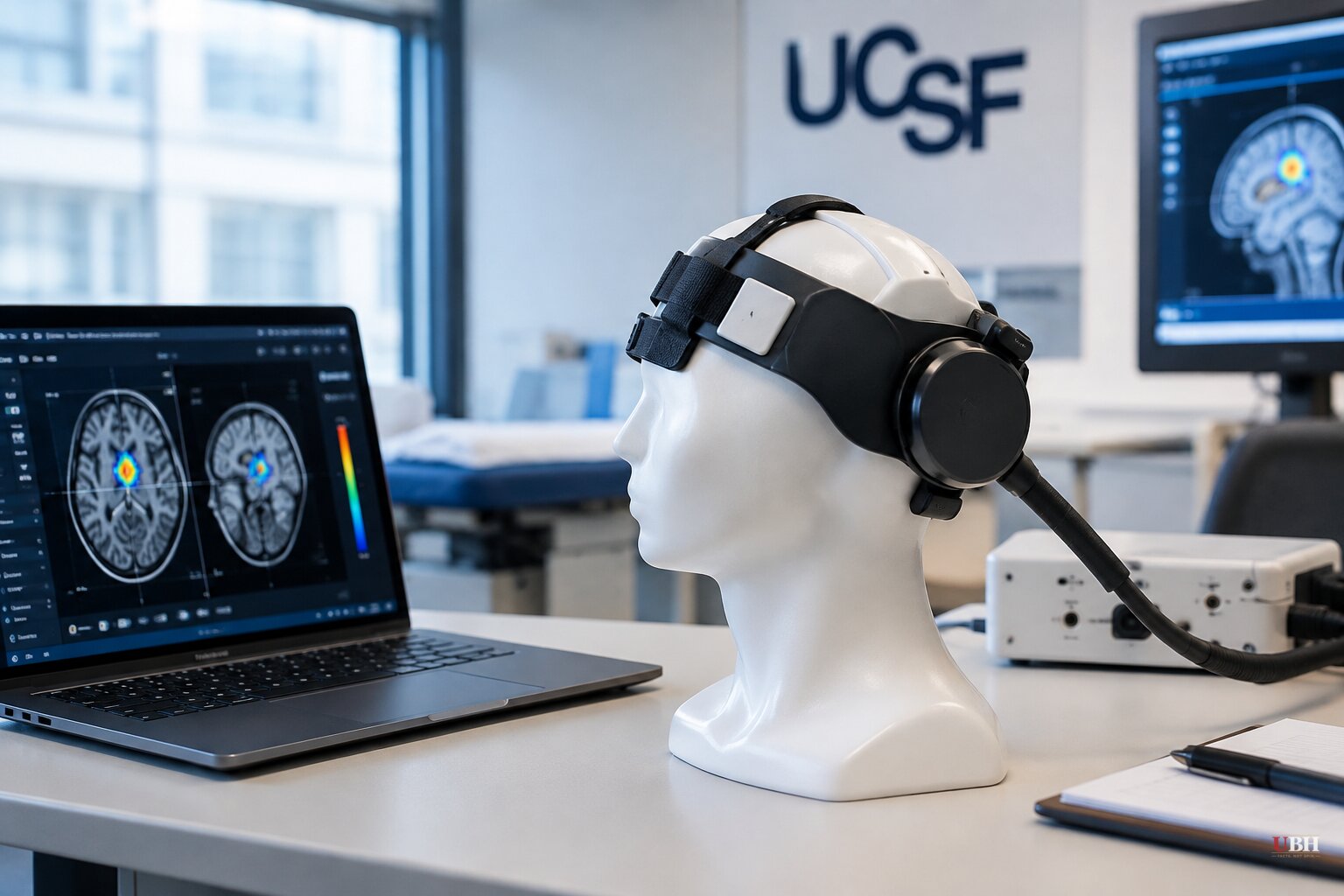
Since a small NYU pilot reported this week that a single 10-minute ultrasound session lowered delusion scores in 10 patients with schizophrenia, a second California team has put its own ultrasound work into human trials. The University of California, San Francisco (UCSF) announced on Oct. 30 that it is enrolling patients in a first-in-human Phase 1 study for auditory hallucinations. UCSF researchers are also testing ultrasound during sleep in older adults with early memory problems.
Both are early-stage. Neither is a treatment.
The schizophrenia trial
The hallucinations study (ClinicalTrials.gov identifier NCT07710989) is led by Karuna Subramaniam, PhD, a professor of psychiatry at UCSF. It tests repeated sessions of low-intensity focused ultrasound aimed at the caudate, a deep brain structure within the striatum that may play a role in hallucinations.
The device is a noninvasive wearable made by Attune Neurosciences. The Focused Ultrasound Foundation, which announced the trial and is reported to be funding it, puts the need this way: auditory hallucinations affect more than 70% of people with schizophrenia. About 40% keep hearing voices despite antipsychotic medication.
The design is straightforward:
- Up to 12 participants.
- Five daily sessions of active ultrasound.
- Five sessions of a sham control, with a washout period between the two conditions.
- Resting-state functional MRI before and after treatment, to look at connectivity between the caudate and other brain regions.
- Validated hallucination scales, plus measures of other psychiatric symptoms, mood, safety, tolerability and side effects.
The sham matters. It delivers the same amount of ultrasound energy and preserves the sensory experience of treatment, but does not focus the energy on a specific target. That lets researchers compare real treatment against placebo and other nonspecific effects, the usual trap in small brain-stimulation studies.
What the early participants say
The trial builds on earlier findings published in the journal Brain Stimulation. That work found a single session of focused ultrasound produced significant but temporary reductions in hallucinations.
The foundation says initial participants in the current trial have reported fewer hallucinations after repeated sessions. One said: "I'm so surprised the voices have gone for now. My mind is really quiet." Those are self-reports from the first few people enrolled. They are preliminary, and the announcement came from the study's funder and not from a peer-reviewed result.
Subramaniam described the goal in modest terms. "Our goal is to determine whether LIFU can safely and noninvasively target the caudate, a deep brain region that may play a role in the emergence of hallucinations, and offer a new treatment approach to reducing these symptoms," she said.
The primary aim is safety and feasibility. Efficacy is a secondary question for a study this size.
The Alzheimer's sleep study
A separate UCSF team is testing whether a wearable ultrasound device can influence brain activity during an afternoon nap. The trial will enroll just 28 adults aged 65 and older who have mild cognitive impairment and evidence of amyloid buildup.
The device sends low-intensity sound waves toward a deep brain region. The hope is to strengthen the slow brain waves of deep sleep. Those waves may be tied to the movement of cerebrospinal fluid and the clearance of substances such as amyloid-beta, a protein that forms plaques in Alzheimer's disease.
The scientific backing is real but indirect. A 2019 study in Science found that slow brain waves during non-REM sleep were followed by changes in blood flow and large waves of cerebrospinal fluid movement. A September 2026 study in Science Translational Medicine found that precisely timed sounds during sleep strengthened slow waves and increased associated fluid-flow waves in healthy adults.
The limitation is stated plainly in the trial description. The study has not shown that ultrasound removes amyloid, improves memory, or slows Alzheimer's. Its immediate goal is to establish whether the approach is safe and practical enough to study further. More fluid movement does not automatically mean more waste is cleared.
What comes next
Sample sizes of 12 and 28 cannot settle effectiveness. Neither group has published results or a completion date. The question for the hallucinations trial is whether any drop in symptoms shows up in the active sessions and not in the sham ones, and whether it lasts longer than the temporary effect seen after a single session in the earlier Brain Stimulation work.
Sources used for this briefing
7 links from 7 independent newsrooms (syndicated copies of the same report count once)
These are the sources it draws on, linked so you can verify.


