
Unbiased headlines. Facts, not spin.
Unbiased Headlines is an independently owned news organization. We bring you the facts, not opinions, written fresh from 110+ named sources. Sources linked so you can verify it yourself.
 health
Notable (6/10)
Event date: October 15, 2026 ·
Google DeepMind's Antigravity Agent Flags 97-Amino-Acid Antibiotic Candidate. Lab Tests Still Pending
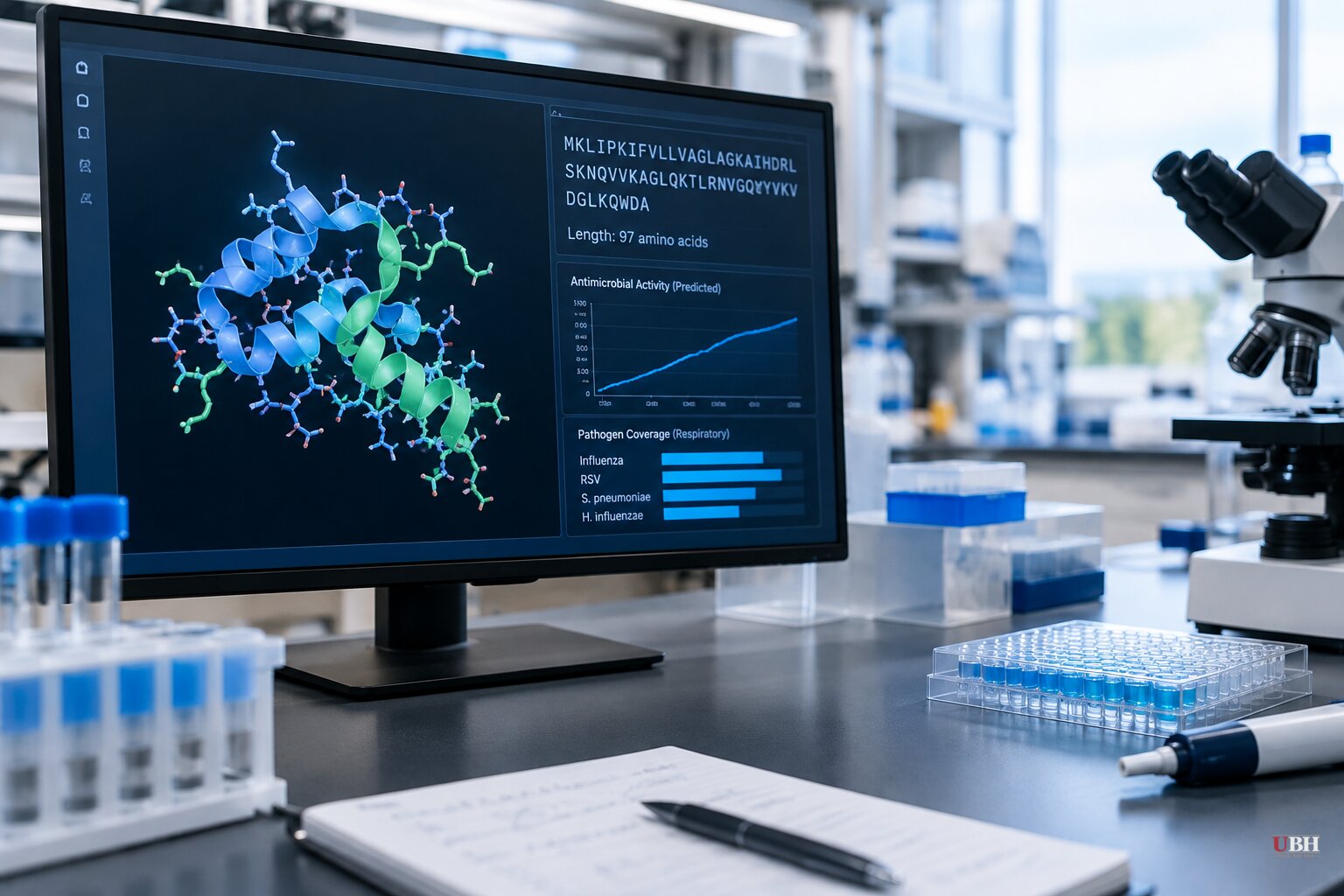
Google DeepMind published a technical walkthrough on October 15, 2026, describing how a biologist used its Antigravity agent platform to find a candidate for a new antimicrobial peptide. The candidate is a 97-amino-acid bacteriocin. DeepMind says it is now in wet-lab validation.
The lab work matters most. Two weeks after the announcement, the result is still a computational hypothesis. DeepMind has not released lab data showing the peptide kills anything.
What the agent did
The walkthrough was written by Pengfei Tian, Maxwell L. Bileschi, Zoi Tsangalidou, Sukhdeep Singh and Lucy J. Colwell. The researcher set one goal: find and computationally vet new antimicrobial peptides in Streptococcus pseudopneumoniae.
The agent queried the UniProt protein database and cut millions of entries down to a shortlist. It landed on a bacteriocin, UniProt ID A0A0U0D591, from the Lactococcin 972 family. The post says the candidate is predicted to be active against pathogens behind respiratory tract infections.
Then came the novelty check. The researcher had the agent run the sequence against curated Swiss-Prot proteins using the EMBL-EBI NCBI-BLAST service. It found no meaningful homolog among manually reviewed proteins.
The agent then pulled the predicted 3D structure from the AlphaFold Protein Structure Database and ran a Foldseek search against experimentally determined structures. Structural comparison showed similarity to a known bacteriocin. The agent also checked neighboring genes for supporting biological evidence and reviewed existing literature to build hypotheses about how the molecule might work and which pathogens it might hit.
The researcher steered throughout. The post describes a multi-turn session in which the human decided what questions to ask and what evidence to collect, while the agent handled the cross-database legwork.
Where ProtNLM fits
Most of the sequences sitting in public databases have no useful annotation. UniProt holds millions of proteins of unknown function. They came out of genome projects and look nothing like well-studied proteins, so standard similarity searches miss them.
DeepMind's answer is ProtNLM, a protein language model trained to predict function directly from raw amino acid sequences. The company says it has enriched millions of previously unnamed UniProt entries with high-confidence functional labels. The agent's filtering relied on those labels.
Pushmeet Kohli, Google Cloud's Chief Scientist and DeepMind's VP of Science, described the speed in a LinkedIn post: "As an example, in a single session using Antigravity, our scientists working on Antimicrobial resistance surfaced a novel antimicrobial peptide candidate."
The claim here is about time savings. Work that normally sprawls across several databases and tools fit into one session.
Why peptides, and why now
The post frames the work against antimicrobial resistance, which its authors say could cause an estimated 10 million deaths a year by 2050. That is DeepMind's framing of the projection.
Antimicrobial peptides, bacteriocins in particular, are pitched as an alternative to classical antibiotics. They evolved to attack basic weaknesses in competing bacteria, from the cell envelope to intracellular machinery. The authors argue that makes it harder for pathogens to evolve resistance.
There is precedent. Nisin is widely used. Darobactin, Dynobactin and Lariocidin are recent finds mined from genomes.
What is and is not shown
The novelty check only covers manually reviewed Swiss-Prot proteins. The structural match to a known bacteriocin points to a familiar mechanism rather than a new one. Neither check shows the peptide works in a living system.
DeepMind itself describes the output as computational evidence for further investigation. It does not claim the candidate is effective or safe. The company has said the peptide and several other candidates from the same process are undergoing wet-lab validation to see whether the predictions hold up experimentally.
Antigravity began as a coding tool. DeepMind has been extending it into science by pairing Gemini models with specialist tools such as AlphaFold and AlphaGenome. This walkthrough is a demonstration of that pairing, not a clinical result.
What comes next
The test comes at the bench. Wet-lab results will show whether A0A0U0D591 and the other candidates inhibit bacteria at all, and whether they are toxic to human cells. DeepMind has not said when those results will be released or where they will be published.
Sources used for this briefing
5 links from 5 independent newsrooms (syndicated copies of the same report count once)
These are the sources it draws on, linked so you can verify.


