
Unbiased headlines. Facts, not spin.
Unbiased Headlines is an independently owned news organization. We bring you the facts, not opinions, written fresh from 110+ named sources. Sources linked so you can verify it yourself.
 health
Notable (5/10)
Diabetes Screening for Asian Americans Starts at BMI 23. GLP-1 Eligibility Still Starts at 30
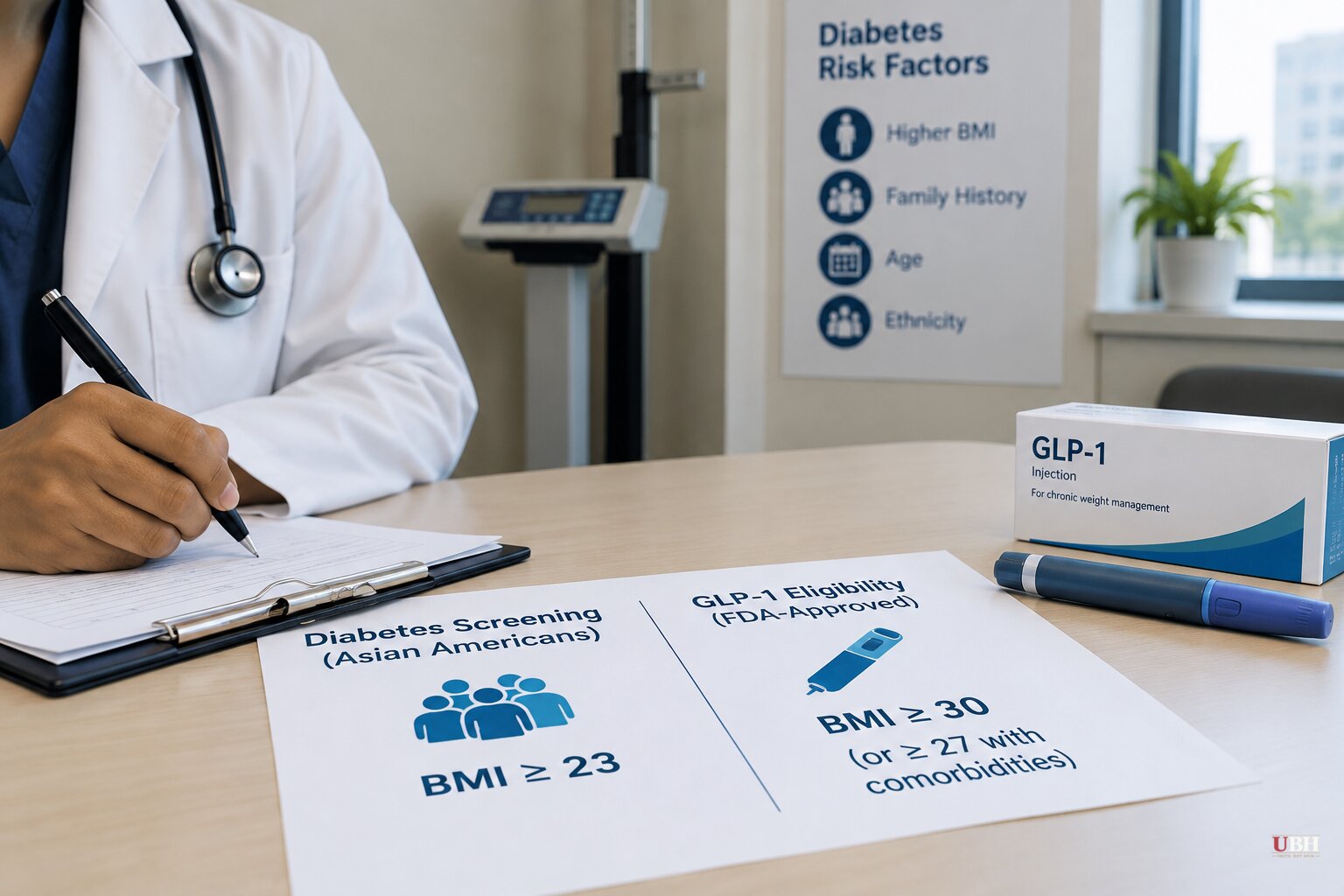
A physician who is Pakistani American says she has landed in a gap between two sets of rules that use the same number.
Writing in MedPage Today, the physician (the piece carries a first-person account) says that under American Diabetes Association guidance her doctor should begin diabetes screening once her body mass index passes 23, because Asian Americans develop the disease at lower weights. Her BMI is 26.5. When she asked about a GLP-1 receptor agonist, the answer was no.
The reason is the label. FDA-approved GLP-1s for weight management are open to people with a BMI of 30, or 27 with at least one weight-related condition. At 26.5 and without diabetes, she meets neither test.
Why the same BMI means different risk
The author points to body composition. At the same BMI, people of Asian descent carry more visceral fat and less muscle than people of European descent. That fat is not visible on a scale, which is why BMI can read low.
The 2025 iCARDIO global obesity guidelines, as the author cites them, put an Asian person's BMI about two to three units below a white person's at the same level of body fat.
The World Health Organization recognized the problem in 2004. It set lower action points for Asian populations, at BMIs of 23 and 27.5.
The author also cites the American Heart Association, which has found that type 2 diabetes and cardiovascular disease reach Asian adults at lower BMIs. Across every subgroup the association has examined, the rates are higher than among white adults.
The England numbers
The sharpest data point comes from a study of nearly 1.5 million adults in England. Researchers asked at what BMI each ethnic group reaches the diabetes risk that white adults carry at a BMI of 30.
For South Asians, the answer was 23.9. For Chinese adults, it was 26.9.
In practical terms, a South Asian patient at a BMI of 24 carries the diabetes risk that earns a white patient an obesity diagnosis. The treatments tied to that diagnosis are not available until 30.
How the trials set the cutoff
The author says the labels copied the entry criteria of the pivotal trials, and those trials were built around Western definitions of obesity.
A 2026 analysis of 352 GLP-1 trials, as cited in the piece, examined every inclusion criterion the studies used. BMI was the one that excluded Asian patients.
Under a trial cutoff of 30, 41.5% of non-Asian American adults would be eligible. For Asian Americans the figure is 13.5%. For Koreans it is 7.2%.
Blood sugar, kidney function and liver criteria admitted more than 93% of every group. The BMI line is the filter doing the work.
The author adds that trials have under-enrolled non-white patients for 30 years, and that each under-representative trial then becomes the evidence base for the next label.
Coverage is moving the other way
The access problem is getting tighter. The author says Medi-Cal dropped coverage of GLP-1s for weight loss in January, and MassHealth did the same in July.
When a benefit shrinks, the author argues, patients whose eligibility was already marginal are the first to lose it. Asian Americans below a BMI of 30 are in that group.
In June, the ADA also released Asian-specific waist and BMI thresholds for diagnosing obesity. The author's summary: the clinical definition moved one way while access moved the other.
What the numbers do and do not settle
This is a first-person account, and the study figures come from the author's citations. The ADA's June thresholds govern diagnosis. They are not coverage rules, and nothing in the piece says the FDA or any insurer has changed a threshold in response.
There is also a fiscal question that cuts both ways. States cutting weight-loss coverage are weighing the cost of expensive drugs against taxpayer budgets. The author's argument is that a flat BMI of 30 is a poor proxy for risk in a population the data show develops disease earlier. That is a question about whether the rule measures what it claims to, and it is separate from how much to spend.
The open question is whether the FDA labels, which still read 30, or 27 with a weight-related condition, will be revisited now that the ADA has published Asian-specific diagnostic cutoffs. Until they are, the screening threshold and the prescribing threshold for the same patient remain several BMI points apart.
Sources used for this briefing
1 link from 1 independent newsroom (syndicated copies of the same report count once)
These are the sources it draws on, linked so you can verify.


