
Unbiased headlines. Facts, not spin.
Unbiased Headlines is an independently owned news organization. We bring you the facts, not opinions, written fresh from 110+ named sources. Sources linked so you can verify it yourself.
 health
Notable (5/10)
UCL Researchers Say Decipher Gene Test Scores Track Which High-Risk Prostate Cancer Patients Gain Most From Abiraterone
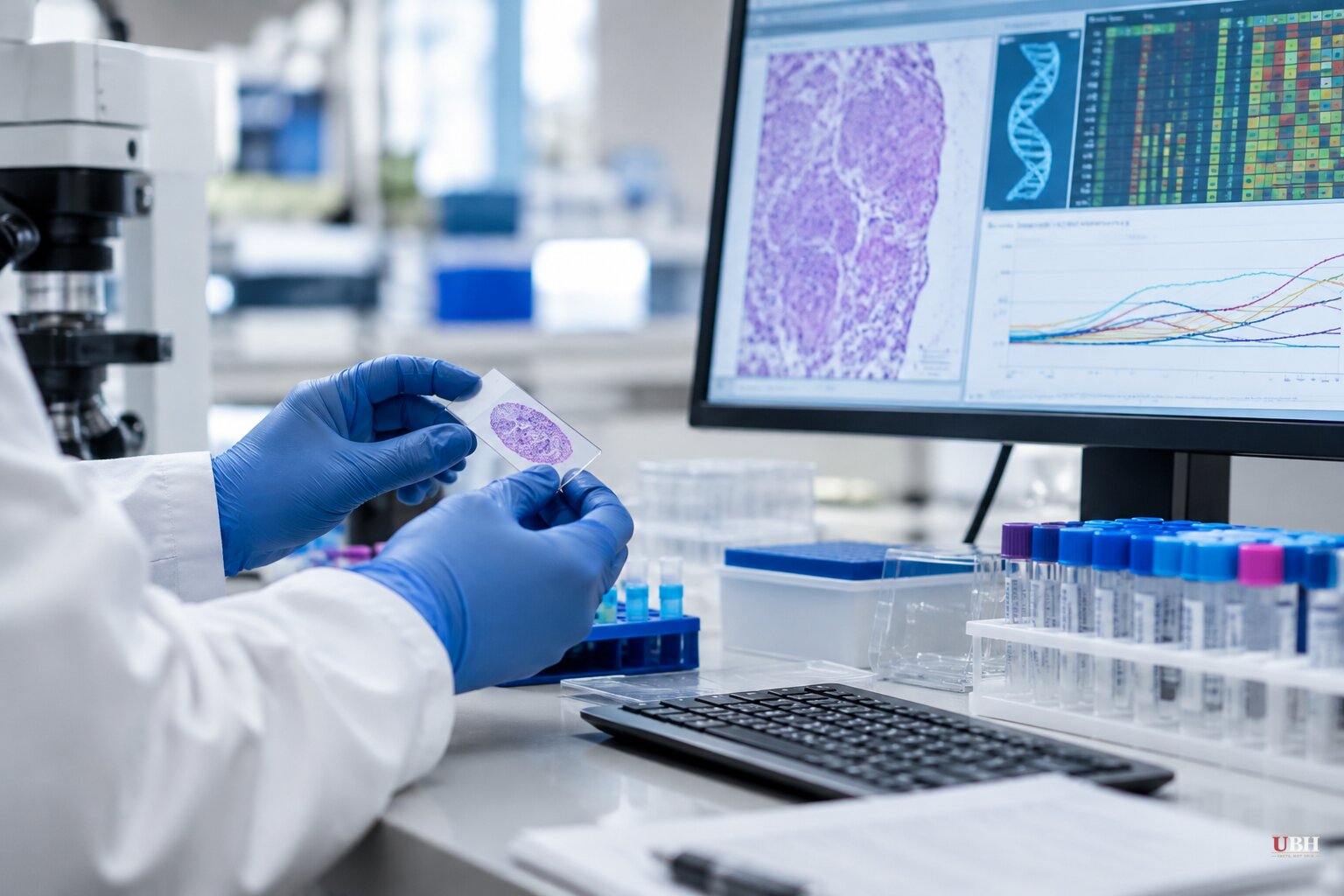
Abiraterone cut the risk of death roughly in half for men with high-risk, localized prostate cancer in the STAMPEDE trial. The problem is that not every man needs it.
Researchers at University College London now say a tissue test called Decipher may show who does. They presented the findings at the European Society for Medical Oncology (ESMO) Congress in Madrid, which runs Oct. 23–27.
What the UCL team did
Decipher analyzes the activity of 22 genes in tumor tissue already collected during a biopsy or prostate operation. No extra procedure is needed. It produces a score between zero and one. A higher score means a greater risk the cancer spreads or comes back.
The team looked at Decipher scores from more than 27,000 patients in real-world data. They also looked at 401 men with non-metastatic prostate cancer who took part in the STAMPEDE abiraterone trial.
Higher scores consistently predicted worse outcomes. According to figures the Daily Mail published from the study, each 0.1 rise in score was tied to a 49% higher risk of spread to distant organs and a 38% higher risk of dying from prostate cancer.
The score also pointed to which men with disease not yet in the lymph nodes would gain most from adding abiraterone to standard treatment.
The over-treatment problem
Abiraterone blocks testosterone production. The Daily Mail lists fatigue, liver damage and urinary tract infections among the side effects. The drug was rolled out on the NHS in England this year after being adopted in Wales and Scotland.
Dr. Sarah Howlett of the UCL Cancer Institute, the lead researcher, told the Daily Mail: "Abiraterone saves lives but we may currently be over-treating some patients with this therapy."
In a statement, she said men with high-risk disease but a low Decipher score have low rates of cancer spread and could potentially be spared more intensive treatment. Men with a high score could be prioritized for it.
Howlett said the same pattern appearing in both a large real-world dataset and a randomized trial strengthens the findings. She added a limit: "further validation in other datasets is needed before the test is used routinely to make these decisions."
The test maker's stake
Elai Davicioni, medical director of urology at Veracyte, which makes Decipher, said: "We believe this growing evidence gives physicians a stronger reason to use Decipher before making decisions that can affect both cancer outcomes and patients' quality of life."
That is a company executive describing evidence about the company's own product. Howlett's own caution about validation is the more restrained reading.
Dr. Marc Siegel, a Fox News medical analyst who was not involved in the study, said prostate cancer is not a one-size-fits-all disease. He said localized tumors can carry mutations that predict how aggressive they will be and whether they might respond to targeted therapies.
A separate ESMO trial pushes the other way
Also at the Madrid meeting, Dr. Tamim Niazi of McGill University presented DASL-HiCaP, a randomized trial of very high-risk prostate cancer. Men who received darolutamide (Nubeqa) on top of androgen deprivation therapy and radiation had better metastasis-free survival by conventional imaging at four years: 95%, against 88% without the drug.
Niazi said the safety profile did not change appreciably. He called the result a "new paradigm" for men at very high risk of recurrence who are planned for curative-intent radiation.
That is an argument for more treatment, not less. It also raises the question the Decipher work is trying to answer: which men need the extra drugs.
Silke Gillessen of the Oncology Institute of Southern Switzerland, the ESMO invited discussant, called DASL-HiCaP clearly positive but said questions remain. She noted the benefit was measured by conventional imaging, not PSMA-PET imaging. She also said it is not known how large an improvement in that measure is needed in 2026 to stand in for overall survival.
Gillessen also said the definition of "very high risk" keeps shifting. Three randomized trials have addressed treatment intensification and produced two answers. STAMPEDE showed a benefit. ENZARAD, which added enzalutamide, did not. She said the way each trial defined high risk likely influenced the results. Almost 40% of the STAMPEDE population had N1 disease, against 11% in ENZARAD and 24% in DASL-HiCaP.
Blood markers years before diagnosis
Separately, a study in European Urology drew on the EPIC cohort, which recruited participants in 1992–2000. It measured 6,412 plasma proteins in 982 men who developed prostate cancer and a comparison subcohort of 1,573 men, with a median follow-up of 16.5 years.
Three proteins were linked to overall risk after correction for multiple testing. KLK3, the PSA gene, was by far the strongest. ACP3 and FLT4 were also associated with higher risk. The authors reported that some associations predated diagnosis by more than a decade.
The study did not have family history or ancestry data.
What comes next
No regulator or health system has announced that Decipher will determine who gets abiraterone. Howlett's team says other datasets must confirm the result first. Until they do, the decision on who skips the drug still rests on conventional risk definitions that Gillessen says remain unsettled.
Sources used for this briefing
8 links from 7 independent newsrooms (syndicated copies of the same report count once)
These are the sources it draws on, linked so you can verify.


