
Unbiased headlines. Facts, not spin.
Unbiased Headlines is an independently owned news organization. We bring you the facts, not opinions, written fresh from 110+ named sources. Sources linked so you can verify it yourself.
 health
Notable (6/10)
Event date: November 18, 2026 ·
Two New Four-Drug TB Regimens Beat Standard Therapy on Early Marker in Phase II Trial as WHO Reports 1.13 Million Deaths in 2025
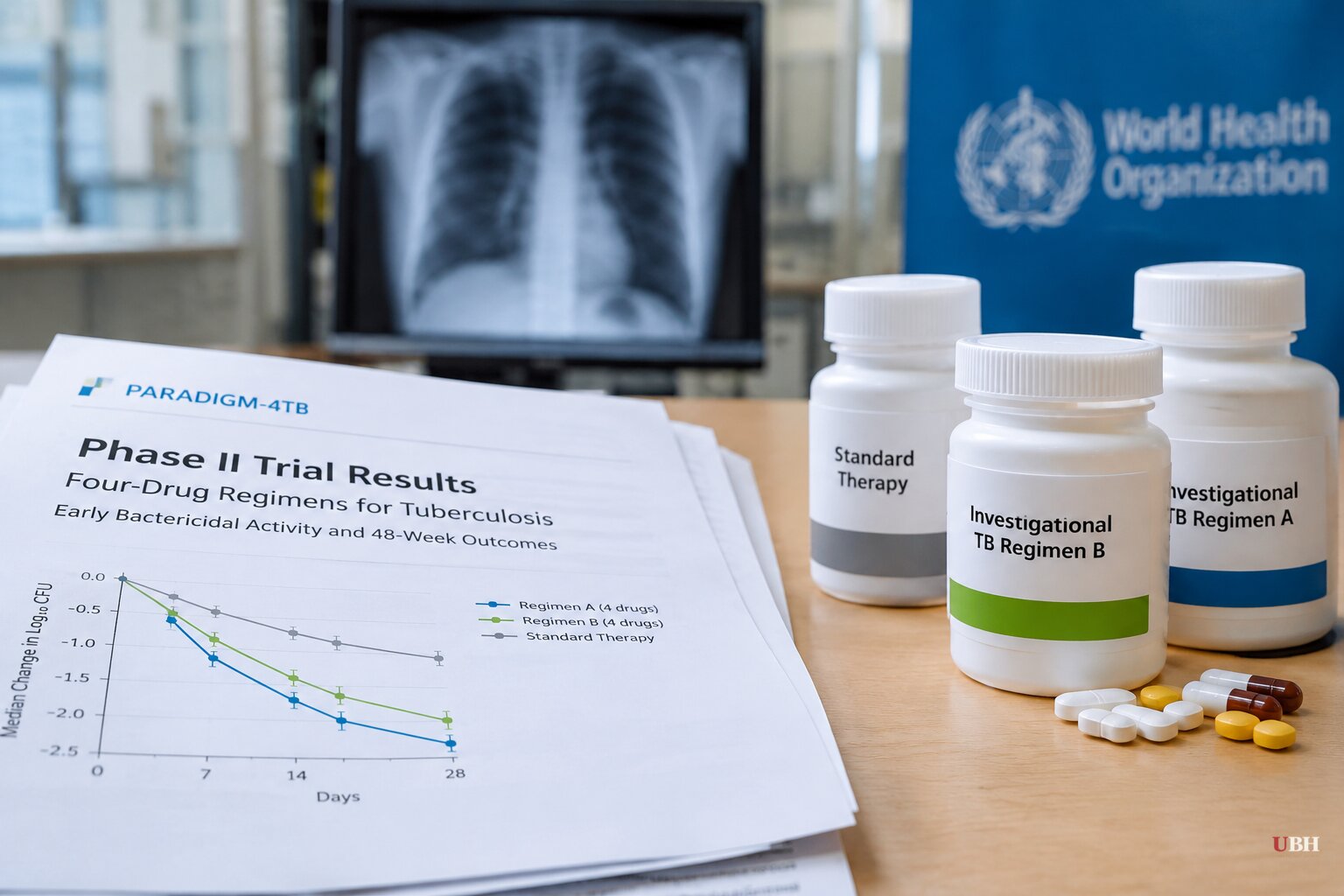
Tuberculosis is still the world's leading infectious killer. The newest numbers show it is killing slightly fewer people, and two new drug combinations just cleared an early hurdle. Money is the problem.
What the PARADIGM-4TB trial found
Researchers led by Nicholas Paton of the National University of Singapore published phase II results in the New England Journal of Medicine. The PARADIGM-4TB platform trial tested investigational regimens against the standard six-month combination of isoniazid, rifampin, pyrazinamide and ethambutol (HRZE) in people with rifampin-susceptible pulmonary TB. According to the published account, it enrolled 401 adults at 14 sites in South Africa, Tanzania, Uganda, Vietnam and Moldova.
The primary measure was the time-to-positivity slope. It tracks how fast the time needed for TB bacteria to grow in a sputum culture changes over 12 weeks. A steeper slope means faster clearance.
The numbers, in log10 days per week:
- Ganfeborole plus bedaquiline, pretomanid and moxifloxacin (BPMG): 0.129
- BTZ-043 plus bedaquiline, delamanid and moxifloxacin (BDMT): 0.142
- Standard HRZE: 0.118
That is a relative improvement of 9.1% for BPMG and 20.5% for BDMT. The posterior probability of superiority over HRZE was 0.83 for BPMG and 0.99 for BDMT.
The 48-week outcomes are mixed
At week 48, 93% of the BDMT group had a favorable outcome, against 89% on standard therapy. BPMG came in at 80%, below the standard arm.
The investigational regimens ran 16 weeks, versus 24 weeks for HRZE, according to the trial description. Both new combinations move to the trial's second stage.
Hanif Esmail of University College London, the trial's clinical lead, said the platform design let investigators "evaluate more treatment options in less time than traditional approaches allow."
The caution from Harvard
Eric Rubin of the Harvard T.H. Chan School of Public Health, writing in an accompanying NEJM editorial, called the design "a potentially very useful approach to prioritizing which regimens should be tested in very long and expensive phase III trials." He also said the growing pipeline of new TB agents "creates a combinational nightmare."
Rubin warned against reading too much into the early marker. "Although almost all drug combinations can kill the bulk of bacteria, a small subpopulation seems to be responsible for the lengthy regimens that are necessary to cure all patients," he wrote. Time to positivity, in his words, "most likely tell us more about the bulk population than about the rarer bacteria that might survive for extended times."
His conclusion: later-phase trials remain essential. Quoting Miracle Max from "The Princess Bride," he wrote, "You rush a miracle man, you get rotten miracles."
A second four-month trial is coming
On Nov. 10, the PAN-TB Collaboration announced a separate phase 2 trial of a four-drug regimen meant to cut drug-sensitive TB treatment from six months to four. It combines two Gates Medical Research Institute compounds, TBD09 and TBD11, with TB Alliance's sorfequiline and pretomanid. Three four-month all-oral arms will be tested against HRZE.
Enrollment is expected to begin in the third quarter of 2027 at sites in Africa and Asia. Charles Wells, chief medical officer of Gates MRI, said the current first-line regimen "is decades old, and drug-resistant strains have developed." He added that evidence from a related ongoing trial could show whether treatment can shrink to three months.
WHO: deaths down, funding down
WHO's latest global TB report counts 10.6 million people falling ill with TB in 2025 and 1.13 million deaths. That is a 4% drop in deaths from 2024 and 35% below 2015. The 35% figure hits the first milestone of WHO's End TB Strategy, five years late. The 2035 goal is a 90% cut.
The funding picture is worse. TB funding reached $6.6 billion in 2025, up from the prior year but far short of the $22 billion per year UN member states set as a 2027 target. International donor funding fell from $1.1 billion in 2024 to $0.94 billion in 2025, a 14% decline.
The U.S. was a top TB donor before 2025, and USAID was the lead implementing agency. An analysis by KFF found 79% of USAID's TB-related awards were terminated in 2025, after the Trump administration dismantled the agency. WHO says other donors also cut funding.
"Innovation alone will not end TB," said Tereza Kasaeva, director of WHO's Department for HIV, Tuberculosis, Hepatitis and Sexually Transmitted Infections.
Migrant treatment interrupted in South Africa
Doctors Without Borders and other aid groups say anti-illegal-migration protests in South Africa have disrupted care for migrants, including people on HIV and TB treatment. Some protesters have blocked foreigners from clinics, claiming public facilities are reserved for South Africans. South African law allows foreigners to receive treatment there. Protesters also accuse people in the country illegally of crime, taking jobs and straining public services.
Claire Waterhouse, Doctors Without Borders' advocacy director for Southern Africa, said many migrants at displacement sites went months, and in some cases up to a year, without care for fear of being turned away or harmed. She said patients who default on TB treatment face worsening illness and raise the risk of drug resistance in the wider population.
Tens of thousands of migrants have gone home to countries including Malawi, Nigeria and Ghana. Khanyisa Mapipa, an attorney with the rights group Section27, said a December 2025 court order compelled the Gauteng health department and the city of Johannesburg to produce a plan to let patients into facilities. The second part of that application is still pending.
What comes next
The BPMG and BDMT regimens now enter the second stage of PARADIGM-4TB, where relapse and treatment-failure data will decide whether either advances to a phase III trial. The PAN-TB trial is not expected to begin enrolling until the third quarter of 2027.
Sources used for this briefing
5 links from 5 independent newsrooms (syndicated copies of the same report count once)
These are the sources it draws on, linked so you can verify.


