
Unbiased headlines. Facts, not spin.
Unbiased Headlines is an independently owned news organization. We bring you the facts, not opinions, written fresh from 110+ named sources. Sources linked so you can verify it yourself.
 health
Notable (6/10)
Engineered Malaria Vaccine Blocked Infection in 13 of 15 Volunteers in Small Phase 1 Trial
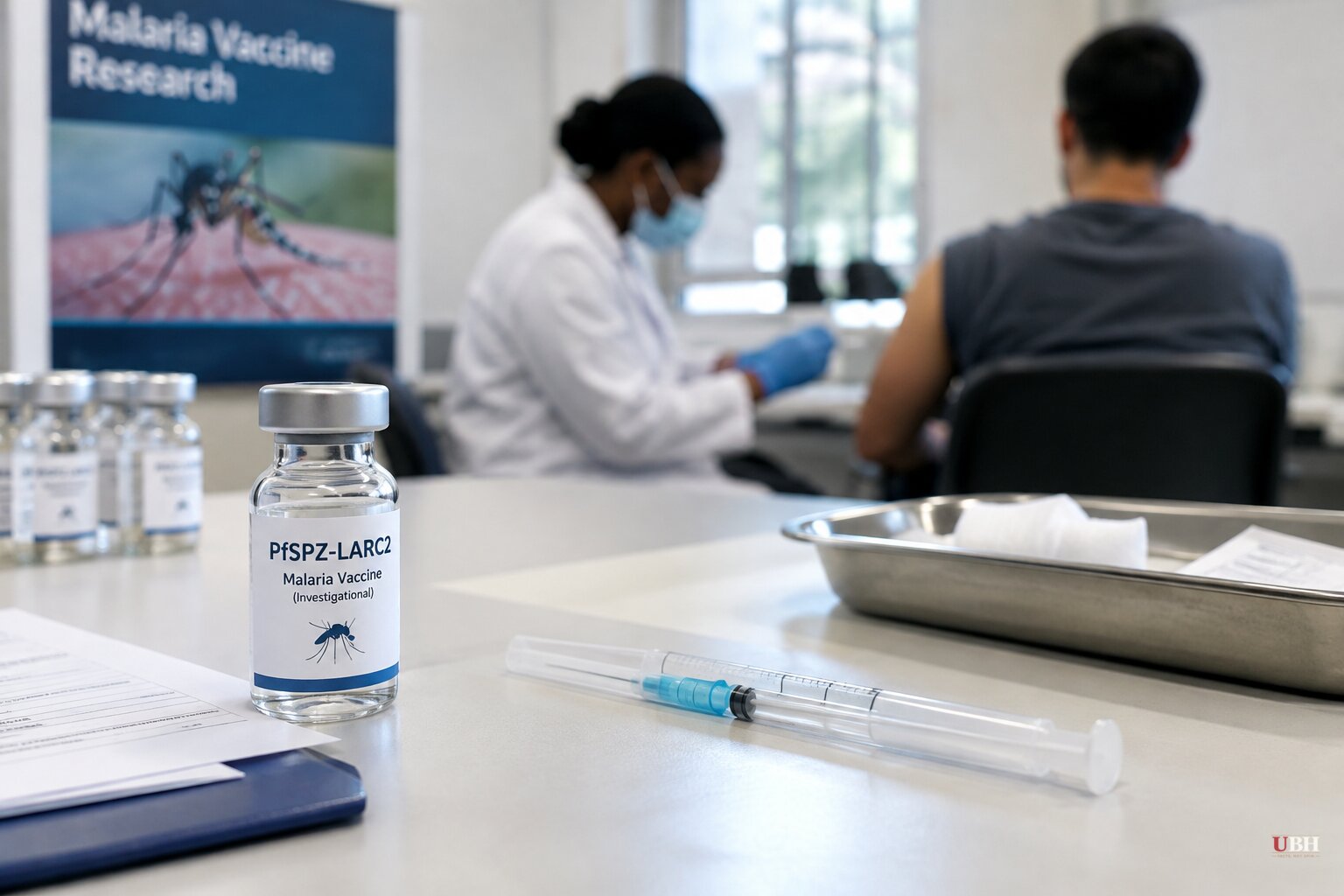
A live, genetically engineered malaria vaccine kept 13 of 15 vaccinated volunteers free of infection after researchers deliberately exposed them to the parasite. All seven volunteers given a placebo became infected.
That works out to 87% efficacy against infection. Dr. Sean C. Murphy of the University of Washington School of Medicine and Seattle Children's Hospital presented the Phase 1 results on Nov. 19 at the annual meeting of the American Society of Tropical Medicine and Hygiene near Washington, D.C.
What the trial did
The vaccine is called PfSPZ-LARC2. It is made from live Plasmodium falciparum sporozoites, the form the parasite takes when a mosquito injects it.
Two genes, Mei2 and LINUP, have been deleted. The parasite grows in the liver like a normal malaria parasite, then stalls late in the liver stage, before it can reach the blood and cause illness. Because it lives long enough to show the immune system a wide range of parasite proteins, the approach differs from the two WHO-recommended childhood vaccines, RTS,S and R21, which each target a single protein.
Twenty-two healthy volunteers were exposed to malaria 12 to 16 weeks after their last dose. Fifteen had been vaccinated and seven had received placebo. Two vaccinated volunteers became infected. Everyone who got infected was promptly treated.
The challenge parasite did not match the vaccine. The vaccine strain originates in West Africa. The challenge strain was a Brazilian parasite, identified by Sanaria as 7G8, from South America.
Sanaria Inc., the Rockville, Maryland, company that developed and manufactured the vaccine, said the two vaccinated volunteers who got infected carried fewer parasites in their blood than the placebo group. It also reported no vaccine-related serious adverse events and called the vaccine safe and well tolerated.
Who made it and who paid
The attenuated strain was created in the Seattle Children's laboratory of Dr. Stefan Kappe, who now directs the Center for Vaccine Development and Global Health at the University of Maryland School of Medicine. Co-inventors include Debashree Goswami and Ashley Vaughan. Sanaria took it from there.
The trial ran through the Infectious Diseases Clinical Research Consortium and was sponsored by the National Institute of Allergy and Infectious Diseases, part of the National Institutes of Health. That makes it federal taxpayer-funded research. Enrollment began in summer 2025. Murphy's co-principal investigators were Dr. Jim Kublin of Fred Hutch Cancer Center and Dr. R. Scott McClelland of the University of Washington.
"We engineered the PfLARC2 strain with the goal to have a safe vaccine that stimulates a superior response against malaria parasite infection in the liver," Kappe said. He called it rewarding to see protection against "a highly divergent malaria strain."
The size of the number
Sanaria's own release gives a 95% confidence interval of 60% to 99% for the 87% estimate. That is a wide band. A Tech Times analysis noted that the WHO's preferred product characteristics cite 90% protection over 12 months as an example target for infection-blocking vaccines, and that a 22-person trial cannot say which side of that line the true figure sits on.
The same analysis pointed out that the volunteers were healthy, malaria-naive adults, tested against one challenge strain at one time point. Medical Daily likewise described the trial as small and early, and said the vaccine is not available. People living in malaria-endemic areas, with prior exposure and different immune histories, may respond differently.
Sanaria, which announced the results, is also the company that stands to gain from them. The efficacy figure comes from the trial team's presentation and the company's release, not from a regulator's review.
There is a track record behind the approach. A first-generation strain with a single gene deletion, delivered by mosquito bite, protected 90% of volunteers in a study published in Nature Medicine in January 2025, according to Sanaria. LARC2 carries two deletions as an added safety margin and is given by injection.
The stakes
The WHO's World Malaria Report 2025 estimates that malaria infected 282 million people and killed about 610,000 in 2024. About 95% of those deaths were in Africa, mostly among children under five.
Sanaria says a vaccine that blocks infection outright could protect the person vaccinated and also cut transmission, a step toward elimination. That is the company's claim about the potential, not something this trial tested.
The next evidence will come from the field. Phase 2 studies of PfSPZ-LARC2 are already running in Burkina Faso and Mali, according to trial registry entries. A first-in-human study in Burkinabe adults and children has been posted on medRxiv. Regulators have not been asked to approve the vaccine, and no approval timeline has been announced.
Sources used for this briefing
7 links from 7 independent newsrooms (syndicated copies of the same report count once)
These are the sources it draws on, linked so you can verify.


