
Unbiased headlines. Facts, not spin.
Unbiased Headlines is an independently owned news organization. We bring you the facts, not opinions, written fresh from 110+ named sources. Sources linked so you can verify it yourself.
 economy
Major Story (7/10)
TSMC October Revenue Hits Record NT$586.89 Billion, Up 59.7% as AI Chip Orders Climb
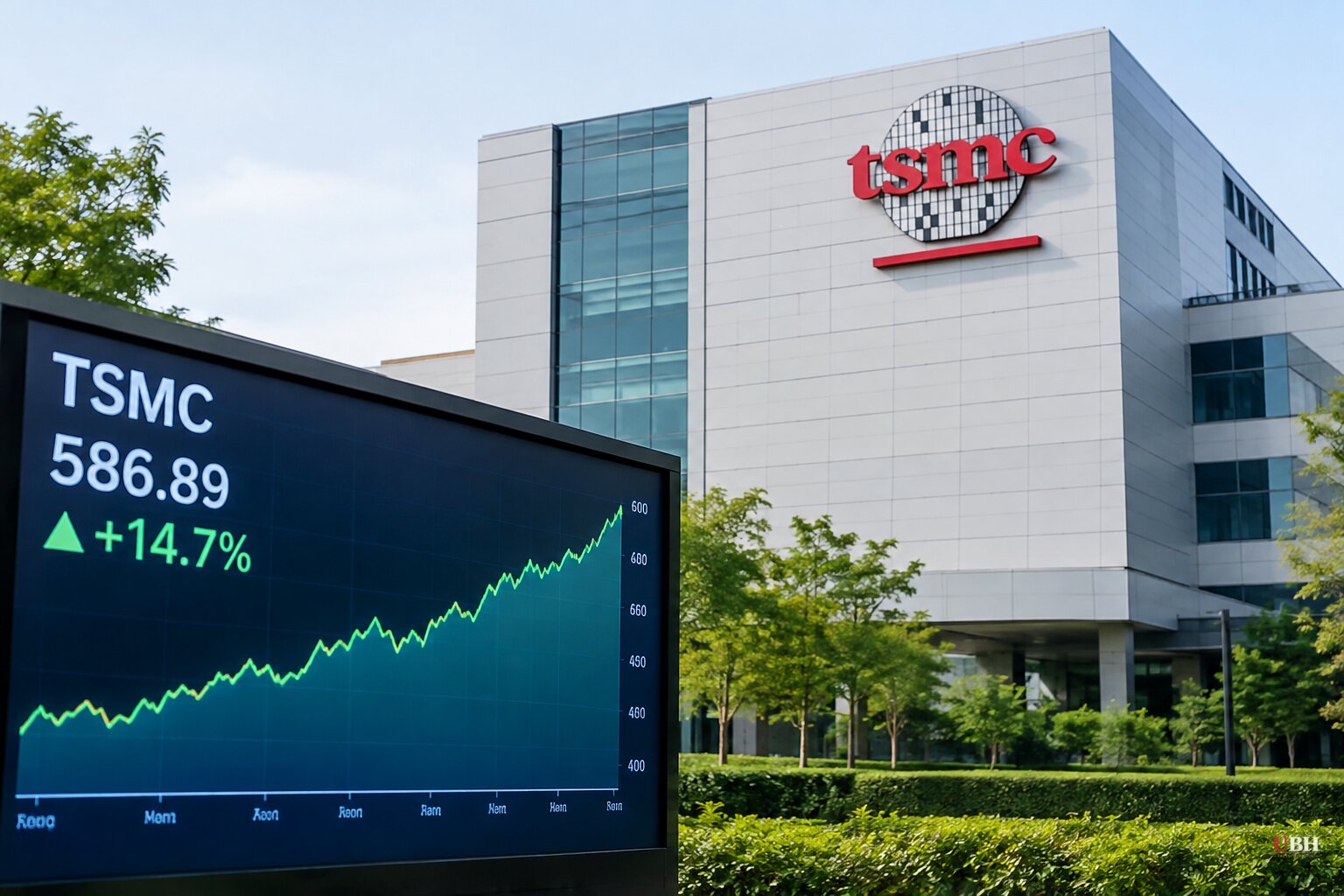
Taiwan Semiconductor Manufacturing Co. said Tuesday, Nov. 10, that October revenue came in at NT$586.89 billion ($17.88 billion). That is up 59.7% from a year earlier and 14.7% from September's NT$511.86 billion, according to the company's monthly sales announcement. It is an all-time monthly high.
The year-over-year growth rate has accelerated. September's was 54.6%. For January through October, cumulative revenue reached NT$4.4856 trillion, up 43.3%, versus 41.1% growth through the first nine months.
The numbers behind the jump
The world's largest contract chipmaker is a central supplier to Nvidia and Apple, and demand for advanced processors used in AI systems continues to run ahead of supply.
Last month TSMC reported record third-quarter net profit of NT$763.1 billion, up 68.7%, on revenue of NT$1.49 trillion. Its operating margin hit 58.7%, above the top of its own guidance range of 58%. The 3-nanometer, 5-nanometer and 2-nanometer processes made up 33%, 28% and 8% of wafer revenue.
For the fourth quarter, TSMC guided to revenue of $52.3 billion to $54.3 billion, a gross margin of 65% to 67% and an operating margin of 56.5% to 58.5%. Analysts on average project 63% revenue growth for the quarter, up from roughly 51% in the September quarter.
TSMC shares closed 2.24% higher in Taiwan on Tuesday.
Spending at record levels
TSMC says its capital spending from 2026 through 2028 will be significantly higher than in the previous three years. It has reiterated that 2026 capex will reach as much as $64 billion, a record.
The company is trying to build and equip about 20 factories at home and abroad. It typically works on four or five new buildings at a time. CEO C.C. Wei has described the company as in "prudent expansion mode." He has said TSMC is exploring a new manufacturing site in Texas and discussing a potential tie-up with Elon Musk's Terafab chipmaking venture.
Taiwan's export boom
Government data released Monday showed Taiwan's October exports rose 58.9% from a year earlier to $96.76 billion, a third straight monthly record. Analysts had forecast about 50%. Electronic components shipments rose 61.4% to $32.68 billion. Exports to the United States climbed 55.9% to $32.93 billion, and shipments to China rose 42.9%.
Imports jumped 75.1% to $68.89 billion. Taiwan's Ministry of Finance expects November exports to grow 47% to 51%, citing holiday orders and continued demand for AI infrastructure.
Separately, Taiwan's financial regulator tightened short-selling rules last week. Since Monday, the daily limit on intraday short-selling orders has dropped from 30% to 3%.
The American side of the ledger
The flip side of Taiwan's record is visible in U.S. data. The Commerce Department reported Thursday that third-quarter GDP grew at a 3.4% annualized rate, up from 2.2% in the second quarter. Equipment investment grew at a 20.9% rate and added 1.16 points to growth. Computers and peripherals alone added 0.72 point.
Imports grew at a 19.7% annualized rate, with goods imports up 26.4%. Net exports subtracted 3.32 percentage points from growth. Harvard economist Jason Furman noted that this is the third-largest negative contribution in the quarterly series, which goes back to 1947.
Breitbart's business digest argues this shows the cost of decades of neglect of U.S. manufacturing. In its words, American businesses are building the infrastructure of the future while foreign factories supply much of the equipment. Its framing is that import dependence is the hidden price of the AI boom.
Some of that is already being addressed. GlobalFoundries CEO Tim Breen said a U.S.-Japan partnership will bring up to $21 billion in investment for two new semiconductor fabrication plants on American soil.
Markets are less certain than the sales figures
TSMC's monthly numbers arrive after a rough week for U.S. chip stocks. The Nasdaq Composite fell 3.37% for the week ended Nov. 6, and the S&P 500 lost 2.68% to 7,376. On Thursday alone, the iShares Semiconductor ETF dropped 12.15%, AMD fell 17.24% and Nvidia fell 9.23%. The Nasdaq lost 5.52% that day.
David Bahnsen, chief investment officer of The Bahnsen Group, told The Epoch Times the pullback reflected the risk of a "blow-off top" in tech. "The recent tech-stock pullback does not represent a buying opportunity," he said. He pointed to complacency around valuations and revenue models.
The midterms added another worry. With Democrats winning Congress, investors have raised expectations of tougher oversight of AI and tighter limits on data-center construction, particularly where electricity demand has become a political issue. Rising financing costs for power-hungry data centers also weigh on the longer-term demand outlook.
None of that shows up yet in TSMC's order book. The test is whether fourth-quarter revenue lands at or above analysts' 63% growth estimate, and whether the finance ministry's 47% to 51% November export forecast holds.
Sources used for this briefing
7 links from 7 independent newsrooms (syndicated copies of the same report count once)
These are the sources it draws on, linked so you can verify.


