
Unbiased headlines. Facts, not spin.
Unbiased Headlines is an independently owned news organization. We bring you the facts, not opinions, written fresh from 110+ named sources. Sources linked so you can verify it yourself.
 economy
Major Story (8/10)
China's Trade Surplus Reaches $1.04 Trillion Through October as Exports Rise 35.2%
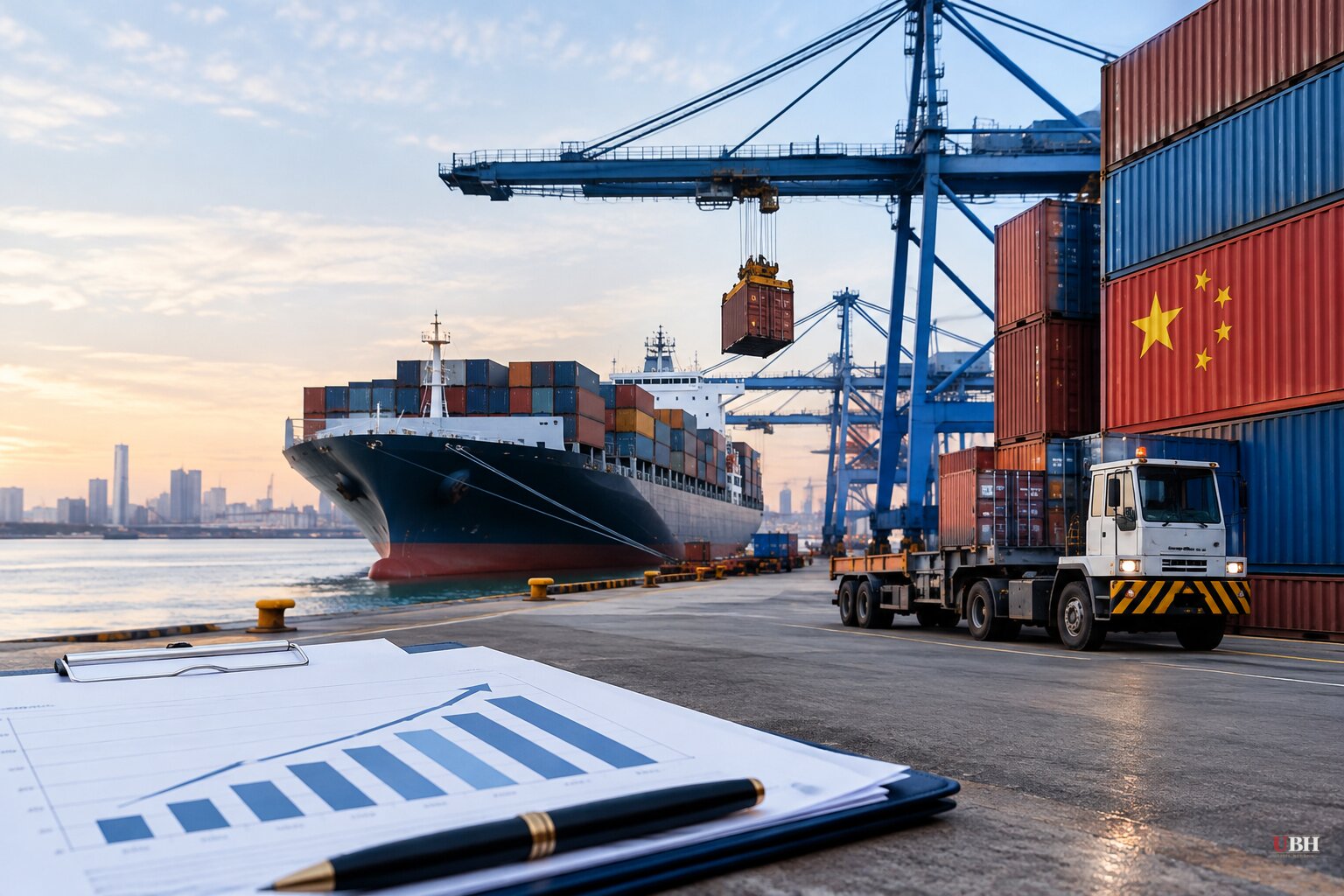
Since China reported a $938.1 billion surplus for the first nine months of 2026, the October figures have pushed the running total past $1 trillion. China's General Administration of Customs released the data Tuesday, Nov. 10, Beijing time.
The surplus for January through October stands at $1.04 trillion. That is the second straight year China has cleared $1 trillion, and it got there a month earlier than in 2025. Last year's full-year record was roughly $1.2 trillion, and this year is on course to beat it.
October: exports up, imports up faster
October exports rose 35.2% from a year earlier in dollar terms. That was a touch slower than September's 36.3%, but ahead of the 33.5% increase economists polled by Reuters had forecast.
Imports rose 41.6%, well above the 32% forecast and September's 31%.
The faster import growth helped shrink the monthly surplus to $105.3 billion from $133.5 billion in September. According to LSEG data cited by CNBC, that is the smallest monthly surplus since April.
What is driving it
High-tech goods are doing the heavy lifting. Semiconductors, electronics and autos have led this year's export growth, and the global race to build AI infrastructure has fed demand for Chinese-made equipment. China does not make the most powerful chips.
"We expect Chinese exports to stay strong for the rest of this year, led by electronics and autos," said Dave Chia, an economist at Moody's Analytics.
Chia also named the downside: "If the AI boom slows or turns into a correction, lower chip and electronics prices and smaller shipping volumes would hit China's exports hard." That concern has deepened with the Democratic victories in the U.S. midterms, given the public backlash against data center expansion.
Exports are also being pulled forward. The EU and Beijing agreed in October to limit Chinese hybrid vehicle exports to the bloc over the next few years, with the restrictions taking effect Dec. 1. Factories are expected to ship more before then.
Weak at home
The export surge sits next to a soft domestic economy. Consumption is subdued and the property slump is in its latest chapter.
Alicia García-Herrero, chief economist for Asia Pacific at Natixis, said overcapacity, excess domestic savings and weak demand are forcing China to ship goods abroad as other countries protect their own industries. "The situation is not sustainable," she said.
Cinders Zhou, who sells eyewear for a manufacturer in Linhai, in Zhejiang province, described the squeeze at the factory level. Products have become so alike that "everyone" has been forced to "compete on price," she said.
In a commentary for The Epoch Times, analyst Wang He cited Chinese data showing retail sales growth of 1.1% and a fixed-asset investment decline of more than 7%. He argues the surplus reflects an economy that cannot consume what it makes.
Beijing's position
Top Chinese officials say Beijing is not trying to enlarge the surplus. They say they want more balanced global trade.
The Shenzhen Cross-Border E-Commerce Association sees the problem the other way around. Its head, Wang Xin, said U.S. and European trade policies have created "a lot of difficulties" for Chinese businesses trying to expand in those markets.
China's trading partners are pressing Beijing to strengthen domestic demand. European leaders have called for more trade curbs.
The U.S. track
China announced Monday, Nov. 9, that it was extending its trade truce with Washington by two months. The truce had been due to expire Nov. 10, and the extension runs into January.
Beijing said last week that any expansion of its purchases of U.S. farm goods depends on both sides implementing the agreed reciprocal tariff-reduction arrangement.
Joe Peissel, lead macroeconomist at Trivium China, said the risk of added tariffs and other trade barriers "will remain elevated in 2027," particularly as Chinese manufacturers keep expanding overseas.
What comes next
President Donald Trump and Chinese leader Xi Jinping are expected to meet on the sidelines of the Asia-Pacific Economic Cooperation summit in Shenzhen later this month. Trade is among the top items likely on the agenda.
The EU hybrid limits take effect Dec. 1. The U.S.-China truce runs only until January. It is unclear whether either set of talks can bring down a surplus that is still growing, with Chinese customs data showing roughly $1.04 trillion banked after ten months.
Sources used for this briefing
6 links from 6 independent newsrooms (syndicated copies of the same report count once)
These are the sources it draws on, linked so you can verify.


