
Unbiased headlines. Facts, not spin.
Unbiased Headlines is an independently owned news organization. We bring you the facts, not opinions, written fresh from 110+ named sources. Sources linked so you can verify it yourself.
 economy
Low Interest (4/10)
TRAI Caps Annual IP Port Charges at ₹5.6 Lakh for 1 Gbps and ₹42.3 Lakh for 10 Gbps, Effective January 2027
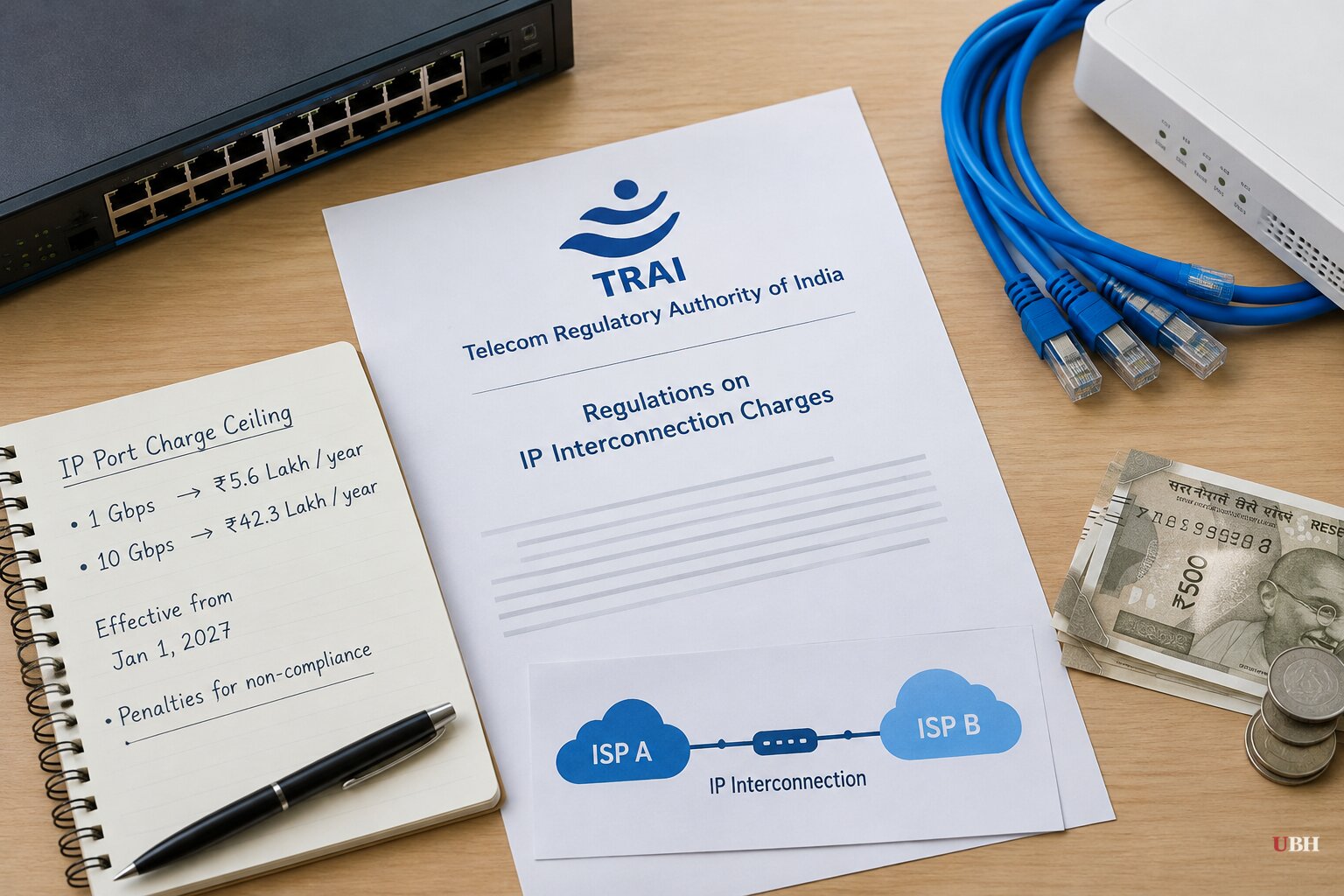
The Telecom Regulatory Authority of India (TRAI) has put a price ceiling on the internet-protocol ports carriers use to hand traffic to one another. The Telecommunication Interconnection (Port Charges) (Third Amendment) Regulations, 2026 were released today, Monday, Nov. 9, and take effect Jan. 1, 2027.
The numbers: annual charges are capped at ₹5.6 lakh for a 1 Gbps IP port and ₹42.3 lakh for a 10 Gbps IP port. A lakh is 100,000 rupees.
How the caps work
The caps are ceilings, not fixed prices. TRAI said providers and seekers can agree to charges below them. They can also agree on other port sizes, as long as the charge is set with the same methodology used for the 1 Gbps and 10 Gbps figures.
The rules apply uniformly across fixed-line, mobile, national long-distance and international long-distance services. TRAI said the charges set earlier "shall continue to apply only to E1 ports."
Why the rulebook needed updating
The existing port-charge framework rests on legacy E1/TDM technology. TRAI said those charges were last revised in 2012. The Telecommunication Interconnection (Port Charges) Regulation, 2001 governs what an interconnection seeker pays an interconnection provider for terminating links at its point of interconnection.
The amendment rewrites the definition of a "port" to cover both legacy E1 ports (2.048 Mbps) and IP ports, with bandwidth measured in Mbps or Gbps. In effect, the rules add an IP price schedule on top of the old one rather than replacing it.
Penalties for breaking the rules
TRAI also wrote in a graded financial disincentive framework. The penalty is capped at ₹15 lakh per service area for each instance of contravention of the specified provisions.
That gives the cap enforcement power. A ceiling with no consequence for ignoring it is only a suggestion.
The consultation record
The regulator started with a pre-consultation paper on April 3, 2025. A formal consultation paper followed on Nov. 10, 2025, and an open house discussion was held on Jan. 28, 2026. TRAI said 17 stakeholders filed comments and nine filed counter-comments.
A separate rule on moving to IP
A companion measure, the Telecommunication Interconnection (Third Amendment) Regulations, 2026, also takes effect Jan. 1, 2027. It requires every new point of interconnection established after that date to be IP-based.
Existing E1/TDM points of interconnection must migrate to IP within three years, in a phased manner. Traffic now handed over at Long Distance Charging Area and Short Distance Charging Area points must likewise move to Licensed Service Area-level points within three years.
TRAI said the shift is expected to simplify network routing, improve management of scarce numbering resources, cut latency and raise service reliability. The same amendment sets a method for determining maximum call-handling capacity at IP points of interconnection, based on concurrent session-handling capability and available link bandwidth, and creates a separate framework for voluntary surrender of a point of interconnection.
What comes next
The two amendments work as a pair. One moves carriers off legacy interconnection over three years, and the other sets the maximum price of the IP ports they will move to.
With the rules taking effect on Jan. 1, 2027, how carriers price their IP ports in negotiations remains open. TRAI's ceiling only binds where they cannot agree on something lower.
Sources used for this briefing
7 links from 7 independent newsrooms (syndicated copies of the same report count once)
These are the sources it draws on, linked so you can verify.


