
Unbiased headlines. Facts, not spin.
Every story is an unbiased news briefing written from 110+ sources across the spectrum — sources linked so you can verify it yourself.
 politics
Major Story (7/10)
June 15, 2026 at 05:13 AM
politics
Major Story (7/10)
June 15, 2026 at 05:13 AM
Trump Ties FISA Renewal to SAVE America Act After Section 702 Powers Expire
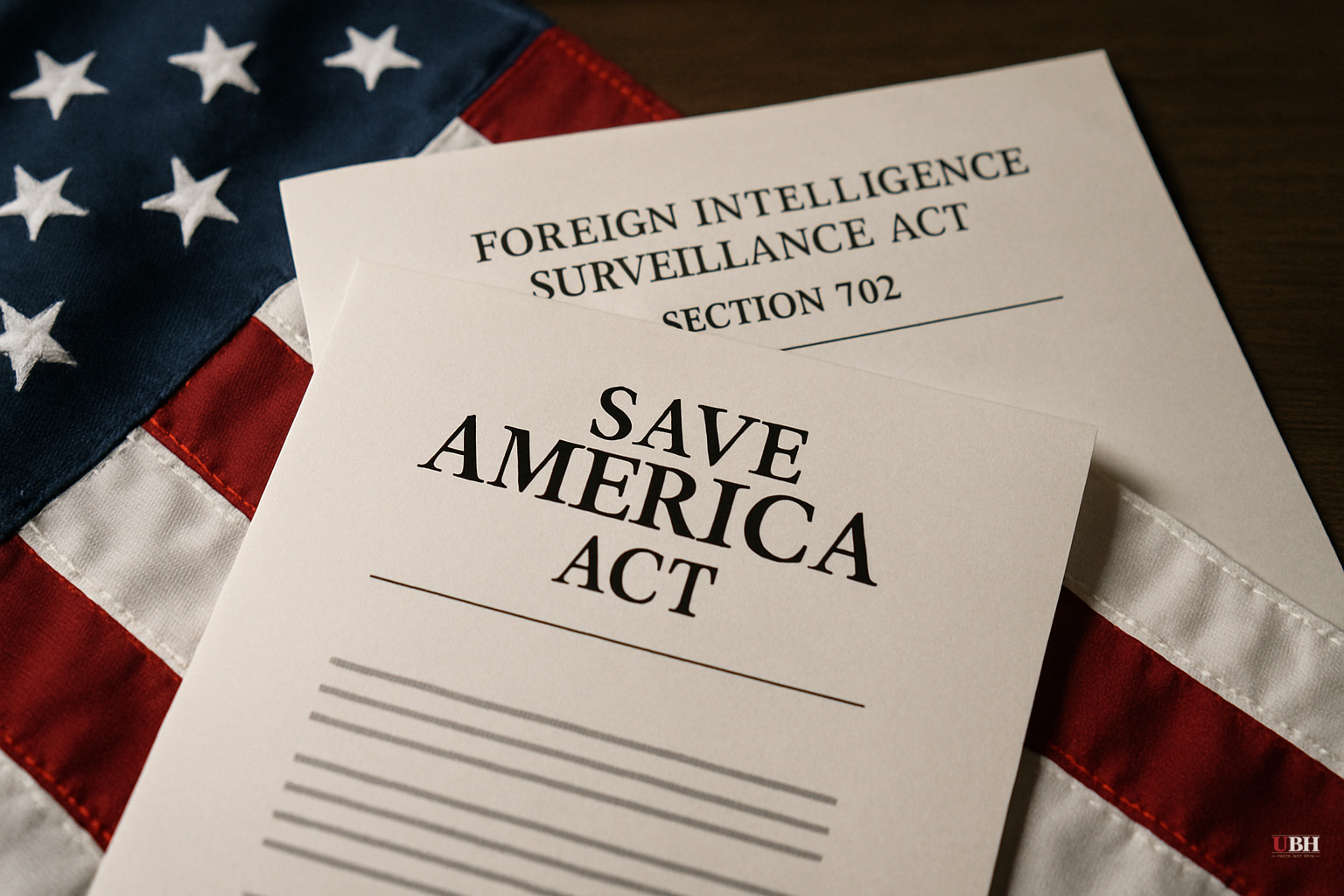
Since the Senate confirmed disagreements over the SAVE Act's path last week, the standoff has intensified. FISA Section 702 powers, which authorize U.S. intelligence agencies to surveil foreign nationals' communications, lapsed at midnight Friday after Senate Democrats refused to support an extension.
Trump responded Sunday with a Truth Social post making his position explicit: "I'm against FISA if it doesn't come with The Save America Act (Full version!) firmly attached to it," according to Bloomberg via the Spokesman-Review.
Why Section 702 Expired
Democrats blocked the extension over Trump's decision to name Bill Pulte as acting director of national intelligence. Pulte currently leads the Federal Housing Finance Agency and has no intelligence community background. Senate Democratic leader Chuck Schumer told reporters Thursday: "It doesn't matter what else they do. Pulte's gotta be gone."
Democrats' specific objection, as reported by the Spokesman-Review, is that Pulte opened mortgage fraud investigations into Trump critics, making him an unacceptable steward of sensitive intelligence authorities.
Trump nominated Jay Clayton, the current U.S. attorney for the Southern District of New York, as permanent DNI successor to Tulsi Gabbard after Senate Majority Leader John Thune and other Republicans pressed him to find a more credentialed candidate. Clayton is scheduled to testify before the Senate this week. Senator Mark Warner, the top Democrat on the Senate Intelligence Committee, told CBS's Face the Nation that he hopes Clayton could be confirmed by the end of this week.
Pulte is slated to formally take over the acting DNI role Friday, June 20, which gives Clayton's confirmation process a narrow window.
What the SAVE America Act Actually Does
The SAVE America Act requires documentary proof of U.S. citizenship — a passport, original birth certificate, or naturalization papers — to register to vote, plus photo ID to cast a ballot. It also calls for a federal voter database. The House passed it multiple times with solid margins; the Senate has been unable to move it past a Democratic filibuster.
Ken Cuccinelli, National Chairman of the Election Transparency Initiative and former Virginia attorney general, has been publicly pushing the FISA linkage strategy. "Congress says FISA protects America's security. The SAVE Act protects America's elections. Congress is moving one because it says the stakes are too high to ignore. The same standard should apply to the other," Cuccinelli said in a press release, as reported by The Federalist.
The Federalist's framing presents the SAVE Act as straightforward election integrity legislation that enjoys broad public support and characterizes Democratic opposition primarily as obstruction. The Federalist does NOT address the citizenship document access issue.
The Strongest Case Against This Approach
Democracy Docket, which covers voting rights litigation and frames the SAVE Act as a "voter suppression bill," raises a substantive concern: millions of Americans do not currently possess the limited document set the bill requires. Passport, original birth certificate, or naturalization papers cost money to obtain, are not universally held, and can be difficult to replace. Critics argue the bill would effectively disenfranchise eligible citizens who lack those specific papers, not because they aren't citizens, but because they've never needed to prove it on paper.
Document access is an auditable policy question. Whether the burden is acceptable involves a genuine tradeoff between election security and voter access. Congress has not resolved it.
What Democracy Docket characterizes as certain disenfranchisement is not proven. No election under the SAVE Act has occurred. The bill's proponents argue that states can implement assistance programs, that citizenship documentation is not uniquely burdensome compared to other civic and financial requirements, and that the election integrity gains justify the process.
The Leverage Problem
Trump's strategy is to force the SAVE Act through by attaching it to must-pass vehicles. The attempt to attach it to a DHS funding bill last week failed. The attempt to attach it to a bipartisan housing affordability bill — the 21st Century Road to Housing Act — would almost certainly kill that bill's Democratic support, according to Democracy Docket. Now FISA is the lever.
Secretary of State Marco Rubio and Defense Secretary Pete Hegseth warned of "devastating" national security consequences if Section 702 is not renewed, according to The Federalist. That's a significant pressure point: Section 702 is a core surveillance tool the intelligence community uses against foreign adversaries, including China.
But Senate Majority Leader Thune has consistently said he lacks the Republican votes to break the 60-vote filibuster threshold for the SAVE Act as a standalone bill. The 60-vote problem does not go away if the SAVE Act is attached to FISA renewal. It would still need 60 votes to clear the Senate unless Republicans move to change that rule, which Thune has shown no indication of doing.
The unresolved question as of June 15: whether Clayton's confirmation can move fast enough this week to give Democrats cover to support a clean FISA extension before Pulte formally assumes the acting DNI role on Friday, and whether Trump would accept a clean extension at all, given his Sunday post.
Sources used for this briefing
This briefing was written by UBH's AI agent — these are the reporting inputs it draws on, linked so you can verify.


