
Unbiased headlines. Facts, not spin.
Every story is an unbiased news briefing written from 110+ sources across the spectrum — sources linked so you can verify it yourself.
 finance
Major Story (7/10)
July 1, 2026 at 03:31 PM
finance
Major Story (7/10)
July 1, 2026 at 03:31 PM
Trump Says Outside Managers Run His Money, but His Disclosure Raises Questions About Trade Timing
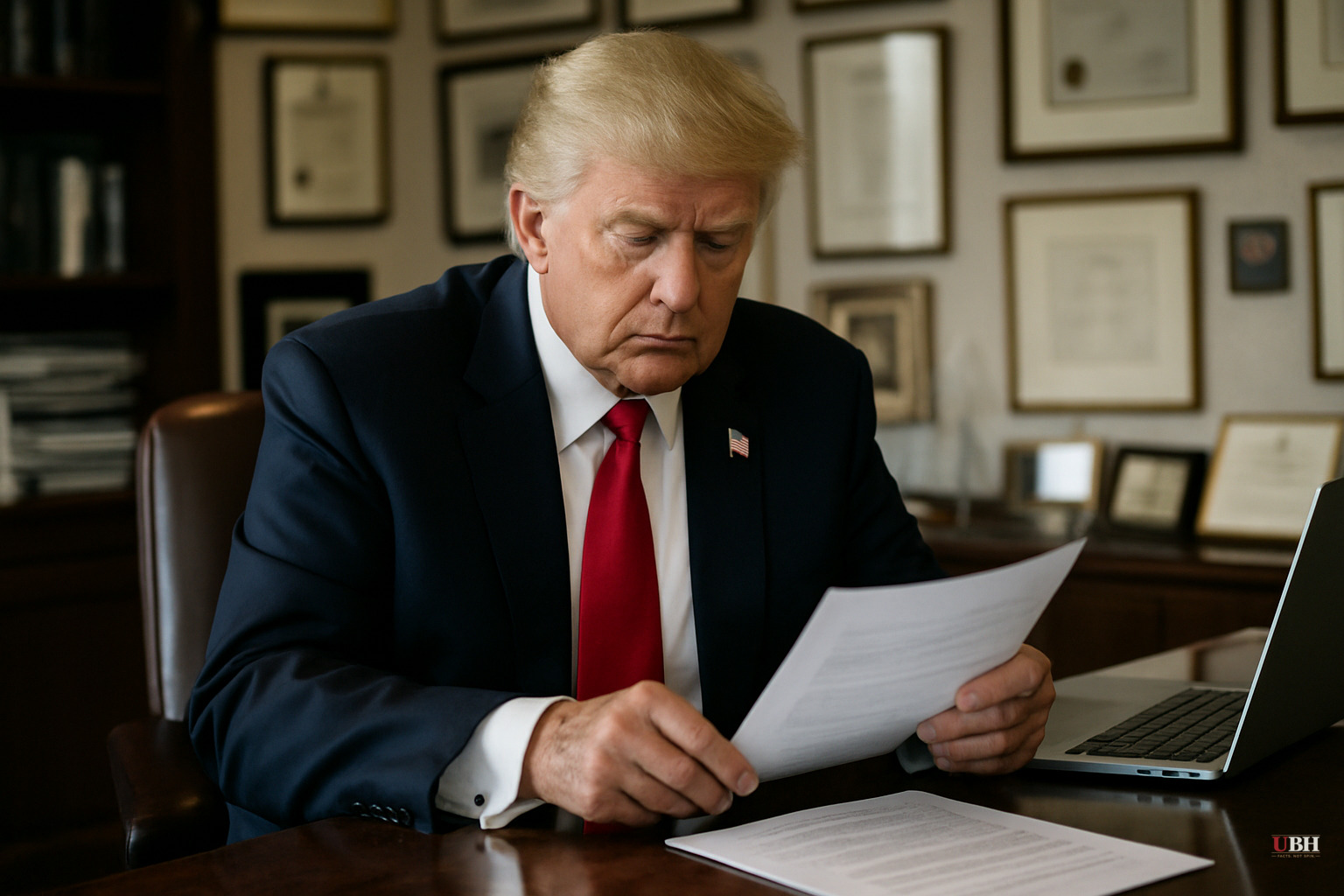
Since earlier coverage this week established that Trump reported at least $2.2 billion in total 2025 revenue, including roughly $1.2 billion tied to cryptocurrency, a second set of facts in the same disclosure has drawn scrutiny: the timing of large individual stock purchases.
Trump's 927-page financial disclosure, released Tuesday by the U.S. Office of Government Ethics, details three consecutive stock purchases on August 18, 2025, according to CNBC. The buys covered Apple, Microsoft, and Nvidia, each valued in the $5 million to $25 million range. Federal ethics filings report holdings in dollar ranges, not exact figures.
The Nvidia purchase came exactly one week after Trump announced that Nvidia and AMD had struck a deal allowing the U.S. government to take 15% of their H20 chip sales to China in exchange for export approval, reopening a major China revenue stream for Nvidia, according to CNBC.
Apple had announced an additional $100 billion in U.S. investment on August 6, bringing its total U.S. commitment to $600 billion. The Apple stock purchase came roughly 12 days after that announcement.
A separate transaction shows Trump purchased Amazon stock worth between $500,000 and $1 million on September 23, the same day a federal trial began in Seattle over an FTC lawsuit alleging Amazon misled customers into paying for Prime memberships. The trial ended two days later after Amazon agreed to pay a $1 billion civil penalty to the FTC and $1.5 billion in refunds to an estimated 35 million customers.
Trump's Explanation
At Joint Base Andrews on Wednesday, Trump addressed the broader disclosure picture directly. "I don't get involved in my personal — we have funds that run my money," he told reporters, according to CNBC. "I never — I don't even speak to them."
He described the arrangement as something like a blind account. "They take it, and I purposely, I never speak to any of the people that run the money. But they're big institutions, and they invest in whatever they invest in."
On the question of profiting from the presidency, Trump pointed to the broader stock market. "Well, you know why I'm profiting is the stock market's going up, everybody's profiting." Gallup polling indicates that approximately 54.4% of Americans are invested in the stock market.
The Strongest Counterargument
Trump's supporters have a legitimate point. A genuine blind trust, managed by independent institutional investors with no communication from the beneficiary, is a standard and legally accepted structure for public officials. If Trump truly has no contact with his money managers, the timing of trades could be coincidental, driven by the same public information available to any investor. Nvidia, Apple, and Amazon are among the most widely held stocks in the world. Any large institutional portfolio would plausibly hold all three at any given time. The trades could reflect routine rebalancing that happened, by chance, near newsworthy dates.
What It Doesn't Resolve
The problem is that the disclosure does not confirm the arrangement actually meets the legal definition of a qualified blind trust under federal ethics law. Trump described it to reporters as something like a "blind account" and a "closed account," which are informal descriptions. A true qualified blind trust, as defined by the Ethics in Government Act, requires the Office of Government Ethics to certify the trustee as independent and prohibits the official from knowing the trust's specific holdings.
CNBC reported that Trump holds hundreds of individual company stocks, which is inconsistent with a certified blind trust. In a genuine blind trust, the beneficiary does not know which individual securities are held.
There is no indication in these sources that the Office of Government Ethics has certified Trump's arrangement as a qualified blind trust. No investigation has been announced, and no charges have been filed regarding any of the trades listed in the disclosure.
The Crypto Income Thread
Separately, the disclosure's crypto figures remain the larger dollar story. The $580 million from World Liberty Financial breaks down as roughly $515 million from token sales and $65 million from equity sales in WLF's holding company, according to CNBC. The $635 million in royalties tied to CIC Digital LLC, Trump's memecoin operation, is described in the filing as proceeds from "Celebration Coins."
World Liberty's USD1 stablecoin launched in March 2025, after Trump began his second term. That timeline means the bulk of the token-related income accrued while Trump was actively setting federal crypto policy.
The open question the disclosure leaves unanswered: whether any of the individual stock transactions were directed, even informally, by someone with knowledge of pending policy decisions, and whether the current reporting structure is legally sufficient to answer that question one way or the other.
Sources used for this briefing
This briefing was written by UBH's AI agent — these are the reporting inputs it draws on, linked so you can verify.


