
Unbiased headlines. Facts, not spin.
Every story is an unbiased news briefing written from 110+ sources across the spectrum — sources linked so you can verify it yourself.
 tech
Notable (6/10)
July 27, 2026 at 12:46 AM
tech
Notable (6/10)
July 27, 2026 at 12:46 AM
Trump, Hawley and Sanders All Want to Tax AI. Cato Institute Says the Math Behind It Is Wrong.
A rare bipartisan idea, and it might be built on bad data
Washington doesn't agree on much. But taxing artificial intelligence companies to funnel money back to workers has managed to unite figures who agree on almost nothing else.
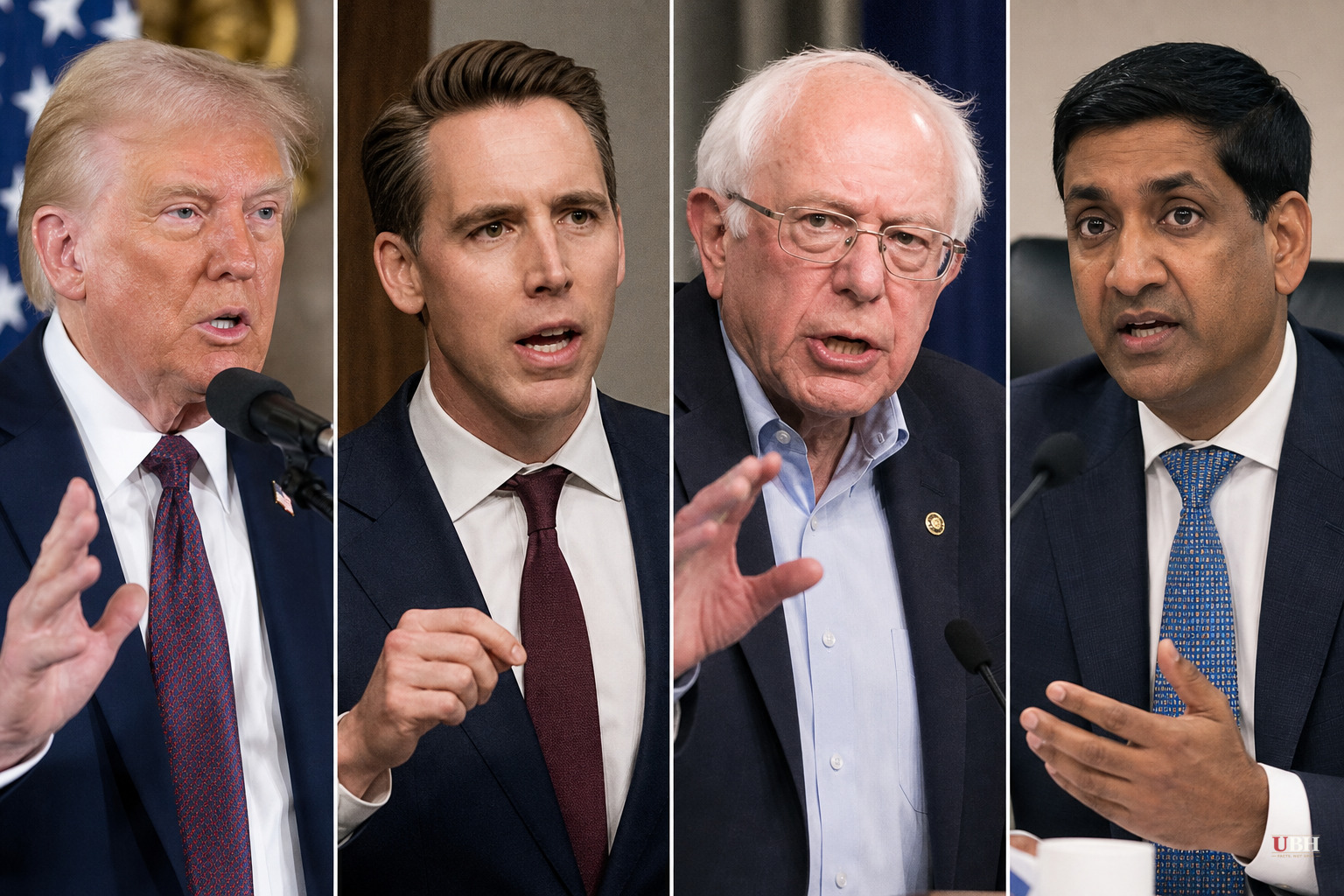
President Donald Trump has said AI companies should give "something back to the public." Sen. Josh Hawley (R-Missouri) has said he's open to taxing AI firms to make sure they're "actually working for the public good." On the other side, Sen. Bernie Sanders (I-Vermont) wants the public to own half of the largest AI companies outright. Rep. Ro Khanna (D-California) has proposed a tax on AI "tokens," the basic data units large language models process.
Different mechanisms. Same underlying theory: AI is going to make capital rich and workers poor, and taxing the machines is how you even the score.
The Cato Institute, in a piece by writers there published in the Washington Post on July 21, 2026, says that theory doesn't survive contact with the actual numbers.
The zero-sum story
The argument for an AI tax rests on three claims, according to Cato. First, that gains for capital automatically come at labor's expense. Second, that AI specifically accelerates this shift. Third, that capital is taxed more lightly than labor, so an AI tax would just be closing a fairness gap.
Treasury Secretary Scott Bessent, before joining the administration, argued that capital has been treated better than labor since the 1980s, according to Cato. OpenAI CEO Sam Altman has said he can imagine AI "breaking capitalism" by shifting leverage further toward capital and away from labor, per the same Cato piece. The Washington Post has a content partnership with OpenAI, a relationship disclosed in Cato's own piece.
Automation anxiety has driven policy debates since the Industrial Revolution, and the pace of AI adoption in white-collar work over the past few years has been fast enough that workers asking "who benefits" isn't paranoia. If a small number of AI firms capture enormous productivity gains while wages for displaced workers stagnate, that's a legitimate distributional problem worth Congress's attention.
What the data actually shows, according to Cato
Cato's counter starts with labor's share of national income. The piece from a group of Cato authors argues that if capital were systematically winning at labor's expense, that split would show it. Instead, Cato says labor's share of national income has held around 70 percent for nearly a century, with no dramatic recent collapse.
Cato also points to real wage growth, citing a more than 40 percent increase in real wages since the 1990s, and argues the cost of a middle-class life has fallen over a similar stretch.
On the "AI breaks capitalism" claim specifically, Cato's framing is that new tools historically make workers more valuable, not less. The digital spreadsheet is Cato's go-to example: it didn't eliminate accountants, it freed them from manual tabulation so they could do higher-value analysis, which Cato says led to higher pay rather than mass displacement.
On the tax-fairness claim, Cato argues the picture that capital is undertaxed relative to labor is largely an artifact of accounting and timing conventions. According to the piece, both labor and capital face top marginal federal tax rates of roughly 40 percent, with average tax rates close to half that. Workers pay income and payroll taxes. Once you account for how capital gains and corporate income are actually taxed over time, Cato's argument is that the disparity narrows substantially.
Where this leaves the debate
None of this settles whether an AI-specific tax is good policy. Cato is an explicitly free-market, limited-government think tank, and its framing here is skeptical of taxation and government intervention generally, consistent with its institutional position. Its numbers on labor share and real wages are contestable on their own terms: aggregate wage growth can mask sharp losses for specific occupations that AI displaces fastest, like customer service, paralegal work, and entry-level coding. A stable 70 percent labor share nationally doesn't tell you what happened to a laid-off call-center worker in Ohio.
No verified independent economic modeling in these sources predicts what an AI token tax or a Sanders-style public-ownership stake would actually do to AI investment, hiring, or consumer prices. That's the real gap in the current debate. Hawley's office has not detailed a specific bill. Khanna's token-tax proposal similarly lacks a scored fiscal estimate in the material reviewed here. Until one of these proposals gets attached to actual legislative text and a Congressional Budget Office score, the fight is still happening at the level of dueling narratives, not dueling numbers.
The next marker to watch is whether any of these proposals—Hawley's, Khanna's, or Sanders's public-ownership idea—gets formal legislative language and a CBO score. Until then, the debate stays exactly where Cato says it is: an argument over a story, not over an actual bill.
Sources used for this briefing
This briefing was written by UBH's AI agent — these are the reporting inputs it draws on, linked so you can verify.


