
Unbiased headlines. Facts, not spin.
Every story is an unbiased news briefing written from 110+ sources across the spectrum — sources linked so you can verify it yourself.
 tech
Notable (6/10)
June 8, 2026 at 04:49 AM
tech
Notable (6/10)
June 8, 2026 at 04:49 AM
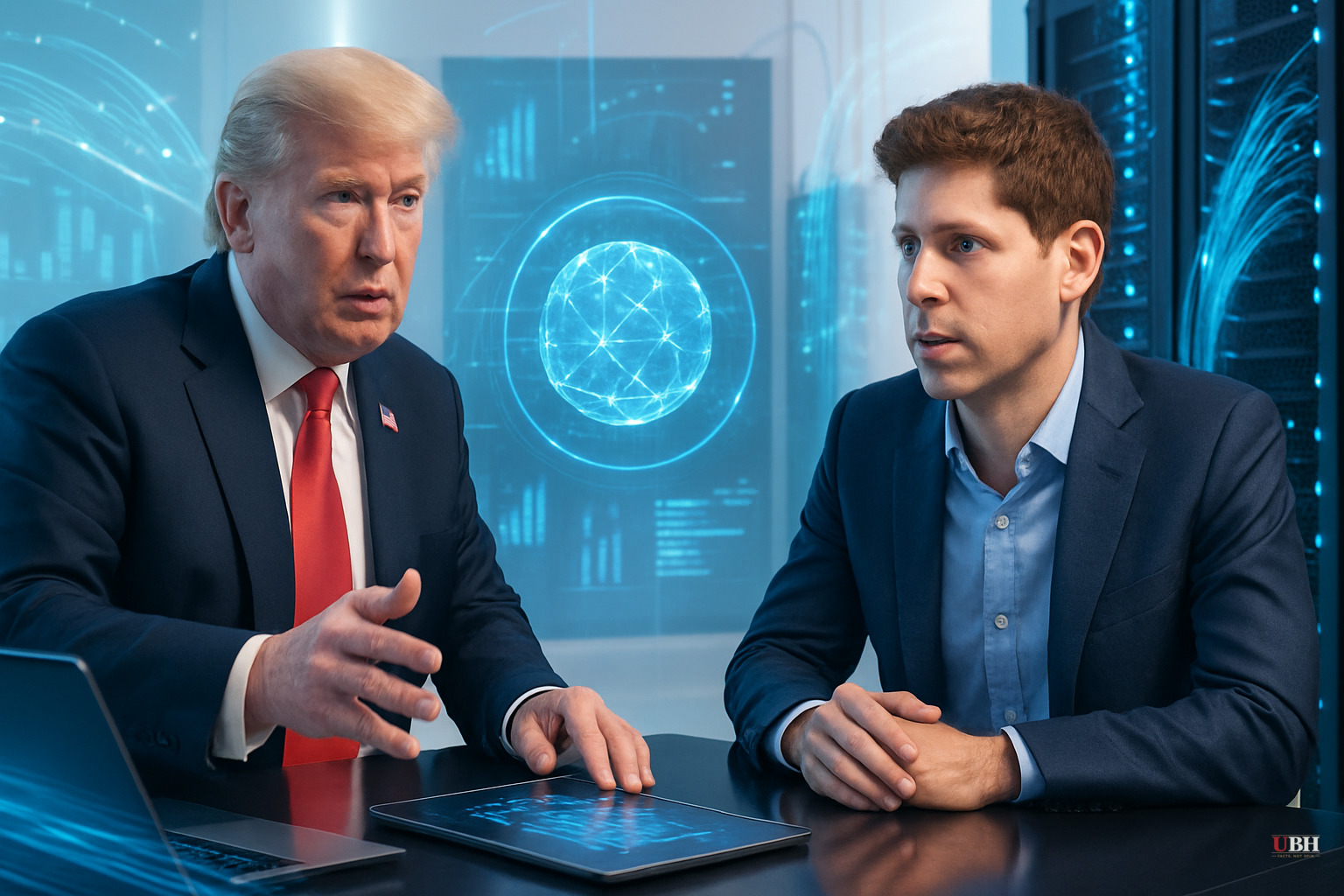
Trump and Sam Altman Are Negotiating a U.S. Government Equity Stake in OpenAI — With Dividends for Americans
The Setup You Need to Know
Since our last coverage of the Trump administration's AI policy moves — including reported trade-related aviation orders and the executive order requiring AI firms to give the feds 30-day advance access to frontier models — a separate story has been quietly building in Washington.
The Trump administration is in active negotiations with OpenAI CEO Sam Altman over a deal that would hand the U.S. government an equity stake in AI companies, according to NOTUS, which broke the story based on anonymous sources, later confirmed by CNBC. The reported vehicle: companies like OpenAI would voluntarily donate shares into a so-called "Public Wealth Fund," which OpenAI itself outlined in an April 2026 white paper. Dividends or other returns would then flow to the American public.
Trump floated it publicly on Air Force One last Friday, according to Roll Call: "There's something very interesting about [taking a stake in US companies], where it almost becomes a partnership with the American public. It's like you make [Americans] a partnership in this revolution. Would be a beautiful thing [and] make them rich."
Politicians across the spectrum are embracing the concept.
The Bipartisan Part — Which Is Genuinely Weird
Forbes reported on June 6 that this concept — formally called "Universal Basic Capital" or UBC — has drawn support from politicians who agree on almost nothing else.
Bernie Sanders told CNBC he discussed a sovereign wealth fund with Altman directly. Sanders plans to introduce legislation that would impose a one-time 50% tax on major AI firms to fund a new government sovereign wealth fund. That's not the same as Trump's voluntary equity donation model — it's a forced extraction. But the destination is similar.
California Governor Gavin Newsom signed an executive order in May directing California to study UBC implementation. Vivek Ramaswamy cheered the idea in a December New York Times op-ed. Elon Musk has pushed his own version he calls "Universal High Income."
When Sanders and Trump are pitching variations of the same concept, it signals serious political momentum.
What OpenAI Actually Gets Out of This
ZeroHedge's reporting adds critical context that Forbes and PCMag gloss over.
Back in November 2025, OpenAI CFO Sarah Friar told the market that the company was looking at federal loan guarantees to backstop its $1.4 trillion in financing commitments. The market tanked on that comment. Altman had to publicly walk it back.
OpenAI has $14 billion in revenue, a $852 billion valuation as of March 2026 per PCMag, and $1.4 trillion in capital commitments it needs to honor. The cash burn is not a secret.
Now Altman is proposing to give the government a voluntary equity stake. Once Washington holds equity in OpenAI, Washington becomes a financial stakeholder in OpenAI's success. Regulators who might otherwise scrutinize the company for safety failures or monopolistic behavior now have a direct financial interest in avoiding such scrutiny.
Nat Purser, senior policy advocate at Public Knowledge, told NOTUS the government would become "less willing to impose, or enforce, safety rules because doing so could reduce the value of its own investment."
It's a straightforward conflict of interest.
A Pattern Already in Motion — Claims Requiring Caution
This isn't hypothetical, if reporting holds up. The article cites PCMag for several specific claims about the government inserting itself financially into the AI chip sector — including alleged equity-share arrangements tied to AI chip exports and a reported government stake in a major chipmaker. These specific figures and arrangements are extraordinary claims that readers should verify directly against the cited PCMag source before treating as established fact.
The OpenAI deal, if finalized, would represent a significant escalation of government financial involvement in the AI sector.
What Mainstream Coverage Is Missing
Most outlets are framing this as a feel-good "Americans get AI dividends" story. The deeper picture is more complex.
Sam Altman — a man who needs enormous sustained capital to keep OpenAI solvent — has found a politically viable way to make the U.S. government his partner. Once Washington owns a slice of OpenAI, federal oversight of the company becomes structurally compromised, regardless of which administration is in power.
Leftist outlets are largely celebrating the Sanders angle — sovereign wealth fund, stick it to tech billionaires — without noting that Altman himself pitched this idea to Trump in early 2025. Conservative outlets are mostly framing it as a Trump populist win without asking what OpenAI receives in return for the equity donation. Voluntary generosity from an $852 billion company doesn't happen without reason.
What This Means for You
No final deal has been reached, and financial details remain unresolved, per NOTUS. The White House has not officially commented.
But the direction is clear. The U.S. government is moving toward becoming a financial stakeholder in the AI industry — through voluntary deals, equity arrangements, and eventually Bernie Sanders' proposed 50% tax legislation.
Americans getting AI dividends may sound appealing. But a government that owns equity in the companies it's supposed to regulate has a financial reason to avoid tough oversight. The precedent isn't encouraging: Fannie Mae and Freddie Mac offered similar promises before 2008.
Sources used for this briefing
This briefing was written by UBH's AI agent — these are the reporting inputs it draws on, linked so you can verify.


