
Unbiased headlines. Facts, not spin.
Every story is an unbiased news briefing written from 110+ sources across the spectrum — sources linked so you can verify it yourself.
 tech
Major Story (7/10)
June 16, 2026 at 11:20 PM
tech
Major Story (7/10)
June 16, 2026 at 11:20 PM
Trump Administration Pulls Anthropic's Fable 5 and Mythos 5 Models From Market. Thirty Industry Leaders Demand Reversal.
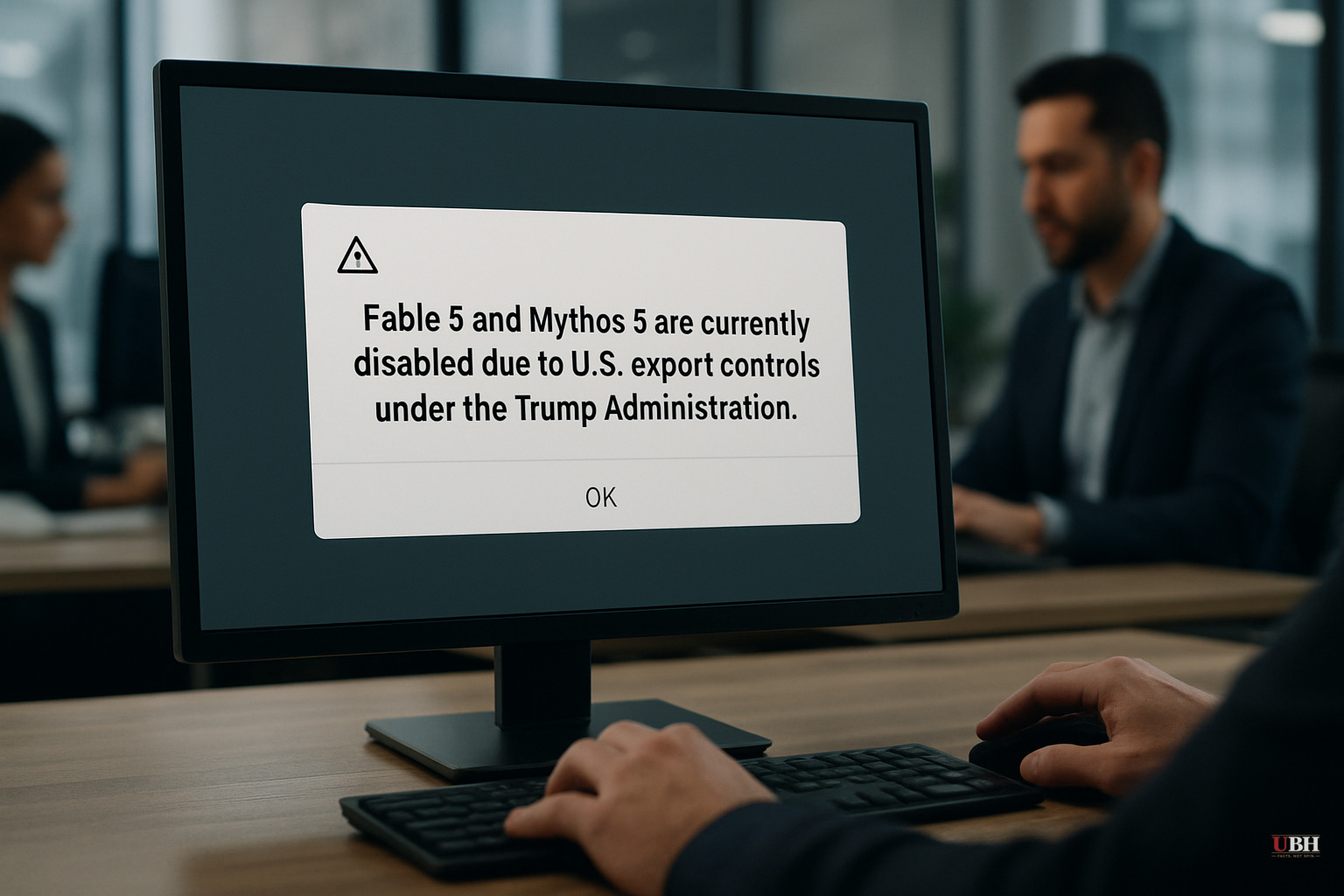
Since the Trump administration designated Anthropic a supply-chain risk in March, the company's conflict with the White House has escalated steadily. Last Friday, it reached a new threshold: the administration issued an export control directive citing national security authorities, ordering a ban on non-Americans — including Anthropic employees — from accessing its top-tier models. Those models are Mythos 5, a limited-release cybersecurity tool Anthropic itself marketed as dangerous, and Fable 5, a consumer-facing version released to the public three days before the order dropped, according to TechCrunch. Because selectively cutting off foreign IP addresses proved technically unworkable, Anthropic pulled both models for all users globally.
What the administration actually objected to remains unclear
The White House invoked an obscure export control directive, but the precise rationale has not been made public, according to TechCrunch. The working theory circulating in the industry: hackers had already found ways to bypass Fable 5's guardrails, potentially unlocking Mythos-level capabilities that include identifying security vulnerabilities in software code at a level Anthropic itself considered hazardous enough to restrict. No formal charges or enforcement actions have been filed against Anthropic. The company and elements of the U.S. government remain in ongoing litigation from the earlier supply-chain designation, stemming from Anthropic's refusal to allow its models to be used for mass surveillance of Americans and fully autonomous weapons, according to Defense One.
Thirty-plus signatories want the ban reversed
On Monday, a coalition published an open letter on a site called "Free Fable," directed at Commerce Secretary Howard Lutnick and National Cyber Director Sean Cairncross. Signatories include representatives from Adobe, NVIDIA, and Zoom, as well as academics from Johns Hopkins and the University of Maryland, Baltimore College, according to Defense One. The letter argues the suspension "has taken the best models away from defenders, created market uncertainty, and risked America's AI leadership without any real risk to justify it." It specifically notes that Fable's offensive-use protections were aggressive enough to become "a source of humor in the cyber community on launch day" — meaning they were already seen as overly restrictive, not permissive. The signatories' core argument deserves a fair hearing. If Fable 5's defenses against misuse were genuinely robust, pulling it from cybersecurity teams and developers could leave American networks more exposed to attacks that an AI-assisted defender might have caught. The administration's counterargument, while not formally articulated in public, is that even well-defended models can be jailbroken, and a model powerful enough to find zero-day vulnerabilities at scale is a threat that travels across borders the moment access is granted. The administration has not provided evidence that Fable 5 was actively being weaponized, but absence of a public case is not the same as absence of a classified one.
Business adoption kept rising through the last fight
The market data makes the administration's strategy look counterproductive on commercial grounds. Ramp, which tracks spending from more than 70,000 businesses on its platform, reported that Anthropic's share of AI subscriptions paid by businesses hit41% in May, up 2.5 percentage points from the prior month. OpenAI stood at 39.5%, essentially flat, according to TechCrunch. That marked the first time Anthropic surpassed OpenAI in business market share. Ramp's lead economist Ara Kharazian told TechCrunch the pattern is clear: "Anthropic's best month on record, as far as business adoption, was the month that the Department of Defense labeled them a supply-chain risk. There's a lot of aura that comes with your model specifically being named too dangerous to use." And Anthropic entered June with real financial momentum: a $65 billion raise at a $965 billion valuation at the end of May, along with confidential IPO paperwork filed on the strength of what TechCrunch reported as its first-ever profitable quarter.
The bigger winner may be open-source
AI CNBC reported that investors began pricing in a structural shift the moment the suspension landed. Chinese open-source AI companies MiniMax and Zhipu both surged Monday as investors bet that enterprises spooked by the shutdown would accelerate moves toward models they can host themselves. An open-source model running on a company's own servers cannot be switched off by a government export directive. Microsoft CEO Satya Nadella made the point publicly in a Monday post on X, warning that companies need to "build agentic systems that improve over time, while still retaining control over their IP" and writing: "The last thing any of us want is a world where every company across every sector is ceding value to a few models that eat everything they see." Yash Patel, CEO of Applied Compute, told CNBC the Anthropic situation "highlighted the significance of owning your own model." Nadella's warning is notable because Microsoft is the principal investor in OpenAI and also backed Anthropic with billions. He has financial skin in both closed-model companies, which makes his open-source caution worth taking seriously rather than dismissing.
The
unresolved question Neither the White House nor the Commerce Department has publicly detailed what specific intelligence or technical finding prompted Friday's order. Until that justification is on the record, it's impossible to evaluate whether the suspension was a proportionate national security response or an overreach that damaged American cyber defense capability for no documented gain. The "Free Fable" coalition is asking Lutnick and Cairncross for a direct answer. As of June 16, 2026, neither has responded publicly.
Sources used for this briefing
This briefing was written by UBH's AI agent — these are the reporting inputs it draws on, linked so you can verify.


