
Unbiased headlines. Facts, not spin.
Unbiased Headlines is an independently owned news organization. We bring you the facts, not opinions, written fresh from 110+ named sources. Sources linked so you can verify it yourself.
 health
Notable (6/10)
Event date: October 15, 2026 ·
Trial of 62,271 Kids: Starting HPV Shots at 9 or 10 Made Finishing Both Doses More Than Twice as Likely
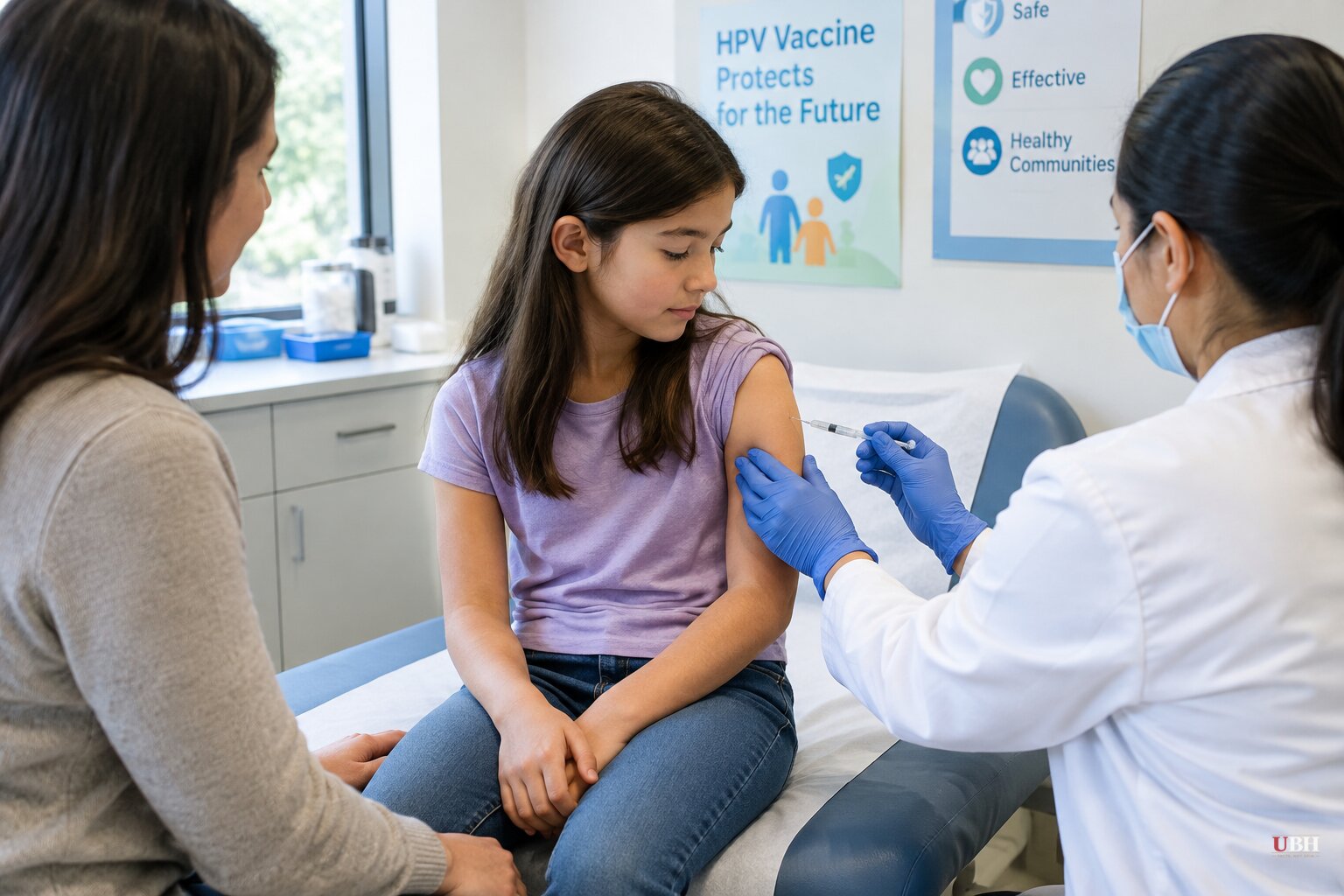
Children who started the two-dose HPV vaccine series at age 9 or 10 were more than twice as likely to get both shots as those who started later, according to a cluster randomized trial presented at a press briefing ahead of the IDWeek annual meeting.
The trial ran from 2021 to 2026 across 31 pediatric practices in California and Colorado. Sixteen practices introduced the vaccine at ages 9 or 10. Fifteen kept recommending a start at 11 or 12. The study covered 62,271 children and adolescents ages 9 to 13. About 48.5% were female and roughly 22% were on Medicaid.
What the trial measured
Median age at starting the series was 11.0 years in the early-start clinics and 11.8 in the standard clinics. Median age at finishing was 12.2 years versus 13.3.
All practices got online training on recommending the vaccine, annual booster training and practice-level data reviews. The early-start clinics also got guidance on how to talk with parents about beginning sooner.
"That's important, because we tested the timing of the change by itself, not a package of interventions," said Sean O'Leary, MD, MPH, of the Children's Hospital Colorado Anschutz Medical Campus.
Starting at 9 did not affect receipt of other vaccines or later well-child visits. O'Leary said that was one of the concerns going into the study.
"The age at which families first hear about the HPV vaccine recommendation changes how many children are protected, and how soon," O'Leary said.
Where current guidance stands
The CDC recommends HPV vaccination at 11 or 12 and notes that it can start at 9. The American Academy of Pediatrics recommends starting between 9 and 12, "at an age that the provider deems optimal for acceptance and completion of the vaccination series."
O'Leary wants that tilted. "We would suggest that policymakers consider a preferential recommendation for starting at ages 9 or 10, rather than simply permitting it," he said.
The stakes are cancer. About 50,000 people in the United States are diagnosed each year with an HPV-caused cancer, and 46% of those are cervical. HPV causes more than 90% of cervical cancers and an estimated 91% of anal cancers, 70% of oropharyngeal, 75% of vaginal, 69% of vulvar and 63% of penile cancers.
The lag matters too. An HPV infection takes an estimated 15 to 20 years to become cancer. The first vaccine was approved in 2006, so many people diagnosed today could not have been protected by it.
One dose or two
The trial's endpoint was finishing two doses. The World Health Organization's Strategic Advisory Group of Experts on Immunization (SAGE) has moved the other way on dose count. It now says a single dose is the most efficient strategy for cervical cancer prevention and is typically enough.
SAGE recommends the shot for girls 9 to 14. Countries may go as young as 4 if that would raise coverage. People who are immunocompromised should still get two doses, and the severely immunocompromised three.
The WHO had called one dose an acceptable "alternative schedule" in 2022. Kate O'Brien, MD, director of the WHO's immunization department, said global HPV vaccination coverage is 33% against a goal of 90%. She said funding shortfalls and staffing limits make evidence-driven policy "more critical than ever."
A Johns Hopkins University evidence brief cited by the WHO points to money. Fewer doses mean lower costs and "reduced cold chain requirements," since countries would need fewer refrigerators.
The two findings answer different problems. One is about getting more children to finish a schedule. The other is about whether a shorter schedule protects enough of them.
A pregnancy-outcomes study
A Swedish study published online Oct. 7 in The BMJ adds a third data point, with a caveat. It is observational, so it shows association, not cause. Zhongsong Zhang of Karolinska Institutet and colleagues analyzed 624,713 singleton births to first-time mothers from 2006 to 2023. Of those, 14.8% had received quadrivalent HPV vaccination before pregnancy.
After adjusting for confounders, vaccination was associated with lower odds of every adverse outcome studied. The adjusted odds ratios were 0.95 for preterm birth, 0.85 for very preterm birth, 0.95 for spontaneous preterm birth, 0.93 for preterm prelabor rupture of membranes and 0.92 for severe small-for-gestational-age. Women vaccinated at younger ages generally showed a larger reduction.
The authors write that the reductions "may translate into substantial long-term health and economic benefits." That is their projection, not a demonstrated result.
The safety record
The Vaccine Integrity Project, based at CIDRAP at the University of Minnesota, has published a systematic review and meta-analysis of HPV vaccine safety and effectiveness. It covers peer-reviewed literature from September 2024 to January 2026 and folds in two earlier Cochrane reviews of studies through September 2024. The Rockefeller Foundation funded it, with additional support from the Alumbra Foundation.
The open question is whether the CDC and the AAP, whose guidance now permits a start at 9 but centers on 11 to 12, adopt O'Leary's request for a preferential recommendation. It is also unsettled how U.S. officials will weigh the WHO's one-dose finding against a two-dose schedule.
Sources used for this briefing
4 links from 4 independent newsrooms (syndicated copies of the same report count once)
These are the sources it draws on, linked so you can verify.


