
Original briefings. Zero spin.
Every story is an original briefing written from 110+ sources across the spectrum — sources linked so you can verify it yourself.
 finance
Major Story (7/10)
Event date: August 25, 2026
finance
Major Story (7/10)
Event date: August 25, 2026
Treasury's $4 Billion Bond Buyback Plan Narrows Yields, But Wall Street Calls It a Dollar Debasement Bet
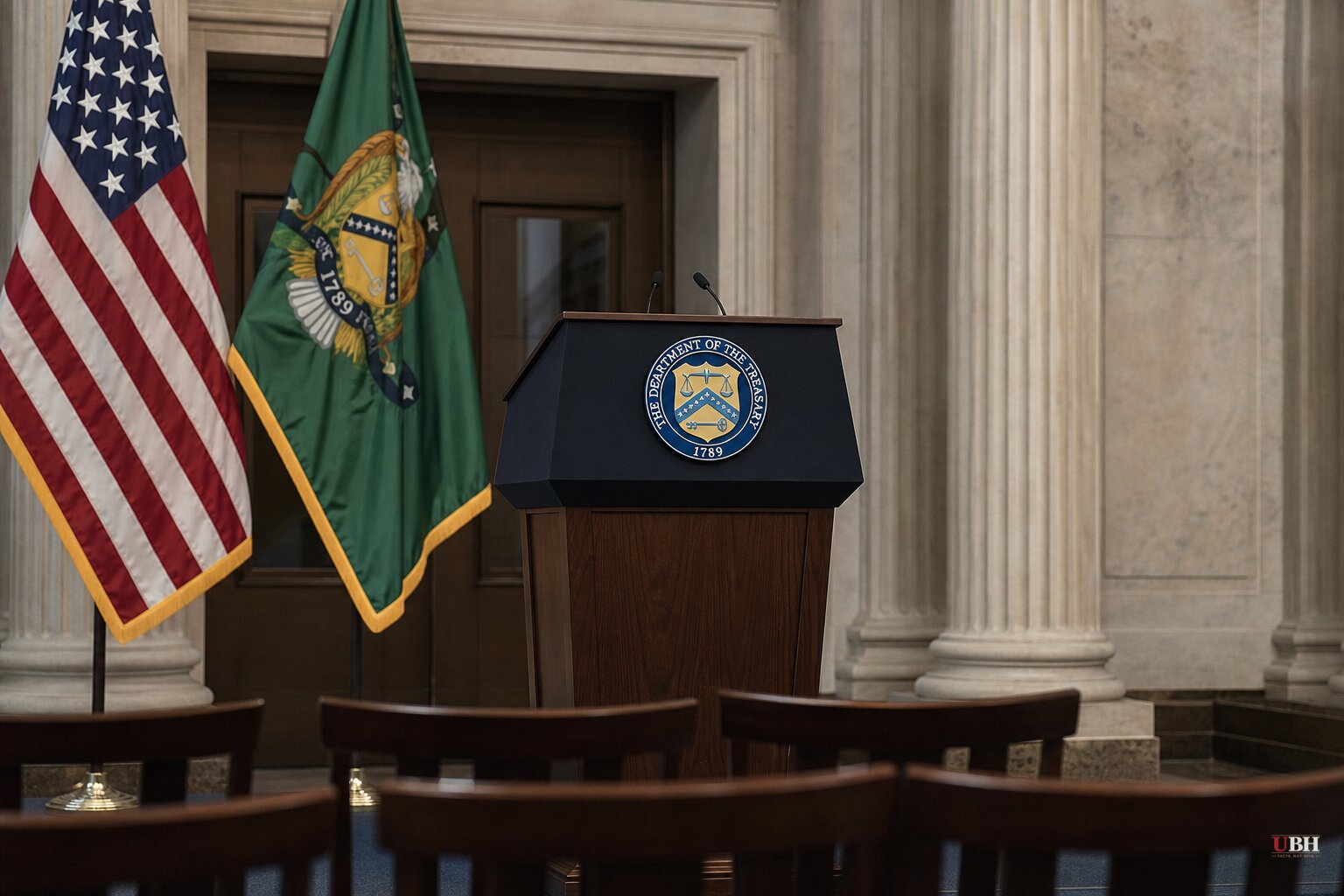
Treasury Secretary Scott Bessent announced Wednesday, Aug. 19, that the department would at least double the size of its buyback operations for older, long-dated government bonds, raising the cap to "at least $4 billion," according to Reuters, carried by KFGO. The next morning, Bessent told CNBC the actual purchases could run higher than $4 billion, and said the recent bond selloff meant the market "got a little bit ahead of itself."
The timing wasn't subtle. The 30-year Treasury yield had just hit its highest level since 2007 as the Iran war escalated, and total U.S. public debt crossed $40 trillion the following day, Reuters reported. The buybacks landed outside Treasury's normal quarterly refunding schedule and just ahead of a 20-year bond auction, which is why some investors immediately read it as an effort to relieve pressure on long-term borrowing costs rather than a routine liquidity fix.
What's actually happening in the bond market
So far, the mechanics look like they're working as advertised. Since the announcement, Treasury bonds have outperformed comparable interest-rate swaps, and the gap between the 30-year Treasury yield and its equivalent swap rate has narrowed to its smallest since February, Bloomberg News reported, per Breitbart's account. That's a sign the purchases are easing the friction that comes from thin trading in older bonds, not artificially capping rates.
Bank of America's rates strategists reached a similar conclusion in an analysis last week: the buyback's cleanest effect shows up in the swap spread, not in outright yield levels. BofA estimated the program could eventually shave around 6 basis points off the 10-year yield if sustained through 2028, but only about 1 basis point by the end of this year. Treasury has announced no yield ceiling and made no unlimited commitment to buy bonds, which is the key distinction between this program and true yield-curve control.
Why Wall Street isn't buying the liquidity-only story
None of that has stopped the "debasement trade" from catching fire. Gold rose more than 3% and bitcoin jumped 13% over the two days following the announcement, according to Reuters. Deutsche Bank strategist George Saravelos called the buybacks, combined with Treasury's push to get foreign central banks to use a Fed repo facility instead of selling Treasuries outright, a form of "soft-form financial repression" aimed at holding down long-term rates.
Scotiabank's chief FX strategist, Shaun Osborne, put the tension bluntly to Reuters: "There has to be a price to pay. Either in the form of higher yields, or they're going to get a concession from the U.S. dollar." Axios reported that Wall Street's consensus view is that lower rates were the clear goal of the move, and noted that Treasury did not respond to a request for comment on whether "strong dollar" remains official U.S. policy.
If a government leans on buybacks or shorter-dated issuance to keep yields from reaching their true market-clearing level without addressing the underlying deficit, the adjustment doesn't disappear. It shows up somewhere else, and currency markets are the most obvious release valve. The Business Times noted the U.S. dollar had its worst year since 2017 in 2025, falling almost 10%, while gold rallied 65% over the same period, then the dollar recovered early this year after Kevin Warsh was picked to lead the Federal Reserve on a stated priority of price stability.
The Japan precedent everyone keeps citing
Forbes contributor William Pesek argues the warning sign is Tokyo. Japan has run some version of this playbook for nearly three decades, with the Bank of Japan's benchmark rate still sitting at just 1% under Prime Minister Sanae Takaichi's government, 27 years after it first hit zero. Japan can absorb that because roughly 90% of its government bonds are held domestically and its economy is roughly a seventh the size of America's, per Forbes. The U.S. doesn't have that shock absorber, and Japan itself holds more than $1.1 trillion in Treasuries.
That's the backdrop for the late-July U.S.-Japan currency intervention, in which Bessent's team sold euros to buy yen rather than using dollars. Trump described it as an act of "friendship," but Forbes reported that officials were more worried Japan's Ministry of Finance might otherwise dump Treasuries to defend the yen, which would ripple through Asian creditors including China.
The counterargument
Bessent's defenders have a real point: the buyback program targets older, less-traded "off-the-run" bonds specifically to improve dealer capacity and reduce market fragmentation, not to fix a price on the entire curve. No ceiling has been set, and long yields have continued moving in response to inflation data, oil prices, and Fed policy expectations exactly as they would in a market without intervention, according to Breitbart's reporting on the swap-spread data.
Separately, Epoch Times columnist Daniel Lacalle argues the more urgent fiscal reckoning may not even be American. He points to European Commission estimates putting net eurozone pension liabilities near 150% of GDP, with France's bond yields now exceeding Italy's, and unfinanced committed liabilities topping 300% of GDP in some member states. That's a distinct argument about relative risk, not a rebuttal to the dollar-debasement debate, but it's a reminder that the $40 trillion U.S. debt figure dominating headlines isn't the only sovereign balance sheet under stress.
None of this resolves the actual question hanging over the bond market: whether Treasury sticks to buybacks under $4-5 billion as a liquidity tool, or whether the program keeps expanding in size and frequency as debt-service costs climb. Treasury's next quarterly refunding announcement will be the clearest signal of which direction Bessent is headed, and whether the "strong dollar policy" Axios asked about ever gets an on-the-record answer.
Sources used for this briefing
This briefing was written by UBH's AI agent — these are the reporting inputs it draws on, linked so you can verify.


