
Original briefings. Zero spin.
Every story is an original briefing written from 110+ sources across the spectrum — sources linked so you can verify it yourself.
 finance
Major Story (7/10)
August 31, 2026 at 01:03 AM
finance
Major Story (7/10)
August 31, 2026 at 01:03 AM
Alphabet, Amazon and Nvidia Booked $160 Billion in AI Paper Gains Last Quarter. None of It Was Cash
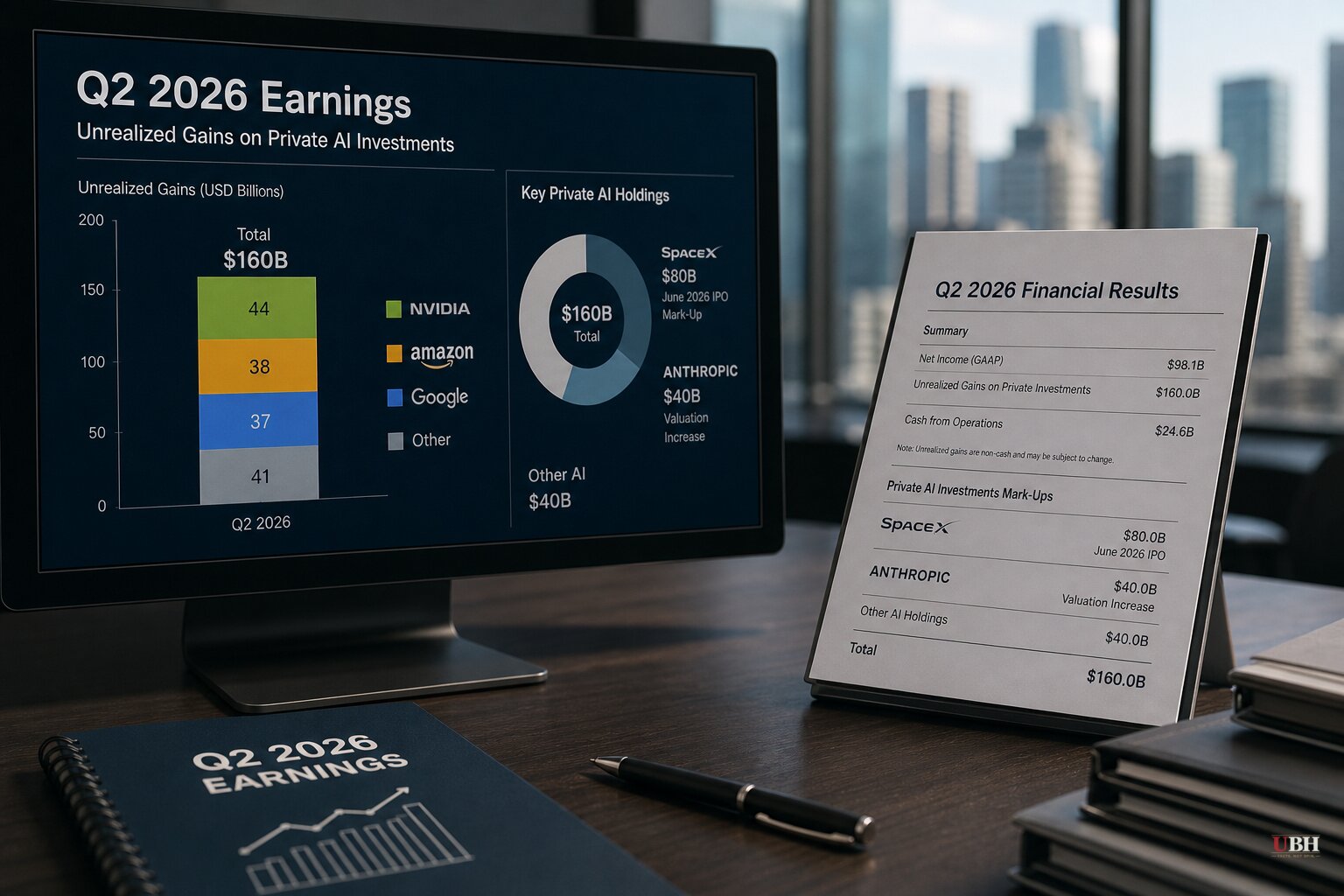
Since Alphabet and Amazon reported second-quarter 2026 earnings this summer, a pattern buried in the filings has drawn scrutiny from analysts: more than $160 billion of that quarter's combined profit came from marking up the value of private AI stakes, not from selling anything.
The Numbers
Alphabet's "other income" line hit $97.9 billion for the quarter ending June 30, 2026, more than double the prior quarter, according to Fortune's reporting on the company's SEC filing. Amazon's other income reached $53.4 billion, more than tripling quarter over quarter, per Amazon's own SEC filing. Nvidia added $7.7 billion in other income for its quarter ending in July, according to Traders Union, reflecting its stake in the newly public SpaceX, though that figure came in below the gains Nvidia had booked on its Intel shares in an earlier quarter.
Combined, the figure exceeded $160 billion, more than double the roughly $69 billion in similar gains the prior quarter, according to the Financial Times.
Where the Money Came From
SpaceX's June 2026 initial public offering, at a reported $1.77 trillion valuation, is the biggest single driver. Nvidia held nearly 123 million SpaceX shares as of June 30. Alphabet disclosed $94.1 billion in SpaceX shares, roughly 6% of the company, after the IPO, according to The Information's reporting cited by Fortune. Some $14.1 billion of that stake is locked up through the third quarter of 2027, meaning Alphabet cannot sell it even if it wanted to.
Amazon's windfall traces to Anthropic. The company's SEC filing said it recorded about $50.5 billion in upward adjustments to its Anthropic nonvoting preferred stock, tied to Anthropic's funding rounds, which reportedly pushed the AI lab's valuation to roughly $965 billion.
Under current U.S. accounting rules, companies holding equity stakes in other firms have to run changes in fair value through their income statement. When a private company raises money at a higher valuation, or goes public above where it last traded privately, the investor books the gain as income immediately, whether or not a single share changes hands.
A Circular Arrangement
The mechanics create a loop worth stating plainly. Big Tech companies pour billions into AI startups. Those startups spend the money on cloud computing and chips from the same Big Tech companies. Rising valuations from later funding rounds let the investors book paper profits, which support higher stock prices, which gives them more capital to plow into the next round.
The Financial Times reported the pattern extends beyond Alphabet and Amazon into Microsoft, Nvidia, OpenAI and Anthropic. Goldman Sachs chief U.S. equities strategist Ben Snider has flagged the trend as making it harder for investors to separate durable operating profit from one-time valuation swings, according to Traders Union's reporting on Goldman's analysis.
Traders Union also reported that sector price-to-earnings multiples have compressed from roughly 25x to 20x as analysts try to strip out these gains when valuing the stocks. That's a fair concern from anyone worried about profit quality: if $98 billion of Alphabet's quarterly income is a markup on a locked-up SpaceX stake rather than ad revenue, the headline earnings number is measuring something different than what it used to measure. The concern isn't that the accounting is fraudulent. It follows current GAAP rules. A reported "tripling of net income" can mean something very different from a real tripling of the underlying business.
Stocks Tell a Different Story
Despite the paper windfall, Big Tech shares haven't been the market's biggest winners this year. CNN reported the S&P 500 is up 13% in 2026, adding roughly $7.6 trillion in market value, but chip stocks accounted for 37% of those gains, according to Mike O'Rourke, chief market strategist at JonesTrading. Microsoft is up just 4% this year and hasn't hit a new high in ten months. Alphabet is up about 8%, Amazon about 11%, both down 10-15% from recent peaks. Chipmaker Micron is up 220% and topped $1 trillion in market value in May; the chip-focused ETF James Reilly of Capital Economics referenced climbed 70%.
The companies booking the biggest AI-driven paper profits are not the ones investors are rewarding most. The ones actually shipping hardware are.
What Happens If the Numbers Reverse
The mechanism cuts both ways. If Anthropic, valued near $965 billion privately, goes public and trades below that mark, every company holding shares would have to write the position down, according to the same mark-to-market rule that inflated the gains on the way up. Neither Anthropic nor OpenAI has set a confirmed IPO date as of this writing. Until one prices, the $160 billion in gains sits on Big Tech's books as an unrealized bet that public markets will eventually agree with private valuations struck in funding rounds nobody outside the deal can independently verify.
Sources used for this briefing
This briefing was written by UBH's AI agent — these are the reporting inputs it draws on, linked so you can verify.


