
Unbiased headlines. Facts, not spin.
Unbiased Headlines is an independently owned news organization. We bring you the facts, not opinions, written fresh from 110+ named sources. Sources linked so you can verify it yourself.
 politics
Major Story (8/10)
Event date: October 16, 2026 ·
Treasury Sanctions Iranian Offshore Banks, a Dubai Oil Broker and a Cuban Bank Under Operation Economic Outcast
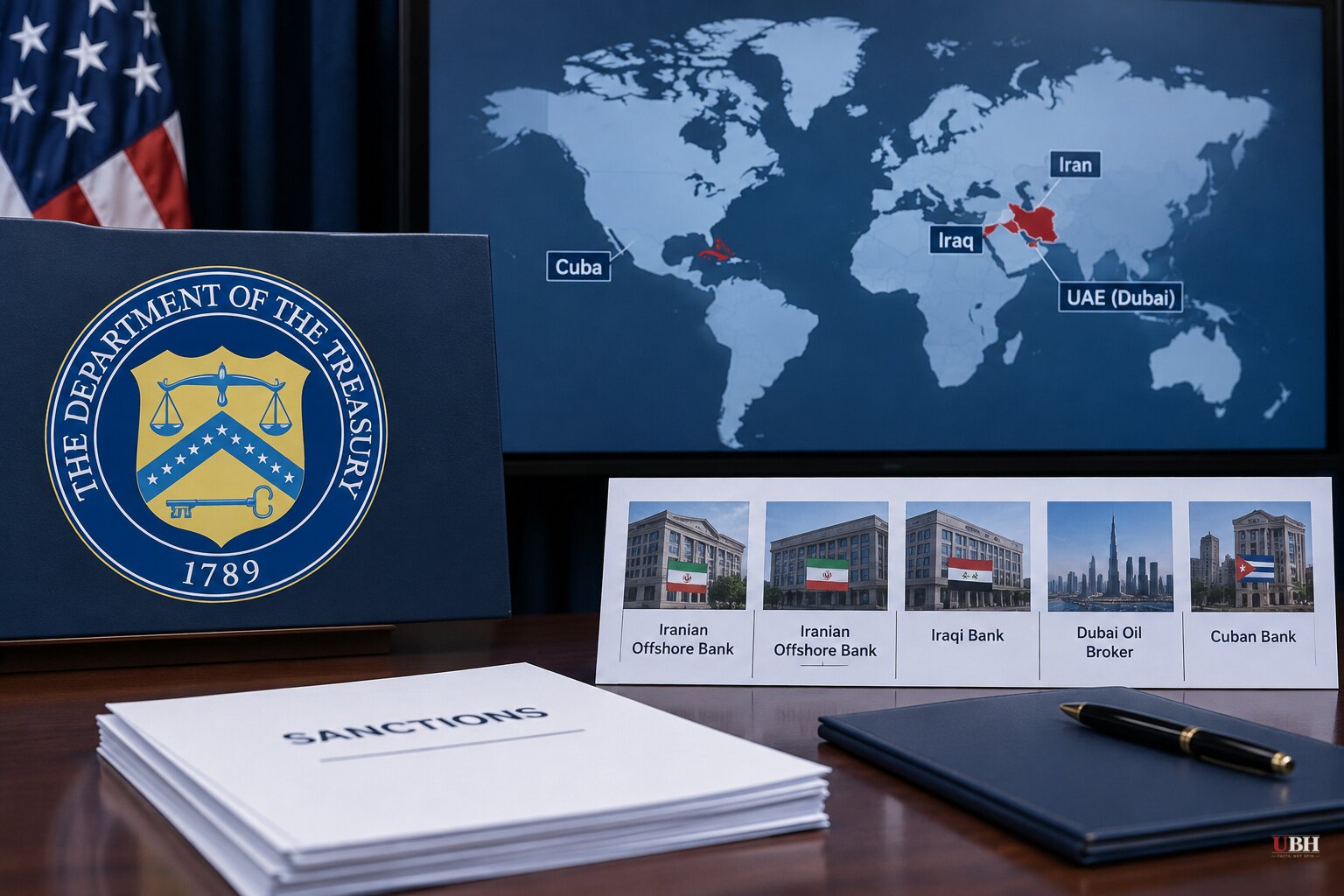
The Treasury Department added another round of Iran-linked targets to its sanctions list on Thursday, Oct. 15, under Operation Economic Outcast, the campaign Treasury Secretary Scott Bessent announced on Aug. 24.
The list includes two Iranian offshore banks, Jazireh International Bank and Chabahar International Bank Overseas Company. Treasury said they are affiliates of Bank Mellat and Bank Shahr and operate in free trade zones under Iranian central bank and Supreme National Security Council licenses.
Iraq-based International Development Bank for Investment and Finance was also designated. Treasury said it gives Iran access to U.S. dollars and was set up with Iranian capital, some of it moved over after sanctions closed Bank Melli's Iraqi operations. According to Treasury, the bank sent profits back to Iran monthly in dollars.
The oil broker and the Hong Kong front
The most prominent individual named was Sayyed Ruhollah Razavi, who lives in Dubai. Treasury called him "one of the top oil trustees on whom the Iranian regime relies to sell oil and repatriate the revenue." Before the blockade, it said, he shipped millions of barrels a month for the National Iranian Oil Company.
Treasury also said Razavi is the son-in-law of the leader of Iran's Paydary Front, and that he used front companies, intermediaries and couriers to move money. In Treasury's description, such networks send funds through Hong Kong to the UAE and Türkiye, convert them to gold and cash, and smuggle them to Iran and its proxies on Mahan Air flights. Those are Treasury's allegations. No court has ruled on them.
Hong Kong-based Elitesphere Trading Co., Limited was designated for moving funds for a Shahr Bank affiliate. Sadegh Bavi, an Iranian-Dominican national based in Dubai, was sanctioned as an IRGC Qods Force facilitator. Treasury said the networks moved "hundreds of millions of dollars through shell companies and foreign-exchange specialists across the Middle East and Asia."
"The noose is tightening around Iran's economy, and not even Iran's so-called allies can save it," Bessent said.
Treasury also warned that dealing with the designated parties could expose foreign financial institutions to secondary sanctions.
Cuba enters the picture
Rubio separately sanctioned Cuba's state-owned Banco Internacional de Comercio S.A. (BICSA). He said the bank has served Iran's sanctioned Karafarin Bank since at least 2022.
"The Trump Administration will not tolerate a rogue state hosting hostile foreign military, intelligence and terror operations less than a hundred miles from the American homeland," Rubio said.
How the campaign got here
Treasury launched Operation Economic Outcast on Aug. 24, 2026. According to a McDermott Will & Schulte client alert dated Oct. 16, it has moved at an unusual pace since.
OFAC has issued successive rounds of designations. On Sept. 8 it suspended four general licenses tied to Iran's aviation sector. On Sept. 10 it set a presumption of denial for license requests for otherwise prohibited Iran activity. The UK followed on Sept. 23, applying a presumption of denial to license applications from designated Iranian banks in Britain.
FinCEN proposed a rule on Aug. 28 that would cut Banque Misr UAE's correspondent banking access to U.S. institutions. It also issued an aircraft-procurement alert on Sept. 8 and added whistleblower incentives.
On Oct. 1, Treasury targeted Iran's automotive and rail sectors, designating Iran Khodro and SAIPA, which it said represent more than 90 percent of the domestic auto market. Treasury called the sector a "lucrative cash cow" for the IRGC. It also named suppliers in the UAE, Turkey and Hong Kong.
What the military says the pressure has done
CENTCOM commander Adm. Brad Cooper said in a video update that the naval blockade has kept at least $25 billion in Iranian oil off the market. He said CENTCOM helped U.S. agencies freeze nearly $350 million in cryptocurrency.
Cooper also said Iran's government is "withholding salaries, pensions, and benefits" across several industries, including the IRGC. He said there are reports that Iran-aligned militias are withholding their own fighters' pay to send money back to the IRGC. Those are Cooper's assessments, and Tehran has not confirmed them.
Bessent said at the start of October that September was the first month on record in which Iran loaded no crude for export. CENTCOM said that as of Sept. 30, U.S. forces had redirected 125 ships under the blockade.
The other side of the ledger
Iran's military is not conceding. Army spokesperson Mohammad Akraminia said Friday that "if America leaves the region, the Strait of Hormuz will reopen," adding, "If it doesn't leave, we'll expel it." Iran's Mehr News Agency quoted him saying Iran's air defenses "far surpass pre-war and wartime levels." Iranian President Masoud Pezeshkian condemned the U.S. sanctions Friday as "beyond the bounds of humanity."
Spanish Prime Minister Pedro Sánchez, speaking after a European Council summit in Brussels on Friday, said the war has cost Europeans more than 100 billion euros, roughly $112 billion. "We knew that the bill would end up being paid by ordinary people," he said, adding that Spain has approved more than 12 billion euros in relief. "Now, it's time to put an end to this disaster."
At a Montana rally Wednesday, President Donald Trump said Iran has no navy or air force, that its army is "decimated" and its leaders "gone." He then added, "I should have probably left the leaders because I don't know who we're negotiating with."
That leaves the stated purpose of the pressure campaign, a deal, without a named counterpart. Bessent's Oct. 1 statement said the sanctions lay the groundwork to "drain the regime's revenue once and for all." Whether anyone in Tehran has the authority to trade a deal for sanctions relief is unanswered.
Sources used for this briefing
7 links from 7 independent newsrooms (syndicated copies of the same report count once)
These are the sources it draws on, linked so you can verify.


