
Unbiased headlines. Facts, not spin.
Unbiased Headlines is an independently owned news organization. We bring you the facts, not opinions, written fresh from 110+ named sources. Sources linked so you can verify it yourself.
 politics
Notable (6/10)
Mahmoud Khalil Asks Supreme Court to Hear Detention Appeal as Justices Fill Docket With Federal-Power Cases
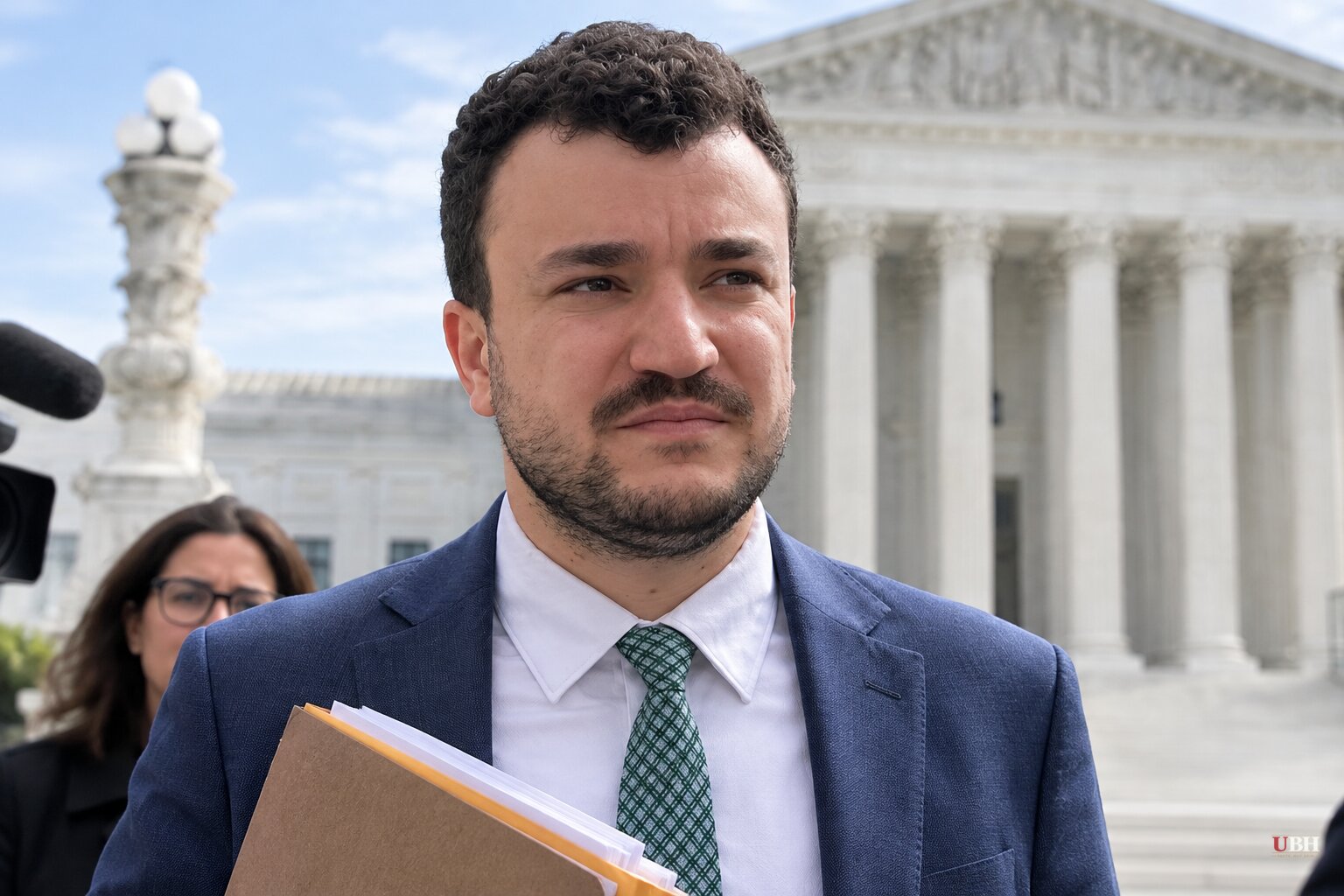
Since the justices' Oct. 19 order list added the Maryland magnet-school lottery and the federal home-distilling ban to the 2027 argument calendar, another high-profile fight over government power has landed at the Court: Mahmoud Khalil filed a petition Monday asking the justices to hear his detention case, his lawyers said.
Khalil, a Columbia University demonstrator and green card holder, was arrested by immigration authorities in March 2025 and jailed for months before a federal judge ordered his release. He has long argued the detention was retaliation for protected speech.
What Khalil is actually asking for
The petition does not ask the Court to decide the retaliation claim. It asks whether a federal judge can hear it now.
The 3rd U.S. Circuit Court of Appeals sided with the Trump administration and held that federal law bars judges from hearing Khalil's arguments until he works through the immigration court system. That system is part of the executive branch. Khalil's lawyers say the arrangement lets the sitting administration drag out proceedings and punish someone in the meantime.
They want him to be able to raise a First Amendment defense immediately through a habeas petition.
"If the decision stands, the government would be handed a powerful and unprecedented weapon to silence its critics, and to chill the speech of countless others, including citizens, who wish to avoid the government's wrath against themselves and their loved ones," the lawyers wrote.
Khalil put it more bluntly to reporters. "This administration knows all too well that its baseless allegations and smears against me cannot survive the slightest scrutiny in federal court," he said, calling immigration courts "kangaroo" courts.
The administration's position, as adopted by the 3rd Circuit, is that Congress channeled these claims into the immigration system and judges must wait.
Timing and the parallel case
The Court turns away the vast majority of petitions. It will take up Khalil's at a closed-door conference in the coming months, and his lawyers say they hope it can be heard this term. Until the justices act, Khalil remains free.
The issue is already at the Court. The administration earlier petitioned the justices in the case of Badar Khan Suri, an Indian national and Georgetown University postdoctoral scholar it has sought to deport, after an appeals court ruled against the government there. The administration has acknowledged the Court may want to take up both men's cases together.
The home-distilling case sharpens the power question
The grants from the same order list raise related questions about where federal authority stops. In Department of Justice v. McNutt, the justices will decide whether Congress had the power to ban distilling spirits in any dwelling house, a rule dating to 1868. Violations carry up to five years in prison and a $10,000 fine. Wine and beer can be made at home for personal use without penalty.
The challengers include the Hobby Distillers Association and members such as Scott McNutt, who has a home still he has used for fuel alcohol, and Rick Morris, who manufactures stills. They sued in Texas after the Treasury Department's Alcohol and Tobacco Tax and Trade Bureau told them they could not get a license to distill at home because of the ban.
The 5th U.S. Circuit Court of Appeals ruled for them. It held the ban exceeds Congress' power under the Taxation and Necessary and Proper clauses. Judge Edith Jones wrote that under the government's logic, "Congress may criminalize nearly any at-home conduct only because it has the possibility of concealing taxable activity."
The 6th Circuit went the other way in a case brought by John Ream, an Ohio brewpub owner who wants to distill for personal use. That split is why the Court stepped in. The federal government itself also asked for review.
The government's argument is that a distiller in a private residence can more easily hide an operation or thwart inspections, and so evade the tax. In its petition it called the restriction "convenient" or "useful" in carrying an enumerated power into effect.
Ream's attorney, Robert Alt, said the founders "would be rolling over in their graves to learn that a pastime in which even George Washington partook... has quite absurdly been turned into a federal crime."
A Reason commentary argues the case is likely the most important Necessary and Proper Clause ruling since NFIB v. Sebelius in 2012. That decision held a "proper" power must be ancillary to an enumerated one rather than a "great, substantive and independent" power. The commentary argues the home-distilling ban is the latter and urges the Court to strike it down.
The magnet-school case
In Association for Education Fairness v. Montgomery County Board of Education, a coalition of Asian American parents challenges a Maryland lottery for magnet middle schools. It ranks students against peers from elementary schools with similar poverty levels. The parents say the process looks race-neutral but disadvantages Asian American applicants from high-performing, low-poverty schools.
U.S. District Judge Paula Xinis dismissed the case in 2022, and the 4th Circuit affirmed in February 2026. The Court narrowed its review, according to Pacific Legal Foundation, which represents the parents, to whether a challenger to a facially neutral policy must show the targeted racial group suffered an aggregate disparate impact relative to its share of the applicant pool.
Pacific Legal Foundation attorney Chris Kieser said a district "should not be able to defeat a discrimination claim by showing that its policy did not harm enough Asian American children." Erin Wilcox, the foundation's senior attorney, said the group has reviewed districts in Boston, New York City and Alexandria, Virginia, with policies it considers similar.
The Maryland and distilling cases are expected to be argued in 2027, with decisions by the end of June. Khalil's petition has no conference date yet, and the Suri petition is still pending beside it.
Sources used for this briefing
5 links from 5 independent newsrooms (syndicated copies of the same report count once)
These are the sources it draws on, linked so you can verify.


