
Unbiased headlines. Facts, not spin.
Unbiased Headlines is an independently owned news organization. We bring you the facts, not opinions, written fresh from 110+ named sources. Sources linked so you can verify it yourself.
 economy
Major Story (7/10)
Event date: November 13, 2026 ·
Traders Put Odds of a December Fed Hike Near 89% as Bessent and Goolsbee Clash Over Energy Shock
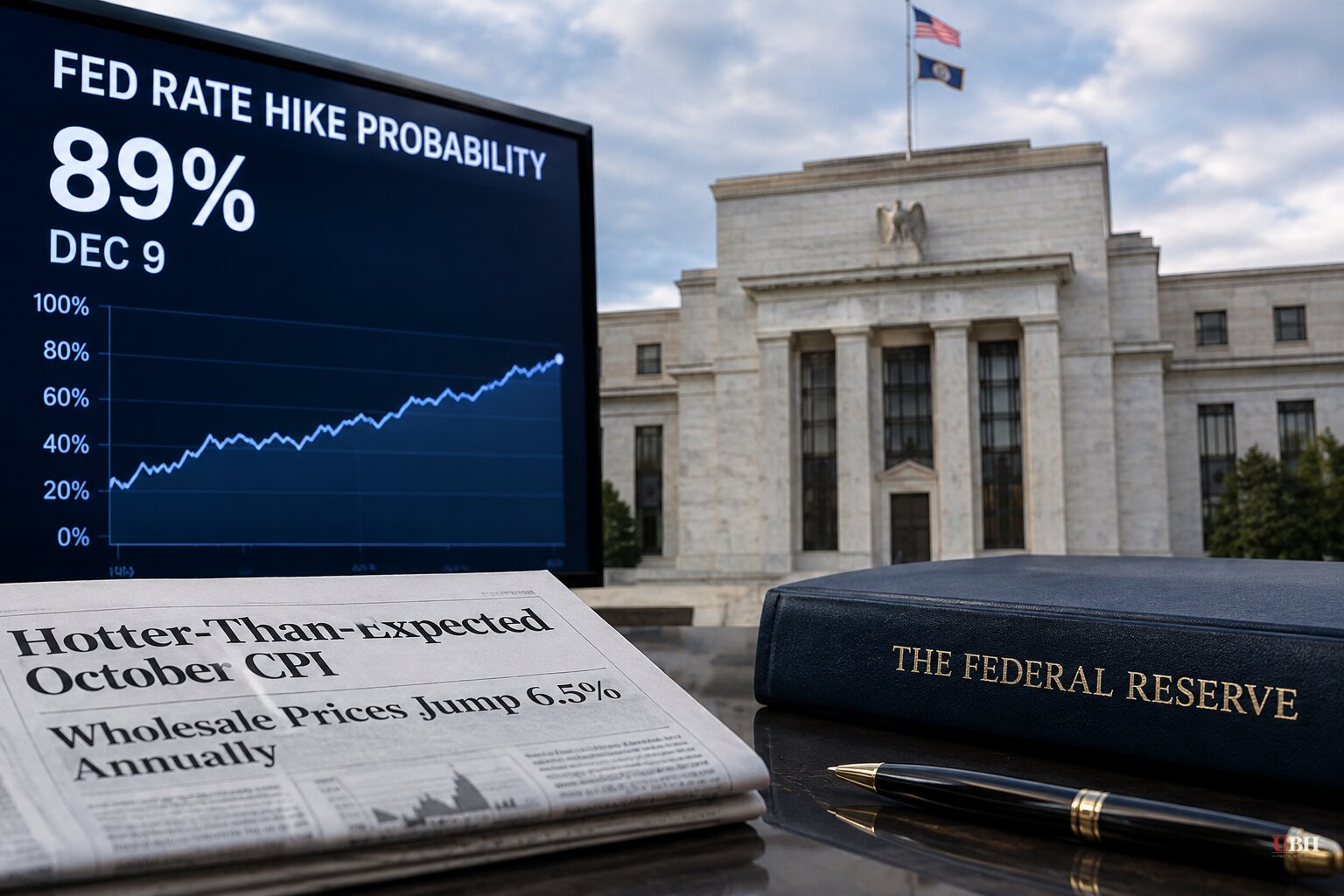
Since the Fed raised rates in September and then held at 3.75% to 4% in late October, a week of inflation data has pushed the debate from whether to hike again to how hard.
The Labor Department said consumer prices rose 0.4% in October, down from 0.6% in September. Core prices, which strip out food and energy, rose 0.3%. Both readings came in a tenth of a point above forecasts.
There is no official annual CPI number. Last year's government shutdown meant no October 2025 data was collected. Riccardo Trezzi, a former Fed economist who runs the consulting firm Underlying Inflation, uses rough estimates to put October inflation at about 4% from a year earlier, with core at 2.8%.
The wholesale numbers were no better. Final-demand producer prices rose 0.3% in October, just under the 0.4% economists expected. Year over year, the index is up 6.5%, the steepest annual gain since November 2022.
Hike odds climb, and a half-point is on the table
CME FedWatch put the chance of a quarter-point hike at the Dec. 8-9 meeting near 89% on Friday. It also showed a better-than-even chance of another at the Jan. 26-27 meeting.
Fed Governor Christopher Waller said at a London conference Tuesday that policymakers should consider a half-point increase in December. A smaller move, he said, "would put our credibility at risk."
Bank of America economist Aditya Bhave expects quarter-point hikes in December, January and March. TD Securities now forecasts three straight quarter-point moves, up from two. In a Friday note, TD said "price pressures appear to be broadening."
Others are holding back on size. Boston Fed President Susan Collins said Friday that "the appropriate direction for monetary policy is clear," but declined to say whether a half-point hike is right. Chicago Fed President Austan Goolsbee has not endorsed one either. Collins votes in 2028 and Goolsbee in 2027, so neither has a say next month.
Bessent versus the Fed
Bessent used a Friday morning business-TV appearance to argue the other side. "I think the Fed should understand that this is an energy supply shock," he said. "The Fed's supposed to look into the future, not look in the rearview mirror."
He also said he was not giving orders to the central bank. "I'm not going to tell the Fed what to do. I am going to say they should have an open mind." Bessent noted the Fed cut rates last year and said a sharp reversal over an energy shock "isn't something that I would do if I were on the Fed. But I'm not on the Fed."
Goolsbee appeared on the same network soon after and disagreed. He said inflation has moved into services and other categories where energy does not drive prices. He also named demand from AI data-center construction as an added pressure. He did not commit to a hike but said the Fed "has definitely got work to do to continue to reestablish its credibility." Earlier in the week he called the CPI data "borderline disturbing."
Bessent has some data on his side. Wholesale energy prices slipped 0.1% in October, and diesel fell 7.9%. AAA said regular gasoline averaged $3.87 a gallon Friday, down from about $4.34 a month earlier. It dipped under $4 on Thursday for the first time since July.
Prices are still elevated. Gasoline is about 79 cents above a year ago, and AAA says this is shaping up as the most expensive November on record. Diesel averages about $6.06, roughly $2.30 higher than a year ago.
The International Energy Agency said Friday that world oil supply outpaced demand in October, the first month that has happened since the war began in late February. Observable global inventories grew by 52 million barrels.
Not everyone wants the Fed to look through
National Review editor Ramesh Ponnuru agrees the Fed should look through energy swings. He argues that even setting oil aside, policy is too loose. He cites Bureau of Economic Analysis figures showing nominal GDP growing at a 5.6% annual rate last quarter. The Fed, he says, has raised rates too slowly and too little.
Fed Chair Kevin Warsh has said high inflation is a "choice," which makes it harder for the central bank to blame outside shocks. In September the Fed's own projections pushed the return to 2% inflation to 2029, from 2028 in June.
The politics
Voters have already weighed in on prices. Democrats took the House and Senate from Republicans in last week's midterms. In the AP Voter Poll of 100,000 voters, about two-thirds blamed President Donald Trump's policies for higher costs, and roughly nine in 10 called the cost of living a crucial or major factor.
Trump has acknowledged voter anger over the Iran war and gas prices but has not changed course. Asked about the conflict Monday, he said, "We're just keeping it the status quo." The Fed's own September projections cite energy prices as a reason it pushed back the date inflation is expected to return to target.
The next test is the Fed's Dec. 8-9 meeting. The committee must choose between the quarter-point move markets expect and the half-point Waller has raised, with Warsh yet to say which way he leans.
The next CPI report will show whether falling pump prices are enough to slow the broader climb.
Sources used for this briefing
7 links from 7 independent newsrooms (syndicated copies of the same report count once)
These are the sources it draws on, linked so you can verify.


