
Unbiased headlines. Facts, not spin.
Unbiased Headlines is an independently owned news organization. We bring you the facts, not opinions, written fresh from 110+ named sources. Sources linked so you can verify it yourself.
 economy
Notable (6/10)
Event date: November 7, 2026 ·
Seventeen New Senators Face Social Security Cut of About 22% in 2032 With No Agreed Fix
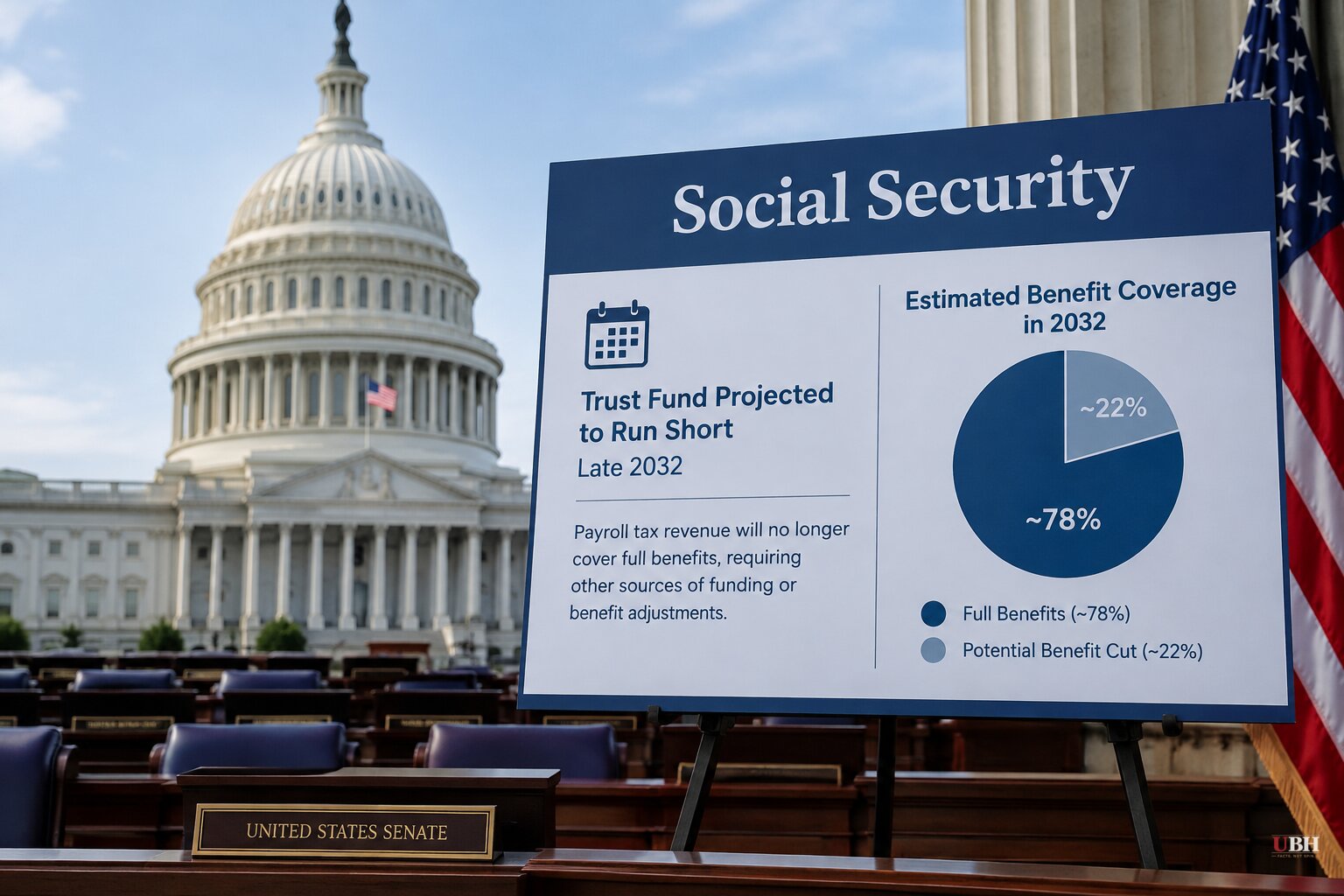
Social Security's retirement trust fund is projected to run dry in late 2032, and the senators elected on Nov. 3 will be in office when it happens. Those elected to full terms serve until January 2033.
Democrats flipped seven Senate seats in red states and won control of the chamber. Seventeen newcomers from both parties will join the next Congress.
If Congress does nothing, payroll tax revenue would cover only about 78% of scheduled benefits. That is an automatic cut of roughly 22%.
The numbers behind the cliff
The program is not going bankrupt. It would keep paying, just less. Combining the retirement and disability trust funds would push depletion out to 2034, when 83% of benefits would be payable. That is still a cut.
A hypothetical household analysis run by Jack VanDerhei, director of retirement research at Morningstar's Center for Retirement & Policy Studies, shows what that means. A single man who averaged $34,000 a year in earnings would see his monthly benefit at age 67 fall from $1,543 to $1,204. That man is one of roughly half of U.S. households with no retirement account money to draw on.
A single worker who averaged about $75,000 would drop from $2,548 a month to $1,987.
The 2025 tax law's senior deduction complicates the picture. It is a temporary deduction of up to $6,000 per eligible person aged 65 and older, and it expires in 2028. According to the Social Security trustees' June report, it was one of the factors that moved the retirement fund's depletion date three months sooner.
What the newcomers have said
Most of the incoming senators addressed the issue on the campaign trail, though specifics were scarce.
The payroll tax cap is the centerpiece of the Democratic proposals. Only the first $184,500 of earnings is taxed this year. The cap rises to $192,300 in 2027.
Juliana Stratton of Illinois said she would eliminate the cap. Social Security's actuaries estimate that doing so starting in 2027, without paying higher benefits on the extra earnings, would close about 58% of the 75-year shortfall.
Josh Turek of Iowa would lift the cap and oppose raising the full retirement age. Troy Jackson of Maine wrote in a September Bangor Daily News op-ed that he would scrap the cap and increase benefits, while ruling out privatization and a higher retirement age.
Adam Hamilton of Kansas would raise the cap rather than eliminate it. His argument is that someone earning $1 million should not pay the same Social Security tax as someone earning $184,500. He has not taken a firm position on the retirement age.
Peggy Flanagan of Minnesota backs Sen. Bernie Sanders' Social Security Expansion Act. Abdul El-Sayed of Michigan said in his final debate that the cap should go and that benefits should not be taxed.
The Committee for a Responsible Federal Budget put a price on that last idea in a July analysis. Eliminating taxes on benefits without replacing the revenue would cost Social Security about $1 trillion over 10 years, plus another $700 billion for Medicare.
Republican Andy Barr of Kentucky took a different tack. He opposes changes for people already retired and wants bipartisan reforms aimed at younger generations. He named no specific tax or benefit changes, but said reforms should encourage more private and employer-sponsored retirement savings.
The argument over taxes versus benefits
Not everyone thinks raising taxes is the right lever. Andrew Biggs, a senior fellow at the American Enterprise Institute and a former principal deputy commissioner of the Social Security Administration, points to a new Penn Wharton Budget Model analysis. He argues that benefit cuts could reduce federal debt more than tax increases, and that economic growth effects are something Washington's usual scorekeepers largely miss. Biggs frames the choice as "the hard way and the easy way."
He also warns of a broader reckoning early in the 2030s, when both Social Security and Medicare are projected to become insolvent.
VanDerhei offers a different test. "Any serious Social Security reform package should be scored on what it does to household retirement outcomes, not only on what it does to trust-fund balances," he said.
Shai Akabas, vice president of economic policy at the Bipartisan Policy Center, said delay has made the problem harder. "We've waited too long already, and the consequences are that the gap has grown larger," he said.
The arithmetic of passing anything
Social Security cannot be changed through budget reconciliation. A fix will likely need 60 votes, which means support from both parties.
That is a steep climb. Several of the Democratic newcomers want to expand benefits and tax high earners. Republicans such as Barr want retiree protection and more private saving. Some Republican candidates also pitched extending the senior deduction, which reduces program revenue rather than adding to it.
Workers are already facing a smaller version of the trade-off. The 2027 taxable maximum of $192,300 means employees earning above the old cap will pay nearly $500 more in payroll tax. Self-employed workers will pay about $967 more, according to Alex Beene, a financial literacy instructor at the University of Tennessee at Martin.
The Social Security Administration also raised the 2027 earnings test limit for beneficiaries under full retirement age to $25,560, up from $24,480. Above that, the agency withholds $1 in benefits for every $2 earned.
The next concrete deadline arrives before the trust fund does. The senior deduction expires in 2028, and no incoming senator has said whether the new Congress will extend it, let it lapse, or pair it with a payroll tax change.
Sources used for this briefing
7 links from 7 independent newsrooms (syndicated copies of the same report count once)
These are the sources it draws on, linked so you can verify.


